
Is there story without conflict? Even in stories which revolve around ordinary people doing ordinary things, we describe such plots as they have in terms of conflict. We speak of character conflict, internal conflict, interpersonal conflict. We categorize stories as having conflicts between man and man, man and nature, man and self. It might be possible to tell a story in which conflict plays no role, but one suspects it would be rather a dull story. Meaning, interest, plot exist in the challenge, in the digression from equilibrium that incites conflict of some form. It is perhaps no surprise, then, to consider that war has permeated human storytelling throughout history, from the stories of Lugalbanda (Gilgamesh’s predecessor) to modern entries like Star Wars.
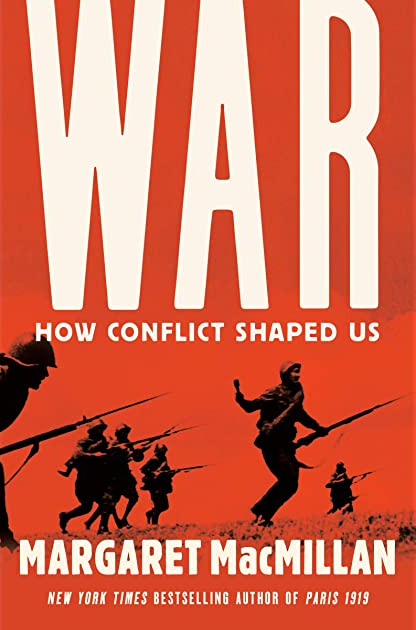
A study of war, therefore, is a valuable pursuit for any author, even if you do not happen to share my particular interest in the topic. It is an extremity of human experience, and therefore ripe for storytelling. With this in mind, I was interested to see what insights I might glean from MacMillan’s War: How Conflict Shaped Us, but the answer, sadly, was ‘not many.’ While providing a well-researched and (mostly) balanced survey of the many interactions between war and human civilization throughout the millennia, War proved a less substantial treatment of the subject than I desired.
MacMillan’s central argument is expressed in the title – that humanity shapes war, and war in turn shapes humanity – and she does well enough supporting this somewhat self-evident assertion. Her focus is very much on the wars of the twentieth century, especially the two World Wars, which made more sense once I learned that this era of history is her area of expertise; while I would have liked more material inspecting other conflicts throughout history, I understand the need for specialization. That being said, that focus somewhat undermines her assertions that her arguments should be considered universal.
What is most lacking from MacMillan’s War is a detailed understanding of, well, war – it is telling, I think, that she does not appear to list any military professionals in her acknowledgements. She clearly explains the ways in which wars have been linked to changes in human society, and how human society has been linked to changes in war, but there is a disconnect in her attempts to contextualize why wars are fought, and why people fight in wars, that makes it seem that she cannot quite bring herself, or believes that her audience would not be able to, believe in war. Many parts of War read like an outsider attempting to explain a religion which they do not practice but who is taking pains to acknowledge that it’s acceptable for some other people to believe in such things.
Most revealing are her discussions of just war theory and international law, which make massive assumptions and go into almost no depth, despite their dramatic relevance to any discussion of war in the past century (I should really do a separate post on just war theory). Her discussion of literature and art also reveals a certain anti-war bias, for she emphasizes and references predominantly anti-war pieces without acknowledging the similar proliferation of art expressing the opposite sentiment; however, she also makes a keen insight that our interaction with a piece can be ties to our views of the artist.
A relatively quick read, the book is best understood as a survey, and taken in that mode by someone who has not long wrestled with the topic of war, it is worthwhile. My issues with it mainly stem from my not being the intended audience – MacMillan is clearly directing her book towards an audience that has not previously made much, if any, study of the topic, but has a passing interest in understanding ‘that weird war thing that other people do.’ Still, for such a treatment, she manages, for the most part, to not be overtly judgmental, and maintains a resolutely objective perspective throughout most of the book. I applaud her for that effort, which is difficult to maintain when addressing a topic which evokes such passions as war.
Condemning war is easy, but understanding war is something else, and coming to terms with war an immensely difficult task with which humans have been wrestling, with varying degrees of success, since time immemorial. If, like me, you have already expended significant effort on that task, you may not learn much from War, but if you are looking to begin approaching the immense subject of human conflict, you would do worse than beginning with MacMillan’s War: How Conflict Shaped Us.
 IGC Publishing
One thought on “War: How Conflict Shaped Us Review”