
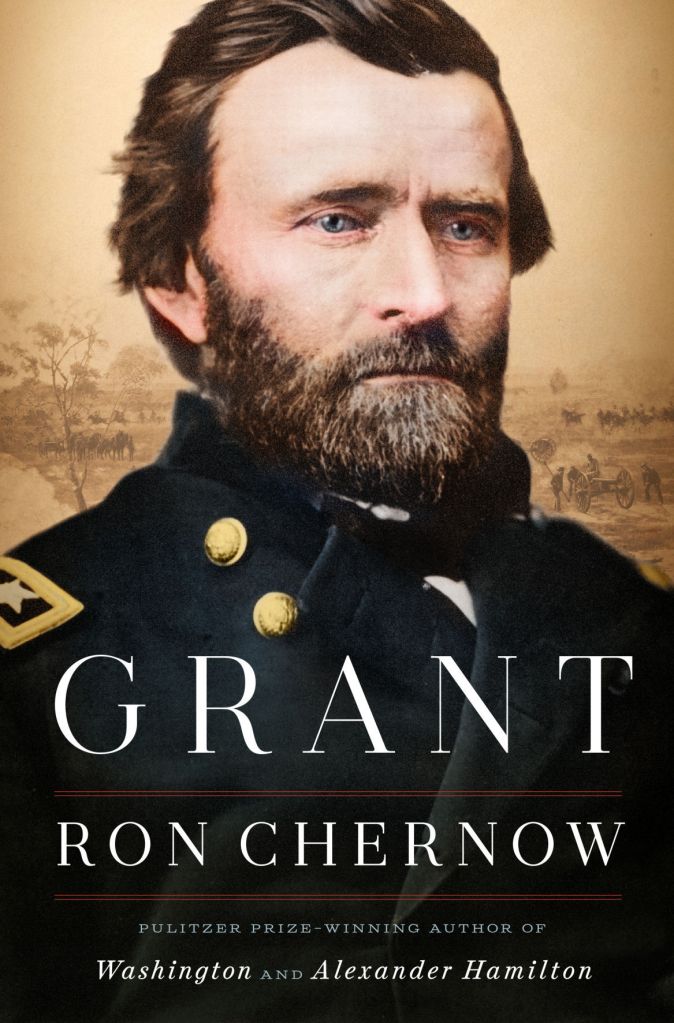
Chernow’s Grant has been on my reading list for a long time, since I finished his Washington and Alexander Hamilton. He might be among the finest living biographers, and I’ve thoroughly enjoyed and appreciated each of his books that I’ve read. I was very much looking forward to reading it, and if I thought about the fact that, at almost a thousand pages, it’s a rather hefty book, it was in the context of thinking how I had better ration myself so that I didn’t devour the whole text in just a few days. It surprised me, therefore, when the main comment people had upon seeing what I was reading was ‘wow, that is a thick book.’
I don’t really think much about the length of the books that I read, beyond perhaps a vague consideration of including some shorter works to balance longer ones in order to maintain my one-per-week average for reviewing purposes. The Long Winter, from the Little House on the Prairie series, is probably the last book that I can remember being intimidated by the length, and that was when I was seven. It never crossed my mind that other people would be intimidated by a long book, but after the reactions while I was reading it, I worry that no matter how glowing I make this review, some of you will decide not to read it because you can’t imagine getting through a thousand-page biography of a nineteenth century general and US president (I was even more surprised when a few people couldn’t remember who Grant was, but that’s another subject).
Even so, I’m going to try. Grant lived up to my exospheric expectations for a Chernow biography in spectacular fashion, and my biggest challenge reading it was not inhaling it in three-hundred-page binges. Grant, like Alexander Hamilton and Washington, starts from Grant’s boyhood and takes us through his life all the way to his death from cancer, but one of the greatest things about a Chernow biography is how, since no life exists in complete isolation, he incorporates and describes all of the side ‘characters’, bringing them to life almost as fully as his primary subject.
We discussed in our review for Mysteries of the Middle Ages that I prefer historians who treat history within its own context and refrain from overt external moralizing and judgement from the false, hubristic pedestal of the present, and Chernow exemplifies the biographer’s implementation of that concept. He is honest about Grant’s flaws and mistakes, not hiding them or sugarcoating them, but he doesn’t make them dominant. Grant’s naivete, his struggles with alcoholism, are placed in context with his remarkable accomplishments, and he provides the important historical context for decisions Grant made. In a word, Chernow is generous in his treatment of his biographical subjects, generous in the same way that we could all benefit from being to each other. He accepts his subjects as human, and he makes them human again on the page, multidimensional and flawed and heroic. Maybe his biographies are so long because it takes that many pages to make a historical figure live again, even if it’s just for as long as it takes to read the book.
While I at least knew the basics about Grant’s career – came from Illinois, made his mark leading the western Union armies during the Civil War, promoted to commander of all Union forces until the war’s end, and US president after Andrew Johnson – and I even visited his Galena home a couple of times, I knew little beyond this. If pressed, I would probably have given the common line that he was a decently competent general with significant material and logistical advantages, and a rather lackluster president presiding over the Reconstruction experiment that ultimately failed. The true picture is far more complicated, as Chernow brings to life, from Grant’s early West Point and Army career, which showed promise but not brilliance, to his struggles with alcoholism and poverty until the outbreak of the Civil War, to his relentless pursuit of civil rights for freedmen, to his enduringly naïve approach to people that caused scandal around him in his administration and financial ruin later in life.
The Civil War/Reconstruction period of American history itself is a sensitive one which I have rarely seen treated with as much insight and respect as Chernow brings in the context of his Grant biography. While this is not a history of that period, it does revolve around it, viewed through the Grant lens, and what Chernow shows is a tumultuous time which, on Grant’s part, was full of good intentions that would not be fully realized for nearly another century. Strange as it might seem, the Grant Chernow paints is as much an idealist as a pragmatic general.
We are all making history every day, whether our contributions will one day be recognized by historians and biographers or not. When we look back, we cannot fully know the people who made the history of their times that led us to this point today, so we create images of them, two dimensional portraits of their contributions and accomplishments, footprints left behind when they go for us to examine like paleontologists extrapolating entire dinosaurs from a fossilized footprint in an ancient riverbank. Chernow’s biographies allow us to do more, almost bringing their subjects back to life for a time for the reader to question, interact with, and understand in three dimensions. So, don’t be intimidated by its length, and add Chernow’s Grant to your reading list.
 IGC Publishing
9 thoughts on “Grant Review”