
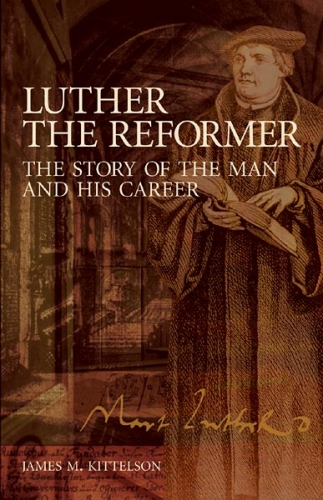
It might have been a mistake to read another biography immediately following Chernow’s masterful Grant, because I found Luther the Reformer something of a disappointment. After purporting to tell the story of “the man and his career,” Kittelson instead provides a dry, biased history that barely even scratches the surface of the complexity of Luther and his times. Considering the pivotal events through which Luther lived and in which he played a vital part, I hoped for a far more detailed, nuanced treatment, for which it seems I will have to continue searching.
Kittelson begins his biography by asserting that Luther was remarkably consistent throughout his career in his opinions and positions on the topics upon which he wrote and lectured and which made him famous, but he never takes pains to explain why, or how he achieved those positions in the first place. This is a glaring oversight, because no one is simply born into complex thoughts, philosophies, and opinions. Although Kittelson tells us a little of Luther’s childhood and calls out a few key personal moments, they are disjointed, unsupported, and out of context. We never really get to know Luther well enough to understand him or how he thinks. The historical distance is a partially exonerating factor, but given Luther’s voluminous writings, and his central role in the day’s controversies, there is substantial documentation from which to make inferences and gather facts (in fact, I shall be reviewing a few of his writings in the future – The Bondage of the Will has been on my reading list for some time).
The biography is presented as the man and his career, but it ought perhaps to simply be presented as the story of his career, so scarce is any information personal to Luther. If this were not so, perhaps I would be more inclined towards generosity towards Luther’s positions. As it is, Kittelson’s unwavering support for Luther’s theological and political writings makes me less inclined to accept them. This is not merely the generosity of spirit which I discussed in my review for Grant; it is a blatant glossing over, whitewashing, and ignoring of Luther’s flaws and complexities. The vulgar bombast of Luther’s language in his polemics, for instances, speaks to one such, an exhibition of his uncompromising and absolutist tendencies, but this is uniformly either ignored, or lauded as a feature.
Indeed, Kittelson actively presents Luther positively for his obstinate dedication to the infallibility of his own theological thought, but never explains how Luther came by such confidence. This view stands in contrast to other works I’ve read, which place Luther as a more passive figure seeking moderate reform only to be swept up, at times unwillingly, in the turbulence of the Reformation. Rather like Grant, actually (clearly, I still have Grant on the mind), some sources even depict Luther as a hapless figurehead for larger historical forces. I am ready to accept a more active role for Luther – someone of such clear intelligence as is exhibited in his writings can neither be purely a figurehead nor entirely ignorant of the consequences of his actions – but some discussion of the larger historical context, especially geopolitically, that helped to drive the Reformation would have helped give a fuller picture. For instance, the same forces that drove the Magna Carta were arguably at play in the reformation.
While I would not go so far as to say that Kittelson’s biography is bad, neither would I say it is particularly worth reading, even as a starting point. Were it a little more nuanced, and a little less biased, it might serve in that capacity. As much as Luther is a fascinating figure, and part of an enormously important historical movement whose ripples affected everything from the course of the European Enlightenment to the rise of western democracy, there are surely better places to begin a study of him and his times than with Luther the Reformer.
 IGC Publishing
3 thoughts on “Luther the Reformer Review”