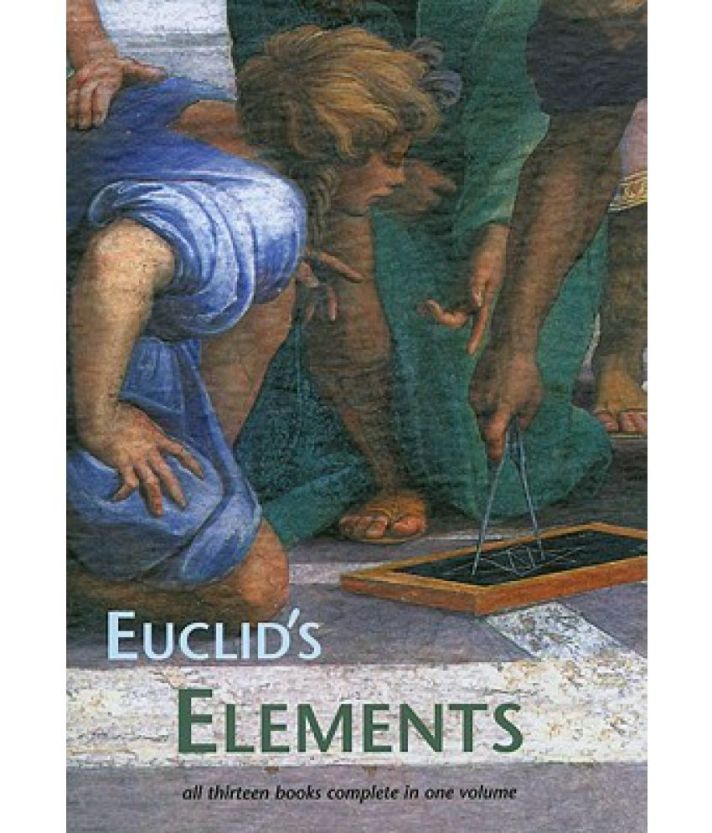
Textbook publishing is a racket. Since they are required by classes, their publishers are insulated from conventional market forces thanks to a bound audience which will be obliged to purchase their books regardless of the quality delivered. Indeed, I have found consistently that the best ‘textbooks’ are the ones that are no textbooks at all, but rather normal books used in that way, which are usually of a higher quality and ten percent of the cost. It makes sense for nonfiction books, especially those with many pictures, diagrams, and so forth, to be more expensive than your typical science fiction novel, but in the multiple hundreds of dollars? It is especially a shame after reading the father of all textbooks, Euclid’s Elements, which is freely (or very cheaply) available in the public domain, has existed for thousands of years, and surpasses every geometry textbook that has sought in this twentieth century to supplant it.
Yes, until roughly the 1920s Euclid’s Elements was the math textbook. Its thirteen volumes consist of rigorous geometric proofs laid out in the exemplary fashion of Greek logic. Each volume begins with a series of basic definitions – what is a line, what is a circle, and so forth – before moving onto a set of propositions, in which Euclid makes a claim, and then walks through a series of steps from first principles to prove why that claim is valid, concluding each time with “which is the very thing it was required to show.” Nor is the text limited to what we today think of as geometry. While all volumes employ what I’ll call geometric thinking, they cover everything from trigonometry to arithmetic to algebraic identities, all neatly proved through the clever manipulation and application of shapes, angles, and lines.
Geometry was probably my second favorite math subject I studied (after multivariable calculus, if you’re curious), in large part due to the method of proofs it employs. Those proofs frustrate many, but to me they make perfect sense. How better to formulate an argument and validate a claim than to establish basic facts and principles to which all can agree and build from there in a series of small, logical, easily followed steps? It appeals to the way my brain functions, and my engineering tendencies resonate with the spatial, physical aspects of geometry. This is the same reason that multivariable calculus appealed to me, for its applications to physics (field theory and so forth).
If I were ever teaching a geometry class, I would not go to McDougal-Little or Pearson or the other big-name textbook publishers, but would instead direct my students to obtain a copy of Euclid’s Elements, and build my curriculum around it. It does not simply teach math, but an entire way of thinking that can be applied to other fields of mathematics, to other fields of study, and to other fields of life. Constructing arguments in the way Euclid constructs his geometric ones is as effective in essay writing as it is in mathematics, on the debate stage and on paper.
I have almost nothing but praise for Euclid’s Elements…but I wouldn’t recommend just sitting down and reading it cover to cover like I did. Firstly, if you already have a solid mathematical grounding it is unlikely you will learn a great deal in that sense, and secondly, after the first volume or two you will have absorbed the argumentative method, at which point you will have little to gain from continuing if you are not actually studying the math involved. That little note aside, I do encourage you to read Euclid’s Elements, whether you’re teaching a geometry class or you’re simply looking to improve your ability to build logic arguments. It surpasses any similar text made today in breadth, depth, and clarity of thought and delivery, which is, after all, the very thing it was required to show.
 IGC Publishing
8 thoughts on “Euclid’s Elements Review”