
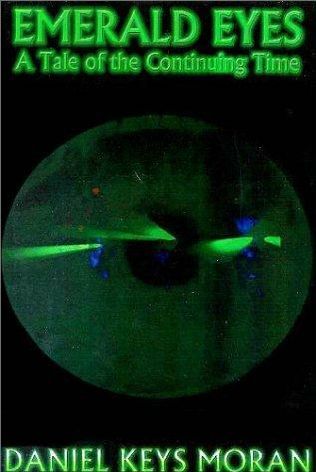
Oftentimes it seems that science fiction can be one of two things, but not both. It can have compelling story and character without as much technical rigor, detail, and imagination, or it can have fascinating, rigorous technical detail without interesting characters or a significant, engaging plot. Emerald Eyes is a rare science fiction novel that manages to provide a high-stakes, enormously intricate plot, complex characters, and a breadth of realistically speculative technologies and concepts that is truly remarkable. The closest comparison I can think of that combines rigorous science fiction elements with high-stakes plot and significant character development is probably Orson Scott Card’s Ender series (to include the Shadow books).
Moran manages to evoke such a richly imagined science fiction setting by an expositional method that I prefer but which some find unapproachable – the sink or swim method. There’s almost no real explanation of anything, no context provided; instead, the reader is thrown into the world and the story as if they were contemporaneous with the characters, and expected to pick up the salient details as they go. Nor does Moran limit himself to just a handful of speculative elements. Emerald Eyes is compelling in part because it examines everything. Where most science fiction will pick one concept to explore in detail, Emerald Eyes features rigorous, scientific speculation in fields ranging from genetic engineering, to materials science, to network communications, to photonics, to transportation, to space travel, to infrastructure and civic planning, to computer technology and programming…and all of this is made even more remarkable when you consider when the book was written.
You might never guess, from the contents, that the book was written in the 80s. Aside from the fact that Moran clearly overestimated our pace of technological progress, the technology, society, and concepts featured and explored manage to feel nearly as speculative now as they must have then. Read today, you will note some elements that have come to fruition since the book’s publication are depicted with startling accuracy, like a character who becomes addicted to the book’s version of the internet (and yes, this book has a version of the internet when the internet was barely past the stage of being a highly classified military experiment), or a “digital assistant”-like tool to manage homes. Other elements remain as futuristic as ever, like a wall created from a single molecule, commonplace fusion energy generation, widespread asteroid mining, and orbital colonies in geosynchronous orbit.
It’s the political changes that seem the most far-fetched, but one gets the impression that they would have seemed equally far-fetched at the time of publication, at least in the details – France becoming the main power in a UN that has brought the whole world under its auspices by force? The details, though, aren’t that important. It doesn’t really matter whether it’s the French, the Spanish, or the Madagascarians, so long as the main elements remain constant: the world forced into unification through a massive war that happened about a generation past. That sets the stage for the events in the story and the machinations that will take place, and the stimuli that will incite certain key decisions.
Like, for instance, the decision to create genetically engineered telepaths and leopard people to serve as unpaid super soldiers, who of course no one could have predicted would eventually demand rights and freedoms like everyone else. Those elements of the plot are rather pat, and overtrodden in other treatments; Emerald Eyes manages to keep that core concept from reading stale by introducing far more nuance and complexity to them than they usually receive. The genetically engineering people seeking their rights are not depicted merely as an exploited, vulnerable underclass. Instead, they are dynamic, varied, and don’t always behave like the “good guys.” In fact, they behave quite humanly, which is a very different matter from behaving humanely.
It would not be wrong to say that there aren’t a lot of new elements in this book, especially reading it today where it seems like every new science fiction novel is about some dystopian society with artificial intelligence running amok and some scientifically derived variant of humanity in need of rights. Instead, what makes Emerald Eyes strong and what kept me engaged throughout is the combination of so many disparate elements that make for a truly immersive science fiction worldbuilding experience, and the terse, almost erratic writing style. It takes some adjustment, but Moran’s style of extremely short, rarely repeating viewpoints worked for me. I don’t know that it would work so well in a fantasy novel, but for the story Emerald Eyes seeks to tell it seems perfectly suited – I can’t imagine the story reading as well were it structed more traditionally.
Hard science fiction has always been niche, especially the kind that practically has an entire scientific research paper appended at the end, and there are plenty of people who will say that it doesn’t have enough plot, or character, to be considered “good writing.” That doesn’t mean that science fiction must become some other genre with science fiction elements, though, and Emerald Eyes represents how to do that. It is hard science fiction, but with a tense, tight, intricate plot, and complex characters. Yes, it’s a steep learning curve, but it is worth the effort. My only real complaint is that there’s a sequel that now I must decide if I’m going to read at some point.
 IGC Publishing
One thought on “Emerald Eyes Review”