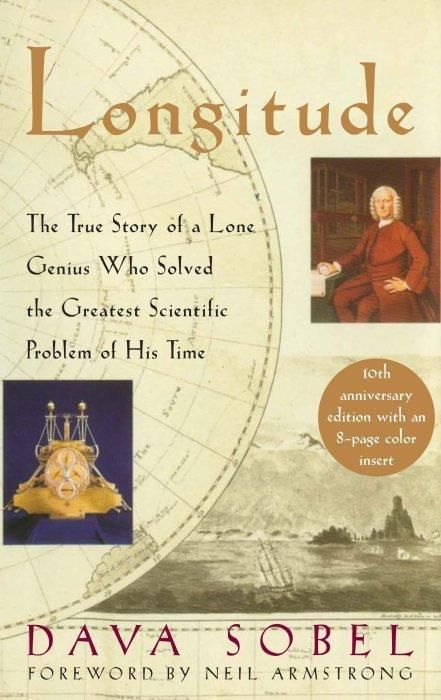
In part two of Impressions, I put Raven on a ship as a navigator with zero experience or training, recruited by the captain to replace traditional methods of navigation with rigorous, modern techniques such as other nations are beginning to adopt at the time. To write these parts, I had to do significant research on the history and science of nautical navigation. Even a small amount of research will turn up a simple dichotomy: finding latitude is easy, finding longitude is fantastically challenging. As part of that research, I came upon several references to Longitude as the book to read on the history of finding longitude at sea, so I added it to my reading list and acquired a copy shortly thereafter (very unusual for me, I know).
Alas, I learned little, or at least I learned little about what I wanted to learn. While this is presented as a history book, it is one of those “popular” history books that sacrifices rigor, detailed citations, and actual context for a compelling narrative, manufactured drama, and frequent author-in-narrative insertions. Even a pure history of longitude might not have presented what I’m looking for, which is a detailed discussion of the techniques, at a rigorous level, involved in finding longitude at sea, either through timing or some other method, but Longitude did not even give me a pure history.
Perhaps I would have been better off seeking out a history of timekeeping, since Harrison’s solution to the longitude problem is a mechanical timekeeper, a series of clocks that are meant to maintain an accurate reference time despite the trials of the nautical environment – a pitching deck, drastic changes in temperature, omnipresent humidity, moisture, and corrosive sea air. Time retains a central role in navigation today, with GNSS based around exquisitely accurate atomic clocks operating with picosecond calibration.
Sobel fixates on the drama of the British longitude committee and the allocation of the prize money, without going into the history of the longitude problem, either on the large or the small scale. We don’t get to see how people dealt with the inability to ascertain longitude throughout history, we don’t get to see a biographic on Harrison and how he came to design and iterate on his clocks, and we don’t get much history on the astronomical methods and figures, either. I guess you could call this a survey work. It might be decent for what it is, and you will likely learn something if you haven’t done much reading on the longitude problem before, but after the research I did for my novel, this had little new to add.
 IGC Publishing
3 thoughts on “Longitude Review”