
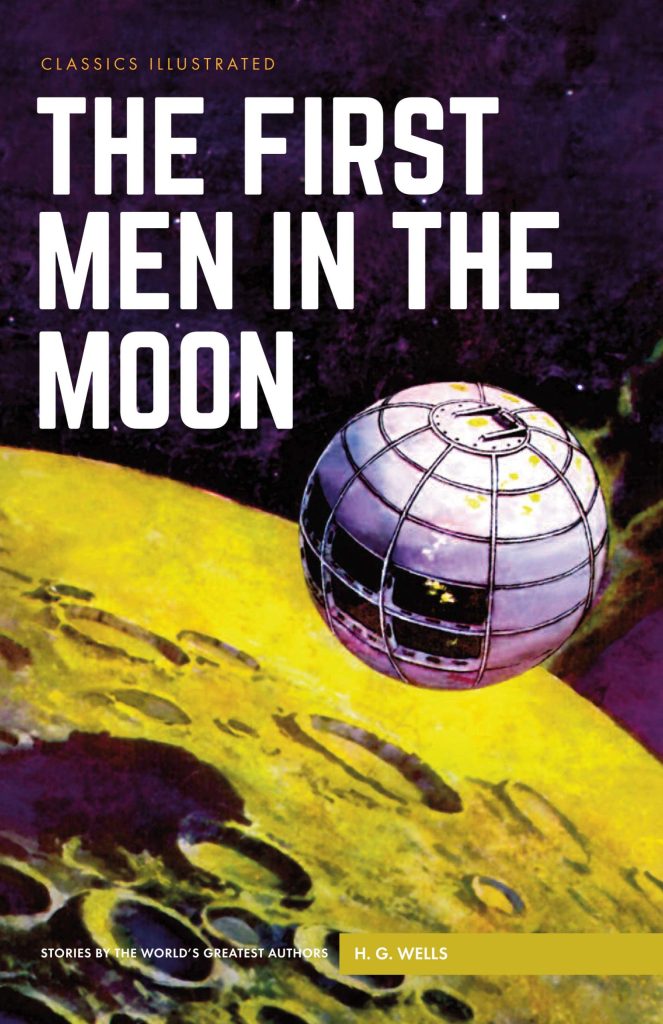
Sometimes, science fiction is remarkably prescient. Jules Verne’s From the Earth to the Moon predicted, with astonishing accuracy, several key facets of the Apollo program a century later, for instance, and Star Trek featured capabilities remarkably similar to modern cell phones and the internet decades before even the earliest versions of those systems existed. Looking at such examples, it is easy to forget the amount of science fiction that has been proven, well, fictitious. Then again, science fiction doesn’t exist so much to predict the future as the speculate on possibilities, and in that sense, The First Men in the Moon fits the genre well. In fact, its core idea, the development of a material which could isolate an object from the gravitational force, is something I’ve investigated as a physical possibility.
HG Wells’ novel of lunar exploration, though, is not an idea story. The gravitational insulation is put to only one deliberate purpose: a wild scheme to prospect the moon (it also, inadvertently, almost expels Earth’s entire atmosphere into space – there is often a strong, cautionary note on scientific progress in Wells’ novels). Like many of the science fiction novels of the period, this is more an adventure novel to a particularly adventurous destination, presented in a epistolary fashion by an “everyman” narrator, who is a failed businessman (the story is never specific about what type of business), and who has decided that the solution for his failed businesses, and the way to get rich quickly, is to…write a play? I know times change, but I somehow doubt that literary pursuits were ever considered a way to rapid affluence.
This everyman narrator is, to me, far less relatable than the scientist in the story, who is the prototypical garage tinkerer, the eccentric genius alone with his work who cares only for the advancement of knowledge and the satisfaction of his own curiosity. They are an unlikely pair to engage in adventures together, and the story makes clear that there is always a tension present between their desires, goals, and visions. This tension forms a core part of the story, and by the end of it, I am left wondering if Wells intended us to sympathize, at the time of publication, with the narrator, or with the scientist, because to my reading the narrator is a decidedly unsympathetic character.
Most of the time, the story is rather predictable, with only one or two twists that I didn’t predict, and those were minor ones. Indeed, the most surprising things in the story were not the plot points, but the incidental events, like someone accidentally getting flung off into endless space as a bit of a side note about which no more concern is given. More interesting to me is the observation that Wells had an apparent preoccupation with speciation. This is not surprising for the time period, but we see it emphasized here, in War of the Worlds, in The Time Machine, and in several other of his stories, where the splitting of work into certain classes causes those classes to specialize to such an extent that they become anatomically distinct species. His Selenites take this idea to the extreme.
Science fiction, and especially Wells’ science fiction, has strong roots in the horror genre, and they come through in The First Men in the Moon, though this is certainly not a horror novel. Those elements are prominent, for all the horror emotions are not evoked the way they would be in a true horror novel, which may be part of why I found it a little lackluster as a piece of science fiction. Indeed, compared to From the Earth to the Moon (which this work references at one point), The First Men in the Moon can barely be considered science fiction at all. It is better thought of as adventure/horror with science fiction elements. If you read it in that guise, perhaps you will enjoy it more than I did when I was seeking a classic science fiction book.
 IGC Publishing