
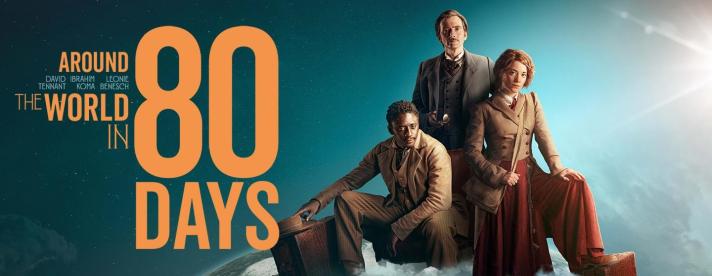
We don’t review many television shows here on the site. I don’t watch much television to review, and it seems like it would be redundant with the weekly book reviews. Ultimately, a good show or movie is going to use similar techniques and ideas to a good book or short story, because it’s all storytelling, regardless of the venue (although there are particular variations based on medium). This week’s post is an exception, for the PBS Masterpiece reimagining of Jules Verne’s classic Around the World in 80 Days (which I should reread one of these days). Yes, the show originally came out a couple years ago, but I re-watched it recently, which served as a reminder of how well done it is.
Adaptations of Verne’s novels to shows or movies are rarely worth watching because the screenwriters seem not to quite grasp what it is that makes Verne’s novels enduring. Unlike Wells’, Verne’s are not thrillers with science fiction elements. As mentioned in our review for The Invisible Man, Wells’ novels and stories present science as a dangerous force, serving as cautionary tales, while Verne takes a more optimistic approach. Whether it is a story about travelling around the world in an unprecedentedly short time, or a story about a submarine attacking international shipping, or a story about launching people to the moon out of a giant cannon dug into the Florida coast, there exists an underlying positivity. Above all, Verne’s stories, to me, capture a sense of vast potential.
Thus, attempts to make A Journey to the Center of the Earth all about running away from subterranean dinosaurs ala Jurassic Park won’t succeed because it misses the point. There is a television adaptation of The Mysterious Island which features Patrick Stewart as Captain Nemo, but even this focuses too much on drama and action scenes. It was with some skepticism, therefore, that I came to watch this reimagining of Around the World in 80 Days, especially given the generally grim tone of so much of modern storytelling.
With this adaptation, though, the screenwriters finally figured out the secret. Though it does not flinch from confronting some of the difficult moral and cultural happenings of the period, it nevertheless maintains a fundamentally optimistic outlook, conveying, through the characters’ enthusiasm and their adventures, that same sense of potential that made the world fairs and exhibitions so energetic during that time period. The characters come alive as themselves, not as players in the writers’ plot, and if they are perhaps a little angstier than would be my personal preference, it does not detract from the vibrancy of the presentation.
The whole conceit, of course, to make this journey an adventure, rather than a mere trip, is that the three protagonists encounter an improbable series of mishaps, delays, significant circumstances, and challenges along the way. A sabotage subplot helps justify some of these, but a certain suspension of disbelief is still required to accept so many extraordinary happenings. This is something I’ve been thinking on (overthinking, more probably) in my own writing recently, the conceit of a story being that events and crises come closer together than realism would allow. It’s why the Ta’veren concept from Wheel of Time is such a beautiful device from a writing perspective, since Jordan never has to justify how events seem to swirl around his main characters. No such fantastical excuse exists for Fogg and his companions in Around the World in 80 Days, so the writers rely on the genuineness of the characters and the way they experience what occurs to keep the viewer engaged.
Are parts of the story contrived, like the drama about the international date line at the end? Of course. The whole affair is contrived, a spontaneous bet by an armchair traveler to circumnavigate the globe in 80 days just to prove it is possible, and, at the end of the day and the end of the show, the writers were wise enough to know this is not intended to be a study in gloomy pessimism in some steampunk dystopia. That does not prevent the viewer from becoming any less engaged with the characters and the riot of emotions they undergo throughout the ebbs and flows of the adventure.
It occurs to me, as it probably occurred to me the first time I watched this, that we can now travel around the world in rather a lot less than 80 hours, rather than 80 days, and that some of those reading this post may well live to see a time when, through suborbital rocket flights or hypersonic passenger craft, we can circumnavigate the world in 80 minutes (satellites in low earth orbit complete such a journey in about that long routinely – indeed, the ISS orbital period is about 90 minutes). We can travel far faster, and with far fewer difficulties, than Fogg and his companions could have dreamt, and in doing so, we miss out on the adventures along the way. Travelling to three different continents for work, I’ve bought identical groceries and worked in identical buildings. Yes, travelling to each of those places was as easy as stepping on a plane (or a couple of planes, in some cases), but it wasn’t really travelling. It was just working somewhere else.
Travelling requires one to leave time for adventures to happen. A backpacking adventure, a bicycle trip, a road trip where you don’t plot a course and don’t bring a GPS: these are the voyages which generate the best stories. Planning a vacation and having diverse experiences is wonderful, but it lacks the same zest, the same liveliness. And why don’t more of us see potential in our own times? Perhaps it is because we’ve forgotten how to look for it. Around the World in 80 Days is, in a sense, a reminder. At the very end, there is a reference to the events of 20,000 Leagues Under the Sea. If the same team gets together again to do that adaptation, that will be a retelling I want to see.
 IGC Publishing