
Religion has a unique role in American history. Many of the colonies established along the Atlantic seaboard which eventually fought a revolution and became the first thirteen United States were founded by religious sects seeking a place to flourish, or to escape persecution, away from the strictures of English and European religious establishments. Where in England the Puritans had a poor reputation for their stubborn insistence on addressing everyone with informal thees and thous, in America they provided a foundational ethic of modesty and hard work. Significantly, these various sects, in forming the United States, from their experience established and enshrined the importance of religious toleration.
At the time, this religious toleration applied primarily to various types of Protestantism. Catholicism was more or less tolerated with a degree of suspicion, and Judaism also, but, like many of the other founding principles, rights, and freedoms established in the Constitution, this limited religious toleration of the time laid the groundwork for the expansive religious toleration as the freedom for religious exercise is conceived today. Significantly, the so-called free exercise clause of the first amendment to the Constitution did not establish a purely secular state. It did not establish freedom from religion, as other democratic revolutions would, but a freedom for religion.
Indeed, the separation of church and state enshrined in the same amendment under the establishment clause has long existed in a certain tension with the free exercise clause. In a majority-Protestant population, and with Founders who used the language of religion, albeit not a specific denomination’s, to establish the principles upon which the republic is founded, it was perhaps inevitable that a kind of civil religion should arise. Debate continues today about that tension between establishment and exercise, fueled in more modern times by determined secularism, the struggles of the Cold War, and the avowed atheism of ideologies like communism and political systems like the USSR.
This is background to a simple statement, which many Americans take for granted, that there should be a separation between the church and the state. Indeed, the establishment clause, which creates that separation, is seen as integral to the free exercise clause, for if a state religion should be established, it would inevitably impinge upon free exercise. Dominant Protestantism and the American civil religion easily incorporate and adapt to these conditions, but other religions do so less readily. Indeed, it may be the dominant factor behind a lingering suspicion of Catholicism which endured well into the twentieth century, for Catholicism traditionally is a fundamentally theocratic faith.
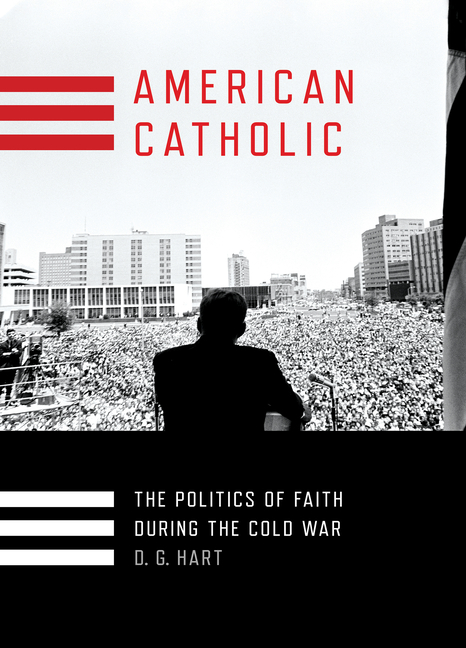
It is from this point that American Catholic picks up its argument, which is…well, it’s hard to say with specificity. Hart seems to set out to explore a few core questions – How did the American Catholic church resolve the inherent conflict between the US tradition of religious toleration and the papal teaching of the Church’s temporal authority over states? How did American Catholicism become a driving force in the conservative movement? How did American Catholicism influence, and how was it influenced by, the changes in the greater Catholic church in the mid-twentieth century? – but if there is a unifying argument he is attempting to make, it eluded me in lengthy, achronological discussions of various and unfamiliar religious thinkers and writers of mostly the mid-twentieth century.
Do not take this as too harsh a critique, for American Catholic was highly educational. The history of Catholicism in the US, and its interaction with events in the mid-twentieth century, are topics with which I had only the most glancing of familiarity, and I learned an enormous amount from American Catholic about aspects of history which are rather outside my usual areas of study. I was never bored reading it, but it also didn’t really have a coherent story to tell. Even a science book like Charge presents a certain unity of structure, which was mostly absent from American Catholic. Perhaps that is a deliberate reflection of the somewhat chaotic cultural processes which the book describes.
The other issue with the book is its narrow focus. While Hart tries to acknowledge, in places, that his chosen lens of analysis is not the only tool by which to understand the events which he examines, there remains a certain sense of the old hammer-nail adage to, for instance, the examination of Catholicism’s role in the rise of the American conservative movement, or the influence of American Catholicism on the events and decisions of, and stemming from, the second Vatican council. Since these events are inextricable from other cultural shifts and impetuses, the result is sometimes myopic, leaving the reader to feel we are only seeing part of the picture. To present more would rather undermine the book’s deliberate focus, but there almost needs to be a companion analysis or history piece to provide that additional context.
Of far more interest are the theological arguments, especially in the first half of the book and leading up to the second Vatican council. Traditionally, the Catholic church called for a state religion – Catholicism, naturally – subservient to the spiritual and temporal authority of the Pope, and endorsed divine-right monarchy as the closest reflection of God’s will. Indeed, it maintained a suspicion of liberalism, religious freedom, and democracy well into the twentieth century, in large part driven by the avowedly secular turn of most European democratic movements. America’s Catholics, though, consistently argued that America was different. Then, when the second Vatican council embraced pluralism, at least to a certain extent, America’s Catholics…continued to argue that America was different. Hart does a much better job presenting the pre-2nd council theological debates than those coming after its decisions.
Perhaps of the greatest interest in American Catholic is the acknowledgement of some of the foundations, largely from the political and cultural movements of the 1960s, of the modern tensions between establishment and exercise. These are perhaps most dramatically encapsulated in recent court cases involving instances where free religious exercise of an individual affects others. At the heart of these cases and the public debates surrounding them is that which made the difference between the American Founding’s concept of religious freedom, and that enacted by other democratic polities, such as France: freedom for religion versus freedom from religion. Hart’s book does not give us much insight into where the debate might go, but it does help elucidate some of its origins. Catholicism has played a significant role in the US, especially after the Second World War, and American Catholic, for all its sometimes chaotic presentation, offers important history and insight into that role.
 IGC Publishing
One thought on “American Catholic Review”