
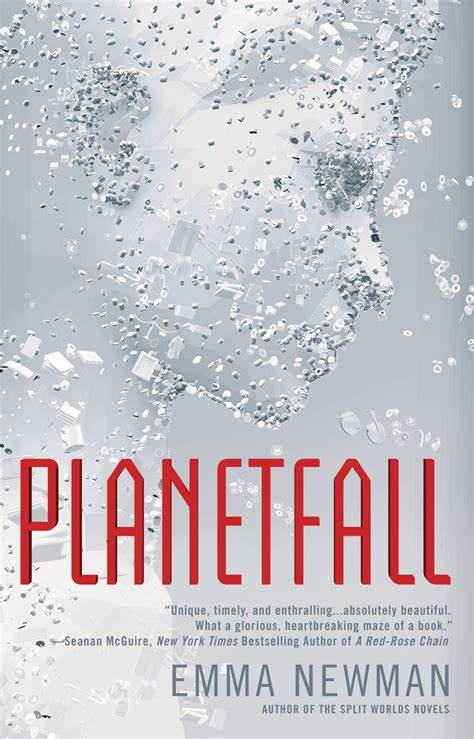
In the Goodreads description for the book, we have a semi-religious, semi-scientific pilgrimage to create a challenging colony at the base of an alien structure. Plus, the main character is a 3D printer engineer. This was sufficient to bump Planetfall up on my list when I was looking for a science fiction novel, but I almost put it down after the first page, when I realized it’s written in the first-person present tense. First person present tense is probably my least favorite perspective to read (of the commonly used viewpoints), despite its apparent popularity in many modern works (especially those aimed at younger audiences, which I don’t believe this one is). Still, I try to keep an open mind, and that description remained intriguing enough to keep me reading. I wish I’d heeded my initial inclination.
On the surface, so many components of the story are intriguing: the integration of 3D printers into a circular economy, the advanced synthetic biology of the alien structure and its connection to the mystery of the pilgrimage’s origin, even the repressed disaster upon arrival which forms the book’s central mystery and provides the core tension surrounding the arrival of a stranger to the carefully calibrated and insular colony. Unfortunately, Newman doesn’t follow through on almost any of these components. They are part of the setting more than they are part of the plot, and even Ren’s role as a 3D printer engineer doesn’t bear the kind of story-weight that I would have wished. Despite the set-dressings, this is not a hard science fiction story. It is a highly angsty character story with some science fiction context. Though I realize it cements my reputation as an old curmudgeon, am I really the only one who is tired of all these angsty characters? They seem inescapable in modern books, movies, shows – modern storytelling, really.
Still, I could mostly look past these elements if the story itself was sufficiently compelling. It is not, mostly because the whole story revolves around hiding information from the reader. All authors and stories hide some information from the reader, which is not itself a problem. (I should probably do a post at some point about this topic.) The problem arises when the narrative, the viewpoint characters, lack a compelling reason to hide that information from the reader. Yes, it is clear that Ren has a kind of psychological block around thinking about exactly what happened…but the broad outlines are also kept from the reader, despite Ren and her coconspirator engaging actively in efforts to protect those secrets. By about halfway through the book, I found it extremely difficult to accept this concealment of information as legitimate. Since the main motive force of the book at that point is the secret, this becomes rather frustrating. Nor is it just one secret: everything seems to be a secret that must only be revealed at the author’s approved time, not when it would naturally arise from the characters thinking or interacting with them.
Hiding information from the reader is always a somewhat dangerous game, especially if it’s information that perspective characters know and are actively engaging with – this is by far the greatest weakness of the book. After persevering through those frustrations, I built all kinds of speculations about what had actually happened at Planetfall, among the answers to other secrets, and this is desirable from both author and reader perspectives…except that the eventual payoff must be all the more potent to match the reader’s imaginings, which Newman fails to achieve. The ultimate reveal is rushed, caged in distracting, dystopic societal functioning presented as jarringly utopic, accompanied by a poorly foreshadowed attack, and banal compared to the flourishing of my own imagination.
Then, when those secrets are finally revealed, the book hares off into fever-dream territory to erratically plunge through the alien structure which has formed a backdrop and set element for the majority of the story. Again, the answers provided in this segment are disappointing compared to what could have been, and, worse, they are vague to the point of hardly being answers at all. Apparently, Planetfall becomes a whole series, but the book seems to conclude everything it needed to conclude, without managing to provide a single satisfying answer. It just…ends. Frankly, the ending reminds me of 2001: A Space Odyssey, in the movie version where the ending is terribly vague and dizzying without the context and insight offered by the book.
Maybe it’s unfair to expect every science fiction book I read to be on the same level as some of the greatest examples of the genre, but Planetfall barely even deserves to be shelved as science fiction. Perhaps, if I’d gone in expecting angsty literary fiction, I would have been less disappointed. Then again, if I’d expected Planetfall to be angsty literary fiction, I wouldn’t have read it in the first place.
 IGC Publishing