
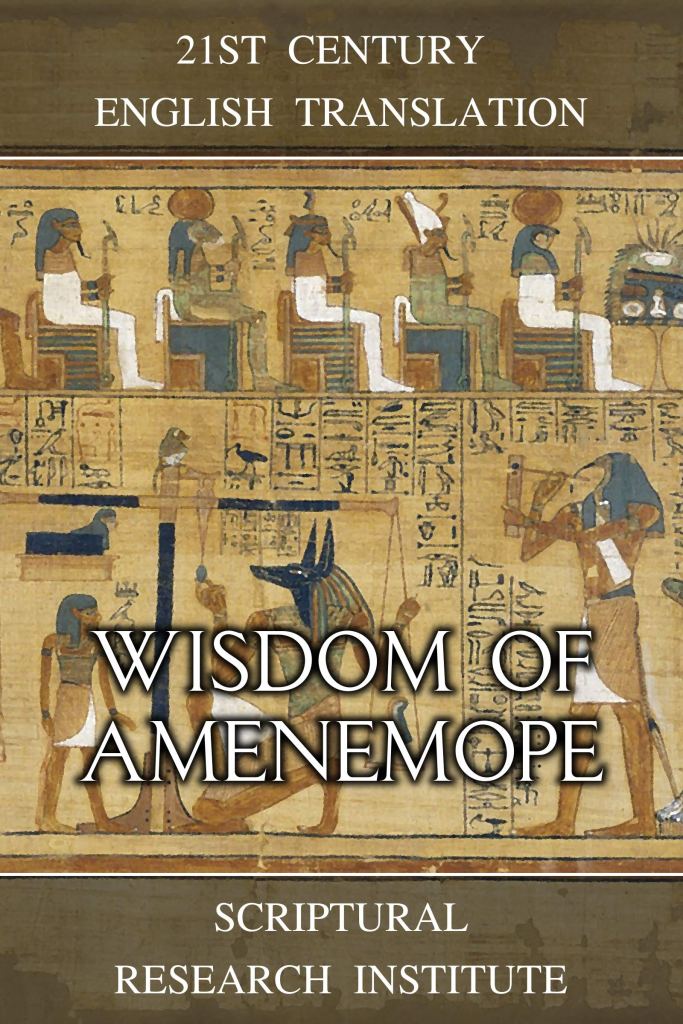
Somehow, in my reading across the ancient world, this is the first text I’ve read from ancient Egypt. It seems a colossal oversight, given the significance and impact of the long-lived Egyptian civilization, and its dominant role in the ancient world. Studying ancient Egypt is a little like studying astronomy: it is an exercise in understanding something on a completely different scale from normal human experience. If we take the typically agreed founding of Rome to the fall of Constantinople as the duration of the Roman civilization, it lasted some 2200 years. If we take the traditional founding of Egypt to Egypt’s conquest by Rome, Egypt endured for some thousand years longer. Egypt was building pyramids in 2600 BC, meaning when Socrates was born, he was further removed from those pyramid builders than you and I are removed from Julius Caesar. I could continue with the comparisons, but the point is the emphasize a sense of scale which it is difficult to keep in mind.
Given those three thousand plus years of history, saying that a text is from “ancient Egypt” is a bit like saying a star is from the Eagle Nebula, an area of space almost 4000 square lightyears as viewed from Earth. To be more specific, Instructions of Amen-Opet, or Instructions of Amenemope (there are at least two different common English spellings), is dated to the New Kingdom period, some time around or a little before 1000 BC. It’s an example of what is often known as wisdom literature, the most famous example of which is probably the biblical Proverbs…which was almost certainly written based on Instructions of Amenemope, given the two works’ relative dates, and the clear parallels between them. Some verses in Proverbs are almost word-for-word for equivalent passages in Instructions, and there are parallels in structure and philosophy as well.
Despite being called “wisdom literature,” Instructions is somewhat sparse on insight, especially enduring insight. It does have some, and there is interest from a historical perspective for what this period of the Egyptian civilization valued in terms of personal fulfillment, moral, upright living, and their ideas of wisdom, but it’s too brief and succinct to offer much – there’s no context. Perhaps, if it were more extensive, there would be more to gain from reading it, but I suspect I may have learned more from reading a different ancient Egyptian text. I should get around to reading the Book of the Dead one of these days.
What would help most is more about who Amenemope was and what motivated him to write these instructions. Well, we know some of the motivation was because it was considered reputable and mete for rulers to write such instructions at the time. But why these instructions, specifically, at whatever time in his life he chose to write them? We simply don’t know, which is the difficulty with some of these truly ancient texts. When they can be part of a collection in communication with itself, like the works of ancient Greece, it is easier to make extrapolations and find that context, but Instructions is somewhat isolated in the historical record. I’ll have to keep looking for works from ancient Egypt, because I would like to learn some of that context.
 IGC Publishing
3 thoughts on “Instructions of Amenemope Review”