
When did knights fall out of favor? Not real-world knights, but the fantastic/mythical kind of knight that appears in stories from the legends of King Arthur to the Magic Kingdom of Landover. They still appear, they’re still a known quantity, but they’ve become a kind of farcical element when they are employed, or at least an unserious one. The notion of the noble knight in plate armor charging into battle to defeat the dragon and rescue the maiden somehow became a joke, a caricature, something deployed to poke fun at the elements involved, not as a serious entry in the story. Whether or not the notion of the noble, honorable, chivalrous knight ever properly existed in reality, the whole concept is associated these days with the wrong kind of quaint. In fantasy literature in particular, knights are linked to the faux-middle-ages, western European settings of a previous era.
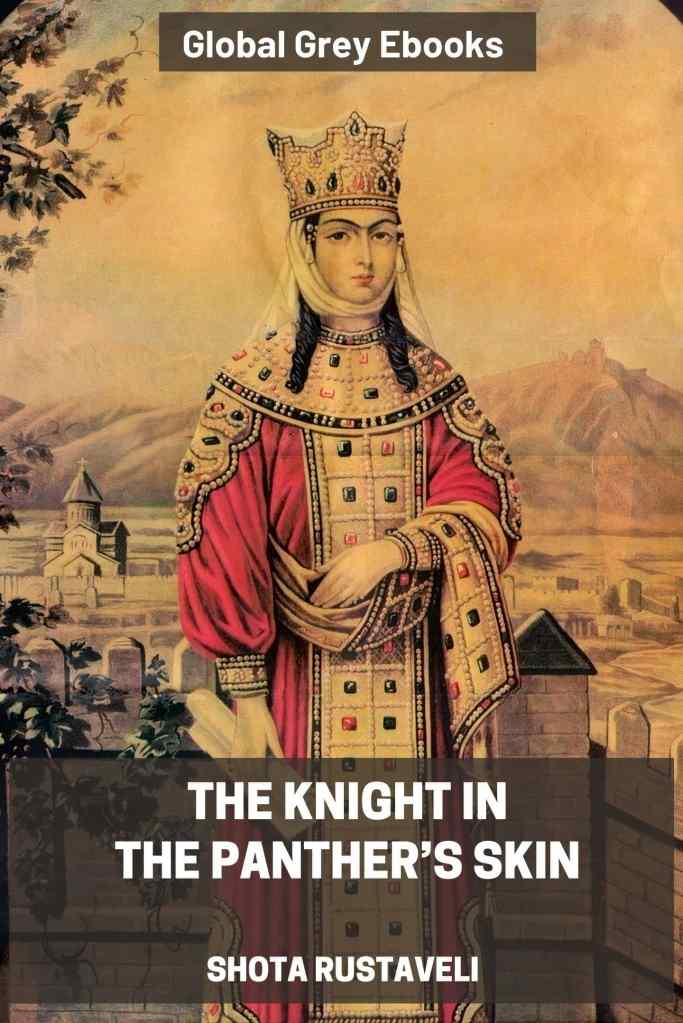
The Knight in the Panther’s Skin does not ride forth from the English round table, though. He rides out of…Arabia. Well, technically India, but the book begins with a knight from Arabia. If Shahnameh combined with The Faerie Queen, the result might look a little like this book, although its far shorter than either, and it was written in the kingdom of Georgia, not Arabia or India. Appropriate, then, that I read it while in the midst of writing Golems and Kings, which is loosely inspired in part by Shahnameh. Few associate knights with that region, though. And perhaps, to some extent, the term means something different than the precise word for which it serves in translation, but it seems close enough in context.
Certainly, these must be some of the most emotional, nay, emotive knights. In that sense, too, they remind me of the knights in The Faerie Queen, but to an even greater extent than those Arthurian champions, the knights in The Knight in the Panther’s Skin are deeply and vocally emotional. There is much wailing, crying, sobbing, tearing of hair, beating of breasts, even clawing of cheeks. Stoic warriors these are not, and all over what is, essentially, a love story. Two love stories, which get rather tangled, and there’s possibly a bit of a love triangle, too, and at least half the tragedies which befall the knights could be averted if they just…told the truth, instead of engaging in secret, complicated plots to win their loves’ affections.
A lyrical poem written in what are called Rustavelian quatrains, which are apparently named for the author of this text and sometimes called shairi, The Knight in the Panther’s Skin is replete with vivid imagery and metaphor, which would be more appealing and impactful if the same metaphors, comparisons, and superlative descriptions were not leveraged for almost everyone encountered in the book. When the first knight is described as eclipsing the beauty of the sun, it’s remarkable. When every knight and their love is depicted the same way, the effect becomes rather diluted. Granted, it is always difficult to know how much of the effect of a poem comes through properly in translation; perhaps there is nuance missing in English which would have been present in the original language.
Rustaveli has an unfortunate tendency to overuse pronouns without bothering to redefine to whom they ought to refer, which makes reading parts of the work somewhat opaque, since the reader must parse the context to infer which character may be referred to in a given line, sometimes different characters all in the same sentence simply being referring to as he. It’s worth parsing, though, because the plot itself, when it’s being advanced (which is often interspersed by protracted segments of reciting things that already happens, and more fraught lamentations), is quite interesting. Though it begins as a basic quest, and a quest remains at the heart of it as it evolves, it is replete with colorful characters and surprising twists, especially towards the end.
The most fascinating part remains the history, though, and the insight into the culture of the time. The “Arabia” and “India” of the story are apparently intended as allegories for Georgia of the time, so it is difficult to say how much Rustaveli might be filling in with his imagination of those distant lands versus projecting his experience of his own time and place. Regardless, one must wonder how a civilization functioned in which people were so, well, dramatic. Everyone running about, driven to madness or the point of death because they cannot see their lover for a day or two…how much is exaggerated because this is a romantic poem, and how much is reflective of how people actually (or ideally, in a cultural sense) behaved? That’s what makes reading these sorts of pieces so interesting to me. I’m not sure that pursuing The Knight in the Panther’s Skin is worth beating your breast and scratching your cheeks over, but it is an intriguing peek into a new time and place.
 IGC Publishing