
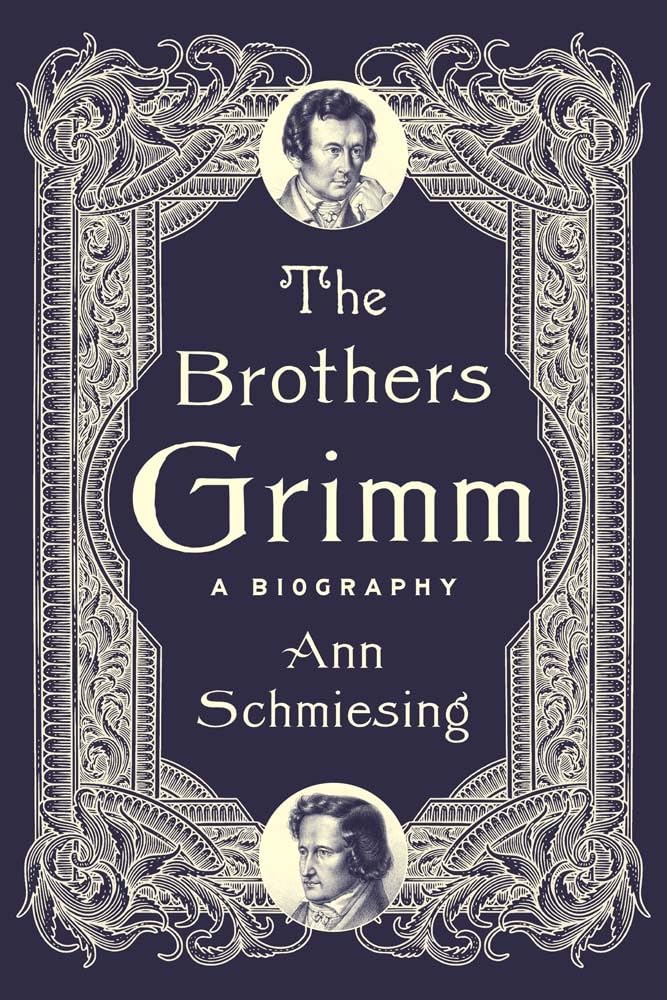
Surprising no one, I found the most difficult part of reading this biography of the Grimm brothers resisting the urge to add every piece of folklore, ancient Germanic epic, and traditional fairy tale to my reading list (provided I could find an English translation) – I managed, though my reading list did not escape entirely unscathed. Alas, additions to my reading list are the main takeaway I have from reading Schmiesing’s biography of the Grimm brothers. It’s not poorly written, but it struggles to convey enough of who the Grimm brothers were as people to be compelling in the way the best biographies are.
More surprising than the number of books I added to my reading list is how little I knew about the Grimms before reading this book. And it is properly the Grimm brothers, without separating much between the two, for Jacob and Wilhelm were all but inseparable throughout their lives, worked closely together on all their major projects, and even shared a single salary. For instance, I didn’t realize the Grimms were from the nineteenth century, thinking for some reason they were at least as far back as the early eighteenth or late seventeenth. This puts their work in a different light, perhaps even akin to Fairy and Folktales of the Irish Peasantry, collected in the early twentieth century, as a collection assembled deliberately to preserve, after the advent of semi-modern scholarship, as the kinds of tales the Grimms wanted to collect were beginning to fade from their traditional fora.
Underlying their experience, values, and decisions, perhaps more than any other single factor, was the convulsion of the Napoleonic conflict across Europe. The main events of the conflict overshadowed their formative years, but the ripples affected the continent for most of the century, and especially the Germany/Prussia region. Indeed, the Prussians essentially invented the modern professional military academy in an attempt to prevent another Napoleon from rolling over them, the idea being that a trained, professional cadre of moderately trained military leaders could counter the kind of random, lone, strategic genius like Napoleon. Military matters aside, Napoleon’s short-lived conquest and the societal factors that underlaid it were a catalyst for the varied and divided states in the Germanic region to pursue some level of coherent national and cultural identity, which was a major theme in the Grimms’ work.
To that end, the Grimms sought to explore the idea of Germanness through fairy and folk tales. This did not mean delving into musty ruins in search of ancient manuscripts, like the booksellers of Florence and their associates seeking to recover the wisdom of the ancient world; it meant making new copies and translations of extant epics, poems, and stories, along with transcribing oral literature. Schmiesing makes much of whether or not they really drew their tales from and wrote them as representative of the “peasantry,” despite emphasizing the vital role at least one peasant woman played in providing a significant portion of the fairy tales the Grimms collected. What Schmiesing dances around in her slantwise critiques of the Grimms’ treatment and transcription of tales and how they (inevitably) filter the stories through their own experiences is the fundamental conversation of translation, both from other languages and between different forms.
It’s something we’ve written about somewhat extensively on the site. Bringhurst and Zolbrod approach the discussion thoughtfully, and I’ve written in conversation with their thoughts on the matter; Schmiesing clearly has opinions on the matter, but they don’t come across in the text as fully formed, and she engages with the matter shallowly, passing slantwise judgements on the Grimms’ editorial decisions and their intersection with contemporary and modern mores, without engaging in a deeper analysis. Frankly, that shallowness is somewhat reflective of Schmiesing’s approach to the biography as a whole. It never drew me in and gave me an immersive understanding of who the Grimm brothers were and why they did the work they did the way other biographers can for their subjects. And no, this is not only in comparison to Chernow’s masterpieces. The Brothers Grimm at times reads simply like a list of events, without deepening context or insight.
Lest you take the wrong impression, The Brothers Grimm is interesting. Schmiesing’s research is thorough, her facts are well supported, and she does attempt to provide context with events in the wider world beyond the Grimms’ immediate surroundings and interactions. There is plenty to be learned, especially for those who matriculated through the American educational system, which tends to gloss over the Napoleonic conflict, its significance, and its aftereffects. I sometimes neglect the nineteenth century more than I should, for it truly was a dynamic, pivotal century. There’s an argument to be made that a lot of modern history has its foundation in the eighteenth century and a climax of sorts in the twentieth (not an end, no matter what some post Cold War pundits and scholars thought), but was formed primarily in the nineteenth. The Grimms were part of that history, serving a role in defining cultural Germanness which saw them become notable public figures later in life. It is significant that Jacob, an introverted philologist whose primary occupations were librarian and reluctant professor, was asked to participate in the creation of a new German constitution.
As Schmiesing observes, a new biography of the Grimm brothers seems to pop up every decade or two; unsurprising, perhaps, given the enduring popularity of the Grimms’ fairytales and derivatives thereof. Schmiesing’s The Brothers Grimm is not, perhaps, the new definitive masterpiece in the genre, but it’s a worthy, approachable entry replete with detail that captures a three-dimensional view of its subjects, if not one as immersive and life-like as other biographies convey. It’s also a fine way to add a dozen or so new pieces of historical literature to your reading list.
 IGC Publishing
2 thoughts on “The Brothers Grimm: A Biography Review”