In their assorted forms popular and historical, the Arthurian legends form one of the foundations for the modern fantasy genre, including an entire subgenre of “Arthurian fantasy” which might contain familiar tropes or character-types, like the magic sword or the destined boy-king, but which is distinct from the numerous spin-offs, retellings, and reinterpretations of the Arthur story which continue to attract readers, viewers, and acclaim. The Blood Magic series, which I wrote as an exercise for myself and can still be read here on the site, is in part inspired by this Arthurian fantasy subgenre. Somehow, though, with all my reading of historical texts, myths, and legends, I heretofore never thought to pursue reading a historical version of the Arthurian legends. The Mists of Avalon, an excellent historical fantasy novel I read many years ago, doesn’t count (nor does A Connecticut Yankee in King Arthur’s Court).
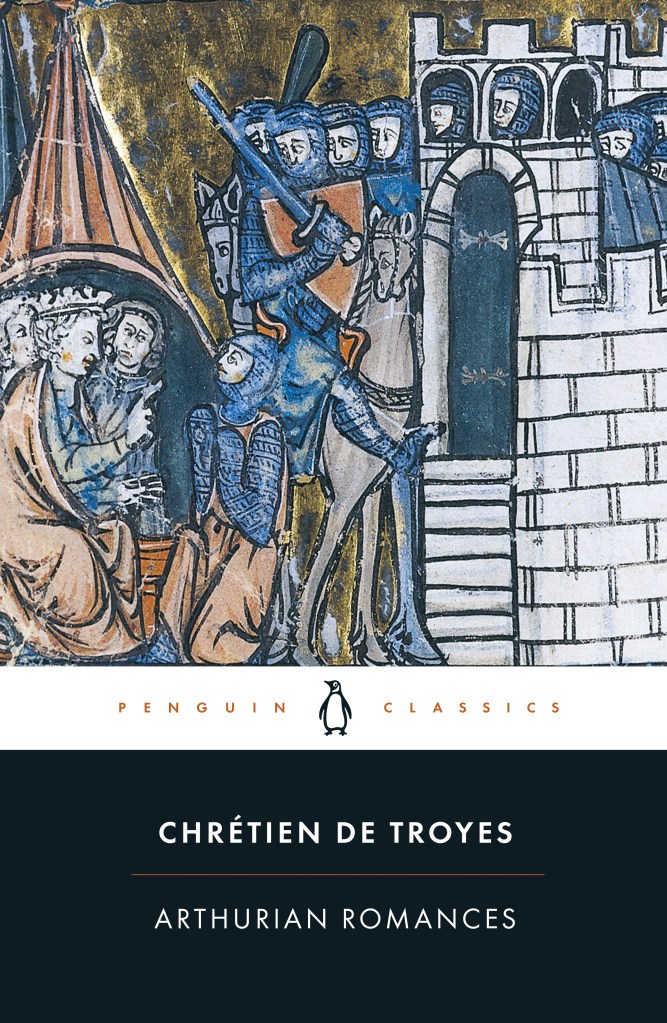
Chrétien de Troyes’ Arthurian Romances are considered one of the earliest written versions of the legends of King Arthur, although they do not tell the core Arthur stories. Instead, they explore the quests of some of his knights, usually involving, well, romance, and in a way that is a reflection of the courtly chivalric vision of twelfth century France. Yes, France, not England, and the original work was in the form of French rhyming couplets. The version I obtained is an English prose translation of the four complete poems, along with a forward by the translator which explores the significance and nuance of thought reflected in Chrétien’s writing, how his notions of romance evolve and become more complex over time, and how those reflect the changing views of the French courtly class. The Romances are interesting from this perspective…and only this perspective.
From a literary perspective, the translation I read was not engaging. The plots are predictable, the characters are flat, and the settings unimaginative, especially in the first two stories. The latter two have somewhat more nuance and complexity of thought, but were still dull to read, and I will admit to skimming significant portions of the text. Perhaps the situation would be somewhat improved by better preservation of the poetic structure and form, but probably not enough to make it worth reading. This is interesting from a historical perspective for its indirect insights into the cultural norms and beliefs of the French court at the time, but does not deliver the insight into the “authentic” form and function of the ancient Arthurian legends I sought.
 IGC Publishing