
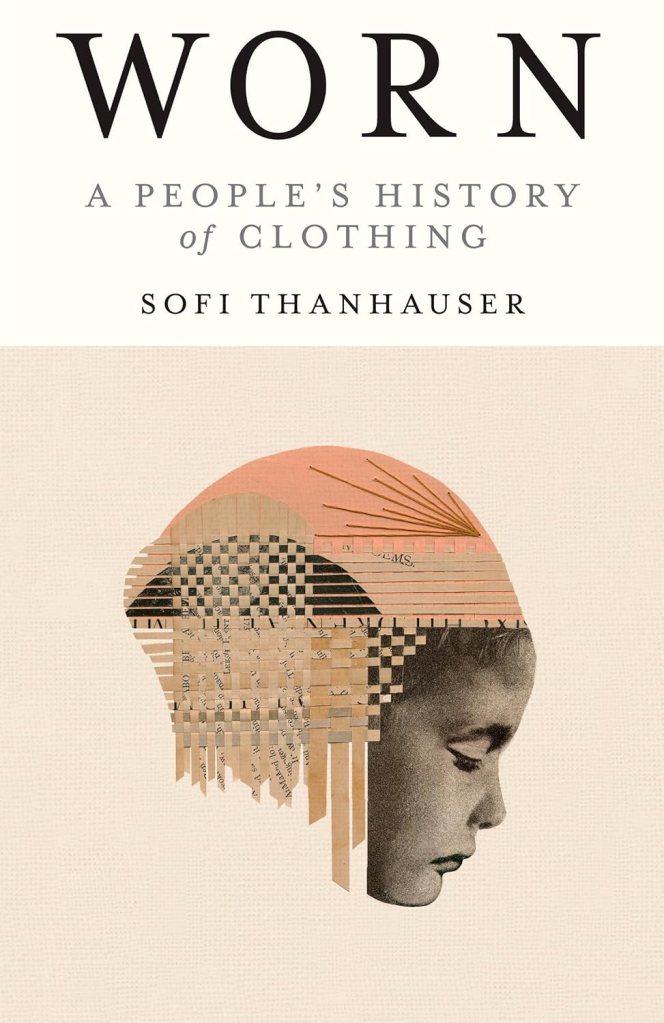
When I went to read this book, I had some doubts. The author is not a researcher, historian, archeologist, or otherwise possessed of deep expertise in the area of clothing and fabric; she is a “writer, artist, and musician.” In a recent review, I wrote that I intended to avoid such nonfiction books written by writers, journalists, and others not actually in the field the book intends to address, and this book should have gone in that category. Yet, here I am, trying to read another “popular nonfiction” book. Why? Well, because I wanted details about fabric and its history, but I didn’t necessarily want to find and read an 800-page scholarly treatise on the topic. Worn, from the summary, sounds like it could be a useful and productive survey in the vein of Material World, which is a decent book despite its flaws and inability to compare to The Substance of Civilization.
I should have listened to my doubts, because this is going into the vanishingly small pile of books I did not finish and will not return to – I didn’t even skim to the end. This is not a history of clothing, of fabric, its manufacturing, its properties, or its evolution. It is an unnuanced screed incoherently stitching together fragments of grievance politics and pet causes into a disjointed fabric that reads like a collection of opinion pieces written for a socialist periodical. Worse, in her “investigative journalism,” Thanhauser comes across as disrespectful of the people she encounters if they don’t share her elitist tunnel vision, and she enters each encounter with preconceived notions she shows no interest in challenging.
Even so, I might have finished the book, or at least skimmed to the end, if I felt I was gaining valuable insights and information from it. I was not. Thanhauser spends minimal time on the history and properties of clothing and fabric, despite that ostensibly being the point of the book, unless you count the very recent past, and some of the “facts” she presents are plain wrong. At least, they contradict what I’ve read in, for instance, Mysteries of the Middle Ages, and I’m inclined to trust the book that has footnotes, references, and is written by an actual historian of the period more than Thanhauser’s “popular” nonfiction.
To be clear, the problem is not that I disagree with Thanhauser’s opinions and conclusions, although I do disagree with many of them. The problem is her cherry-picking of anecdotal evidence to support uninformed or ignorant conclusions and opinions which do not reflect the genuine nuance and complexity inherent to each of the areas in which she makes declarations of Truth. She knows what she believes going in, and her confirmation bias is stronger than a thousand threads. Her book makes clear anyone who disagrees is simply Wrong.
As an obvious example, consider the impact of industrialization on the fabric industry. There are flaws, on that I think we can all agree. There are inefficiencies, exploitations, massive waste, environmental degradation, et cetera. However, Thanhauser would have us focus only on these flaws and negatives, while pining for some never-realized halcyon days in our collective pastoral prehistory, without acknowledgement of the benefits which come with industrialization. Fabric is finer, more accessible, and more versatile than ever before, and an enormous amount of time is freed up by the mechanization of its production.
Worn is disorganized, unfocused, poorly researched, and polemical (and it’s not even a good polemic – Orwell’s Politics and the English Language is arguably a polemic, but it’s a well-written, insightful one). It is heavily Americentric and explores the history of fabric only insofar as it touches on America and modern historical preoccupations. Fabric and clothing have a deep, lengthy, complex history. They are together a key human innovation with physical and cultural implications, but Worn will not help you understand them. It seems I’ll need to find that 800-page research tome on clothing after all.
 IGC Publishing