Since the US operation to capture Venezuela’s former dictator there has been sharply increased conversation about international law, including many commentators decrying the operation as “illegal.” President Trump’s comments about the constraints upon his actions were grist for this recent commentariat mill, the usual suspects seemingly still ignorant of how his deliberately expansive and inflammatory comments distract them from critical analysis of the actual substance of the current events and strategic decisions on which they are supposed to be reporting. However, this is not a post specifically about any particular political or geopolitical incident, but rather a general discussion of the peculiar and often nebulous concept which is international law. As usual, the bombast emerging from both sides of the debate cloaks significant, unacknowledged claims and assertions on the subject which should be more prominently highlighted and analyzed.
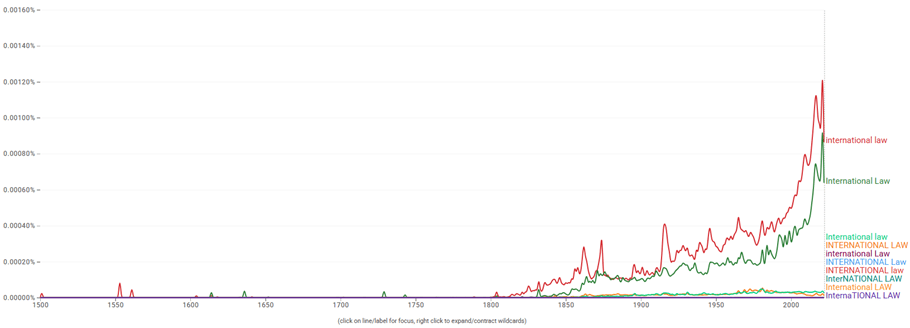
First, it is necessary to draw a distinction between international law in the sense of some supranational authority, and international law as the commonly accepted observance of treaties and other inter-state agreements. While international law in the latter sense exists in the historical record back to at least 2100 BC and likely evolved concomitant with the earliest sources of centralized authority, international law in the former sense didn’t arise as a concept until the rise of the western European Christian states, and didn’t take on anything approaching its modern permutation and scope until the nineteenth century, when the philosophical foundations were laid for what would eventually be given the form of the United Nations. We read the United Nations founding charter as part of The US Constitution and Other Writings, although we did not delve into it in detail during the review, and we mentioned in “Trapped in Silk Slippers” the assertion of some political scientists that UN interventions in interstate conflicts in the late twentieth century marked the transition to a “post-Westphalian” order (referencing the Treaty of Westphalia, 1648 AD). The United Nations is the most durable and inclusive body attempting to act as a supranational authority, and was, at its founding, intended as a forum through which international law could be made and expanded. Such supranational authorities must be considered distinct from traditional bilateral and multilateral agreements because they presume an authority higher than domestic political sovereignty and state-to-state relations, and it is with such authority this post is primarily concerned.
To be clear, an informed reading of international law at a minimum renders the legality of the Maduro operation ambiguous, and there is a strong argument that it was entirely legal. International authorities already considered Venezuela’s most recent elections fraudulent, the actual, democratically elected sovereign to be living in exile, and Maduro to be an illegal dictator illegitimately maintaining his grip on power in the country. This was the consensus on both sides of the political spectrum amongst adherents to, and member-states of, the liberal international order (a loose set of beliefs which can be reduced broadly to support for the primacy of international bodies like the United Nations, the World Trade Organization, the International Criminal Court, et cetera), at least until the US operation to unilaterally do something about the matter. Somehow, this fact is forgotten in many of the recent analyses about the operation, which make much of the US decision to arbitrarily “depose a nation’s sitting sovereign.” There are plenty of other questions and concerns which can be raised about the operation and its implications for sovereignty and respect of foreign territory, but supposing them to be tied to Maduro’s role as sovereign ignores the findings of the very international bodies and laws invoked. This is also why the operation should not be considered analogous to Russian designs upon Ukraine and other former Soviet territories. There is more alignment with Taiwan’s uncomfortable international status, but that nation’s democratic system renders a comparable Chinese operation against its leadership less relevant, and the broader context of the China-Taiwan geopolitical question further complicates such a reduction.
The concept of international law is itself problematic. From whence does its authority arise, and how are its tenets established? If the authority of national governments arises from the governed people, ala social contract and democratic theory, international authority can be considered tenuous at best, so removed it is from the democratic process. It is a “democratic” process in the sense that each nation has a voice – there is no political aspect of the international system as it currently exists in which the individual citizens have any kind of direct influence or voice (meaning, for instance, the election of representatives or even of an electoral body to determine representation in international fora). Unlike traditional bilateral and multilateral agreements, the conceit is that these international bodies can make judgements which are imposed on nations not by mutual agreement, but by the agreement of a majority of member states. In other words, by agreeing to be party to an international body, a state agrees to be subject to such decisions as it might make in the future, regardless of its agreement to those particular decisions. This is a fundamental abdication of core principles of sovereignty, and the reason the US consistently refuses to bind itself to such decision-making bodies. If a state’s most sacred and fundamental responsibility is to its citizens, then any abdication of authority to an international body would be a potential betrayal of those citizens’ interests. The UN’s relative impotence, then, is not an accident – it is a deliberate design decision by states which understood and understand its potential threat to their sovereignty and their responsibilities to their citizens.
Furthermore, international law is increasingly twisted by moral relativism to protect dictators, terrorists, and other euphemistically-named “bad actors,” while constraining, censoring, and punishing democratic, law-abiding nations. The compromises made to create the original United Nations laid the weakened groundwork of which the erosive forces of moral relativism take advantage. By placing all notions of morality on equal footing and normalizing them through accepted practice, right and wrong, never mind good and evil, are muddled to meaninglessness, and international bodies become, rather than a forum in which a consensus of nations can attempt to prevent evils and correct wrongs, a forum in which purveyors of atrocities are given equal weight and voice. This is furthered by supposed defenders of the liberal international order who echo the talking points of terrorists and dictators to the detriment of those who justly oppose them. As I wrote in “Relatively Wrong,” moral relativism provides a slippery slope to the justification of anything and the erosion of all standards. Thus, international law becomes a tool of the exploiter when the hands which guide it lose their belief in shared, fundamental principles.
The answer is not to give up on international law and its fora. However, international law cannot become an end unto itself. If international law and the bodies responsible for it become tools of those who manipulate it to their own ends, shields to dictators, and threats to democracies, then they are wrong, broken, and should be either corrected or ignored. The UN of the 21st century has failed in almost every way to live up to the utopian expectations placed upon it at its founding (perhaps inevitably); this does not mean it should become an instrument of dystopia, or that its vision should be forgotten. International law as agreements between states, recognizing their mutual sovereignty, is to the benefit of all, but it must recognize right and wrong, those who would manipulate the system, and it cannot at present presume a supranational authority, for that, in its current form, would be a road to global tyranny.
 IGC Publishing