
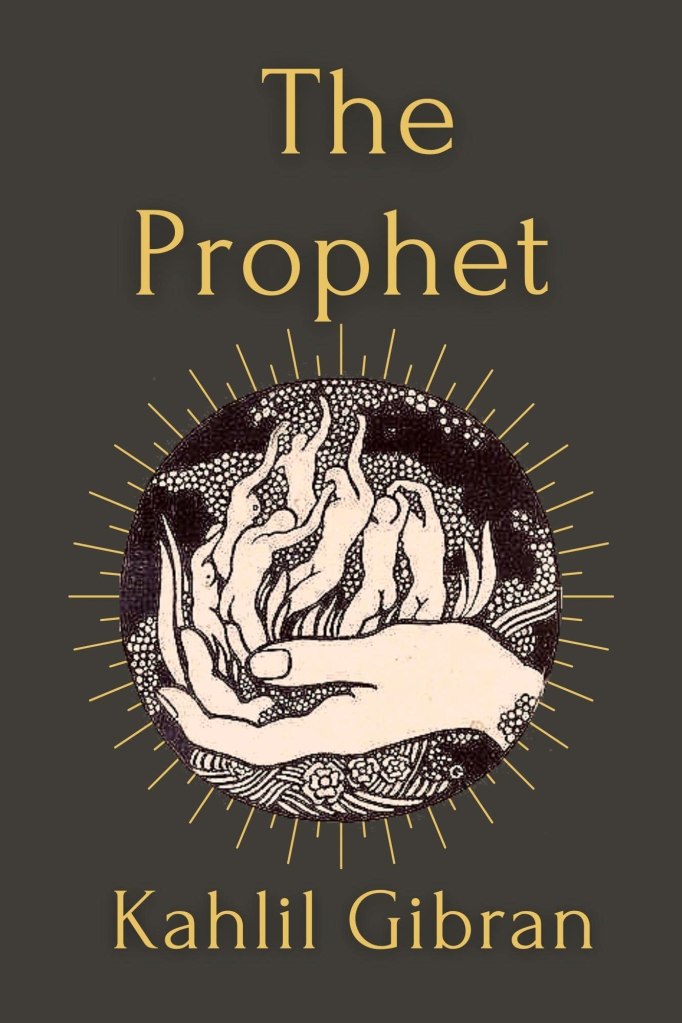
In discussing some of our favorite books, a colleague recommended Kahlil Gibran’s The Prophet as a must-read for someone such as myself with an interest in philosophy, putting it on the same level as Meditations. Since it’s such a brief read – shorter even than its page count suggests, because of the illustrations included with the piece and the large font size – and I found an easily accessible copy in the public domain, I read it soon afterwards, in contrast to most book recommendations I receive, which go on my reading list and don’t actually get read for years. It’s a more modern piece of philosophy than most of what I read, for all it’s nearly a hundred years old, and it’s a series of essays on various topics presented through the framing story of a prophet preparing to depart a city in which he’s been visiting. Ranging from love, to work, to law and freedom, to religion and death, the essays are a mix of clever, worthwhile insights and thought-provoking comments with banal observations, trite contradictions, and naïve assertions.
There is a dreamy sense which pervades the book, a certain removal from reality which undermines the applicability of some of Gibran’s conclusions. Sometimes this is the desirable kind of innocence which might be associated with an optimistic, utopic vision for what humanity ought to be, but it more often comes across as a pleading naivete, especially in sections on crime, punishment, and law. At a few points this leads Gibran into uncomfortable assertions, including blaming the victims of crimes for their execution. Even if people did not have to cluster within walls out of fear, as he asserts at one point, crime and fear would not disappear.
Gibran’s metaphors are the book’s strongest aspect, more than the philosophy they are intended to support, and stand on their own for beautiful prose, especially the longer ones. Even the ones which support philosophical notions with which I have issue have a vividness to them, perhaps because they are allowed so much space to breathe. As short as the book is, it is hardly concise, with some sections growing repetitious.
Largely, The Prophet’s philosophy aligns with Christian New Testament teachings and certain ideas of Buddhism (there are interesting parallels between those two religions, as well). However, it is not an explicitly denominational text. It could be said to be an explicitly religious text, and Gibran does reference God, but as often references a “World Spirit” or similar allusive phraseologies, suggesting a certain agnosticism which reminds me somewhat of the semi-common eighteenth century belief in a “Supreme Being” without accompanying belief in a specific religious interpretation.
The Prophet is artistic, poetic in places, and makes much of its observed contradictions and implicit conflicts, but its original contributions to philosophy, morality, and the understanding of the human condition are few. I wouldn’t recommend against reading it, but it does not have the density of wisdom and insight which you might expect from reading other major works of philosophy. Perhaps it is for precisely that reason that it has managed to maintain a certain passionate following over the century since its publication.
 IGC Publishing