
We all make decisions, from the minor choice of what we want for breakfast to the major questions of what career do we want to pursue or with whom do we want to spend our lives. If free will was just about our apparent capacity to choose between potentialities, it might not be the focus of such voluminous philosophical debate (then again, philosophers love to debate things that are self-evident to everyone else (and I say this as something of an armchair philosopher)); however, free will probes deeper than our apparent ability to make decisions. After all, the human mind is a poor tool for analyzing itself, and what we perceive as a capacity for independent decision-making could be little more than an illusion of control, with all of those apparent choices predetermined by our circumstances and how those stimuli affect our neurochemical balances.
It’s the sort of question that science is not likely to settle, for all it can play a role. Newtonian physics, for instance, was very deterministic, and led to arguments about how free will must not exist because if we perfectly characterized the universe’s physical laws, and knew its initial states, we could propagate forward exactly how everything would play out through the end of time. Now, we know that Newtonian physics is more like a description of a painting than a universal prescription, and it seems likely that making such predictions based on the initial states of the universe, even if we knew all the physical laws involved, would be akin to, well, the universe existing in terms of the time and resources required. Thus, the question is remanded to the field of philosophy. All of this discussion of deterministic realities and physical parameters is tangential, though, to the discussion of free will undertaken by Martin Luther in On the Bondage of the Will.
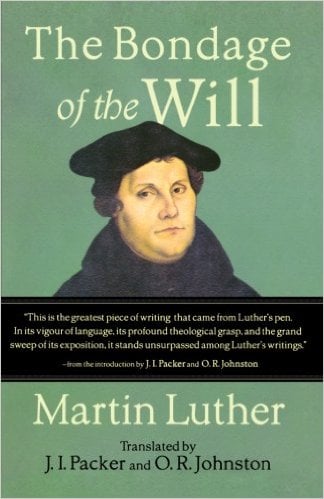
On the Bondage of the Will is one of Luther’s most famous pieces, at least in philosophical circles. It’s been on my reading list for years, and succeeding the biography of Luther I recently read seemed an appropriate time to finally read it. Luther apparently argues against the existence of free will, which, given the title, I don’t think constitutes much of a spoiler, and I was very interested to see what his arguments were. After all, this is a piece of philosophy praised for its insight, lauded for its clarity of composition…and quite disappointing to a reader like me.
Given the author, I expected religious elements and arguments going in, but I expected them to be contextualized and layered with secular logic and reasoning thought. The first of John Locke’s treatises of government is much this way, providing Biblical arguments that support or are supported by reason. Luther, instead, treats his biblical citations as, well, holy writ. His entire argument can be reduced to an assertion that the existence of free will would invalidate the need for divine grace, and therefore free will must not exist. Maybe that’s good enough for you, but that argument strikes me as inadequate. Not just inadequate – I posit that claiming that the need for divine grace implies that free will does not exist is actually counterproductive to the point being asserted, based on the following logic.
If we accept as truth the reality of a divine creator possessed of omnipotence and omniscience (which may be an unnecessary distinction, as one likely implies the other and vice versa), then the existence of non-existence of our free will would be a product of that divine creation. Therefore, if free will does not exist, why would our divine creator have created us in such a way as to be bound to sin, to defy the wishes of that same creator? It does not stand to reason. Alternatively, if the divine creator imbued us with free will, the ability to make our own decisions for good or for evil, then it could in fact necessitate divine grace, for imperfect beings with the capacity for independent decision making would surely never approach the perfection of choice which would be achieved by omniscience. Thus, the central point of Luther’s argument against the existence of free will in fact is a strong argument based on his premises in favor of free will.
The book was a pleasant enough read – Luther’s writing is very colloquially, befitting of a man who in a certain sense argued for the democratization of the Catholic Church – but Luther’s arguments were lackluster. Compared to the new ways of thinking and stretching of the mind I experience when reading something like Plato’s Republic (even if I ultimately disagreed with his conclusion in that piece, too), On the Bondage of the Will did little to challenge me, and I do not see myself returning to it in the future. I don’t think that I can recommend that you read it, but who knows? You might not have a choice. In anything.
 IGC Publishing
5 thoughts on “On the Bondage of the Will Review”