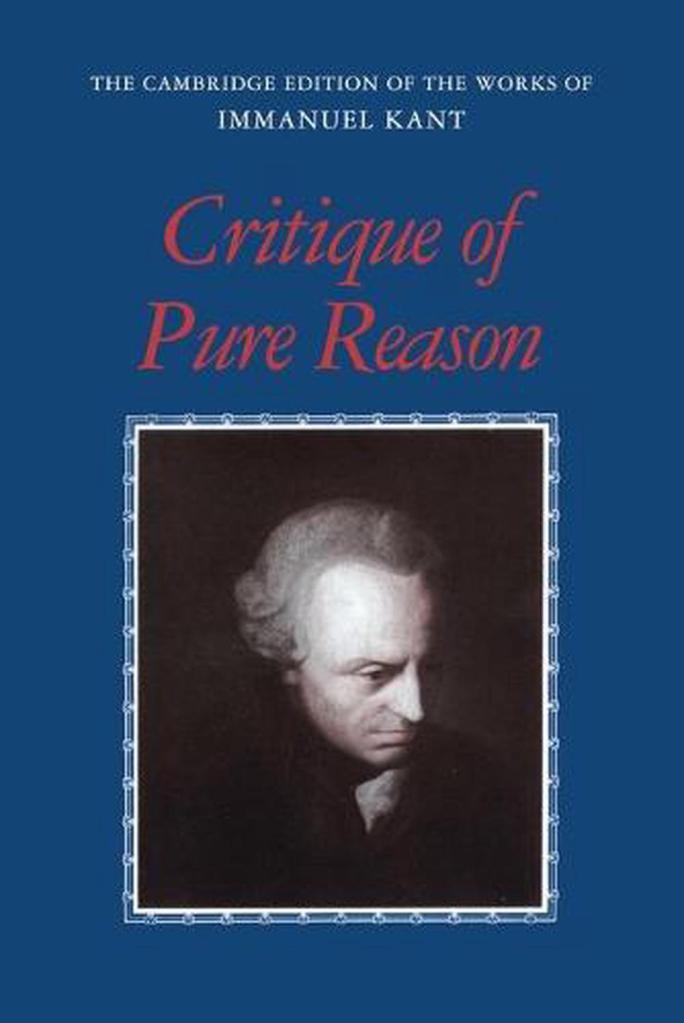
I once heard Kant described as a philosopher’s philosopher. Supposedly, even his philosopher peers regarded him as closeted, out-of-touch with reality, and unapproachable behind the abstract battlements of his ideas which are, admittedly, sometimes challenging to follow. They require thinking about thinking in a deliberate way that is unnatural in a way other approaches to philosophy are not, and while Kant’s works make him a deontologist, that is more a consequence of his reflections than it is their core. The best title to apply to Kant would be that of metaphysicist.
Written and published in the context of the European Enlightenment of the eighteenth century, Kant’s Critique of Pure Reason reads, to me, like the philosophical predecessor to Einstein’s Relativity. It takes the same approach of exploring fundamental, familiar, basic principles in such a way as to make seemingly obstruse conclusions appear perfectly straightforward and necessarily given or implied by the foundational assumptions to which we agreed, this time in the context of the fundamentals of reason instead of the fundamentals of spacetime. That should not be so surprising, given that Kant’s major goal, as he states in several extensive introductions to his Critique, is to apply the concepts of the scientific method that powered so many aspects of the Enlightenment to the field of philosophy, to metaphysics. In other words, he wanted to do for philosophy what Newton did for physics.
It’s an ambitious goal. Kant does not entirely succeed in it, I think in part because he is attempting to apply fundamental reasoning to a field that is insufficiently fundamental to support it, but while I will poke fun at his assertions about spaces being of space and times being of time, his Critique still supplies essential insights into the nature of thinking. After our various discussions of critical thinking in recent posts, it reads like the fundamental physics of critical thinking upon which all of those other discussions are based, like how chemistry, biology, and other physical sciences are all based, ultimately, on physics.
Worth noting is that this does not mean Kant is attempting to conduct a kind of proto-psychology or proto-neurology. He is attempting to derive the fundamentals of reason, not the physical underpinnings of the human brain’s functionality. This presupposes that reason can have an independent existence beyond being an implementation of how the human brain functions under particular circumstances and with specific training, which I consider a valid assumption. Much of Kant’s Critique is occupied with determining what can be known “a priori” – that is, purely from reason – and what can only be known “a posteriori” – that is, from empirical or sensuous evidence.
Can anything be known independent of input from the senses, from empirical evidence? That is a question of etymology, and Kant begins from the premise that, yes, it is possible to know something “a priori.” In particular, we are all familiar with a field of knowledge in which conclusions are achieved, not based on empirical evidence and sensory inputs, but from, well, pure reason: mathematics. That a space cannot be enclosed by fewer than three sides is not a fact derived from observation, but from abstract reasoning based on mathematical principles. Kant’s argument is that there are aspects of reason, and of traditional philosophical subjects like morality, which can be derived in the same way that a mathematical proof might be, a priori rather than a posteriori, by pure reason and not by empirical evidence. It is from that basis that we gain the idea that something should only be considered right insofar as it can be desired to become universal law.
Kant makes frequent reference to several of Aristotle’s works on logic and dialectic, especially those contained in the Organon, and I assuredly had a greater appreciation for Critique of Pure Reason having read that foundational work. Although, foundation may be the wrong term. If Aristotle gives us a how-to guide for logic and critical thinking, Kant gives us the accompanying textbook explaining the background and fundamentals upon which Aristotle’s guide is based.
While it is amongst the classic works of philosophy, Critique of Pure Reason is not as immediately and directly applicable as, say, the works of John Locke, or even Plato. It is abstract, sometimes difficult to parse (exacerbated by being translated from German and therefore riddled with overlong, passive sentence structures), and is truly thinking about thinking, rather than thinking about morality or one of the other core topics which we associated with philosophy. Unlike some of the other philosophical works I’ve reviewed, I would not necessarily recommend that this is one that everyone should read at some point in their lives. This is more for those of you who are looking to dig a little deeper, who like to think in different ways and stretch your brain to think along unusual dimensions. If that’s you, then I recommend you add Critique of Pure Reason to your list.
 IGC Publishing
5 thoughts on “Critique of Pure Reason Review”