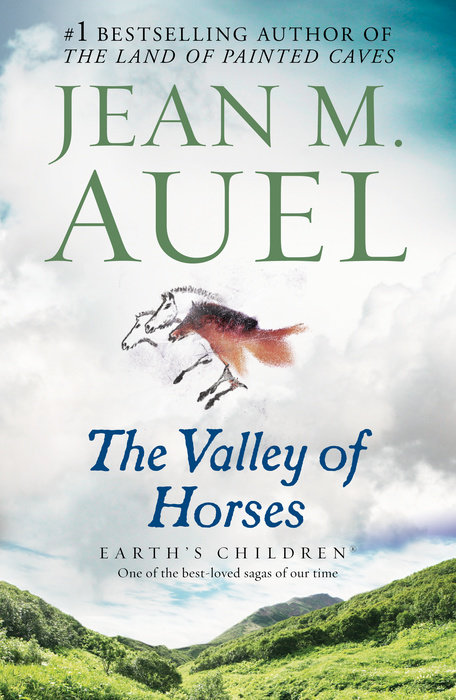
Well, it took me a year (give or take), but I actually got around to reading a sequel. Does that qualify as soon, like I suggested in my review for Clan of the Cave Bear? Probably not, but given my track record, the fact that I read The Valley of Horses at all is a testament to how much I enjoyed the first book in Auel’s Earth’s Children series, and I enjoyed the second book almost as much as the first.
Like its predecessor, The Valley of Horses is exquisitely researched and spectacularly imagined in that small-scale way that is more immersive and substantial than the most grandiose vision. Such rich detail draws the reader fully into Aayla’s world. This is more than descriptions of plants and animals, although the detail provided and in a way that would matter to the people living there is a major component of it; Auel also provides us in-depth, expert-level description of leather preparation and treatment, flint-knapping, paleolithic boat-building, and climatological effects. Her omniscient narrator is close enough to the story to keep the reader deeply engaged, while providing enough context for a modern reader to understand and connect.
While Aayla’s survival story is fascinating and enjoyable (I’ve long enjoyed the immersive nature survival type story), especially when we have the opportunity to perceive all that she accomplishes through an outsider’s lens, I missed the Clan in this book. Their hereditary memories and resulting culture are such a fascinating concept, and Auel does a marvelous job exploring it, that I wished Aayla could have continued interacting with them in some way, although I understand that her journey is to join the humans of her own kind. At some point I foresee myself losing interest in the series as it becomes less about Aayla’s independence and the Clan, and more about her interaction with conventional humans.
While the vast majority of the book was lavishly described and multi-sensorily immersive, a few places threw me out of the story, and most of those had to do with serendipity. Soon, or recently, I’ll be sharing a post about innovation and its elements, in part inspired by reading The Valley of Horses and these jarring sequences in particular. During the book, Aayla makes several revolutionary discoveries/innovations. Each of them is well-founded, foreshadowed, and supported by only a small element of luck/serendipity/coincidence/deus ex machina…but having so many in the same book, by the same person, that no one else even imagines are possible, sometimes jarred my suspension of disbelief. From a writing perspective, Auel does everything right, but the overall effect weakens an otherwise fantastically realistic story (and that realism is part of what makes it so enjoyable).
Those few instances did not detract from my enjoyment of the story, nor from how compelling I found it. Aayla makes for a wonderfully sympathetic, highly competent character, full of very human contradictions, and, as I tend to enjoy, she has many opportunities to leverage that competency. I’d read a story about her in many settings, but Auel’s realism, meticulous research, and vivid description make for a world and culture that could power a story on their own, more imaginative and unique in their own way than the most fantastical secondary world. I don’t know when I might read the third book, but it is a when, not an if.
 IGC Publishing
2 thoughts on “The Valley of Horses Review”