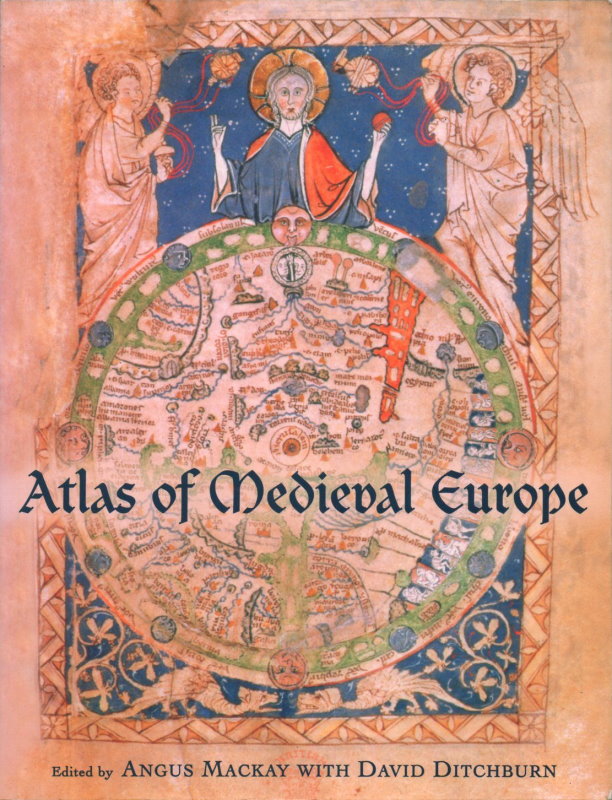
I should probably spend more time in used book stores than I do, but when I’m looking for the next book to read, I usually choose something off my reading list, and most of what’s on my reading list is not likely to show up in a bookstore, new or used. Every now and then, though, usually when I’m on vacation or otherwise travelling, I’ll find myself wandering through such an establishment, and I’ll often find something that catches my interest to take home with me, which is how I came to own a copy of the Atlas of Medieval Europe. As usual when this happens, the book is not quite what I expected when I first flipped through it.
Fantasy books have maps. It’s practically one of the defining features of the genre, and why, amongst the many topics I study, I’ve spent some small amount of time learning about cartography, and especially the discipline’s history. I’ve written about this before, and it was to further that knowledge that I was first attracted to Atlas of Medieval Europe. When I first picked it up, I thought it was a collection of historical maps – as in, maps made during the medieval period – with contextualization and interpretation. Turns out it’s more of a history book than a historical book, with modern-made maps depicting medieval happenings, instead of actual, medieval maps.
Perhaps one day I will find a collection of such cartographic artifacts, but in the meantime Atlas of Medieval Europe is an excellent source of insight. Organized by both timeframe and subject, the collection presents the clearest maps I’ve ever found in a history book, which usually attempt to cram far too much information into a single, static map. With Atlas of Medieval Europe, you can instead experience a kind of stop-motion animation as you watch Europe evolve over the course of a few centuries. Since each map might highlight only a single, specific thing, like the locations of a particular sect’s monasteries, the maps are easy to interpret, and the book is organized so you can (relatively) easily find a map relevant to your particular inquiry.
Nor does the book exclusively feature maps. Accompanying each map is a description, so this atlas leads a double life as a history text. These descriptions are of varying lengths and are written by various historians, providing important context for the maps in question and describing the snapshot in history the map is intended to capture. Valuable as these are, they are not necessarily written for the lay reader. Both the maps and associated descriptions can be quite specific, and it’s easy to get lost if you don’t have a decent knowledge of medieval Europe already. Most events, people, and so forth are mentioned only in passing, without the additional expansion that might be present in a dedicated history book, so the accompanying texts often rely on the reader to either understand the references or look them up separately.
Still, this is one of those texts that really isn’t meant to be read straight through, like I always insist on doing the first time. Instead, as the title suggests, this is better treated as a reference. Though aimed as a reference for historians, or at least history students, it is no less useful to us students of history, or those of us who might use it to inform our writing. If I’m writing something with a setting corresponding to a certain period, I can go to the table of contents and find a map that will answer whatever question I might have. The most important insight to be gained here, though, at least from a writing perspective, is one of scale. In our modern, vast, and interconnected world, I sometimes find that I make anachronistic assumptions about how large and interconnected a world set in an earlier civilizational context would be. Atlas of Medieval Europe helps lay out, in an easy-to-follow fashion, just how prolific connections were, how far people travelled, and over what time periods.
Despite how I read it, Atlas of Medieval Europe really is a reference, a road map, and best used like you would a conventional atlas (for those in the audience who still remember what an atlas is and how to use one). Whether you’re looking to navigate the specifics of medieval history, or find your way through a fantasy world by referencing our own, Atlas of Medieval Europe will make a reliable reference and guide. If that sounds useful to you, then I encourage you to reference Atlas of Medieval Europe soon.
 IGC Publishing