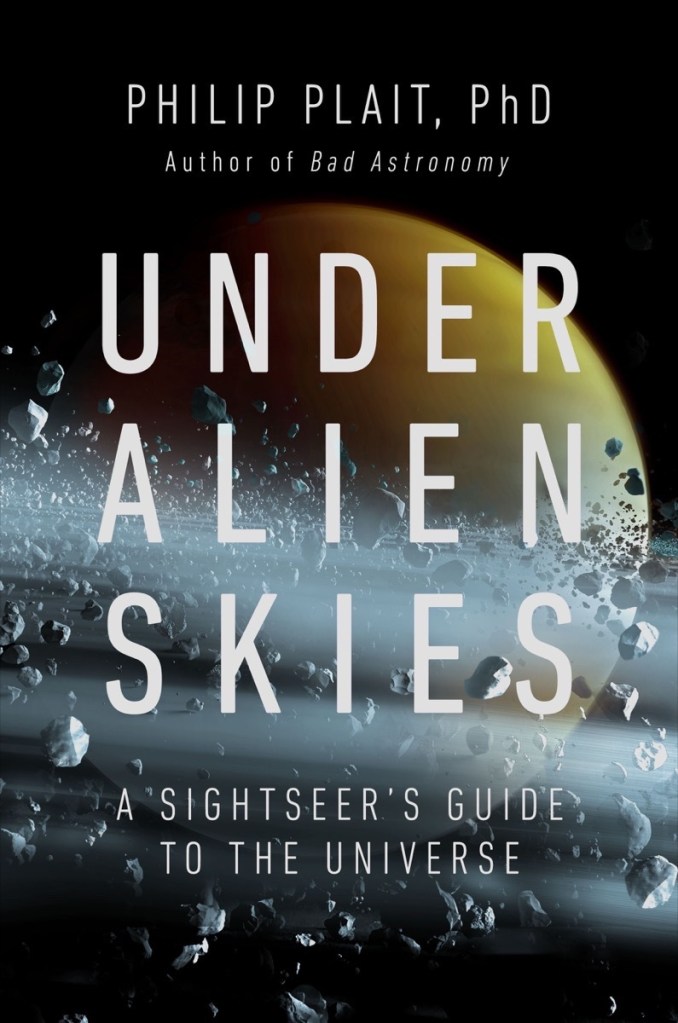
One of my favorite parts of reading and writing hard science fiction (and, for that matter, some of the more creative secondary world fantasies) is the ability to explore the what-if of fascinating alien worlds. Since the revolutionary realization that planets are commonplace in the galaxy, it’s almost become a matter of when we’ll find a planet matching some seemingly implausible set of characteristics, not if we’ll find it. We can imagine moons, gas giants, ocean worlds, ice worlds, worlds orbiting multiple stars, even worlds that are stars. It’s a simple matter in worldbuilding to hang an extra moon or two in the sky, but what does that really look like? What does it do to the system’s orbital dynamics? To the seasons, the tides, the evolution of life? Under Alien Skies tries to answer some of those questions, transporting the reader from our terrestrial cradle to stand beneath alien skies.
It should have been a picture book. There are a few pictures, mostly images taken by various spacecraft and probes, which provide interest but do not necessarily augment the textual descriptions, and there are a handful of orbital geometry diagrams, which are helpful but could have provided more detail and been included more frequently. What would most amplify the book, though, are accurate, scientifically informed artists’ renderings of the skies of which Plait writes. Personally, I would have paid extra for a version with those included. Even better would be if it also had animated diagrams of the various orbits, especially the more exotic ones. If books are not bound to print formats, after all, why should their contents be restricted to what can be displayed on a conventional, printed page?
Under Alien Skies should have been a picture book, but that doesn’t mean it fails in its mission as-is. Plait valiantly provides vivid descriptions of what it would be like to visit and experience alien worlds, from Earth’s Moon to distant nebulae, combining technical information and scientific accuracy with visceral descriptions, presented in a kind of science fiction space tourism framework. Even knowing most of the information already, I found the book enlightening for how it combines that knowledge to infer the human dimension of experiencing these distant and utterly foreign places. The book is at its best exploring our own solar system, particularly less popularly depicted places – getting away from the Moon and Mars to examine asteroids, comets, the Kuiper Belt, and the gas giants and their moons. Its efforts to be more adventurous are mixed: the depiction of a planet around a red dwarf star is insightful, the examination of exoplanets in multi-star systems is interesting if limited in the possibilities it explores, and the visits to more exotic astronomical phenomena lose something of that visceral, physical sense of presence which makes the earlier chapters so pertinent.
Pertinent is an apt word, for it was with a decidedly practical eye that I added Under Alien Skies to my reading list. Despite my recent decision to delay writing Rogue Planet until after I finish Golems and Kings’ novelization, I have every intention of writing that and more hard science fiction stories, of lengths from short stories to novels (I have several short stories which are out for consideration at various publications, and more published here on the site), and I want to depict the settings as accurately as possible. Sure, I probably have enough knowledge to piece together the considerations myself, but Under Alien Skies gives a prepackaged solution, not to mention a template for how to think through other alien worlds. Whether you want to play around with different orbital dynamics for your secondary world fantasy worlds, or you’re trying to write more realistic science fiction, Plait’s efforts compile the research for you.
Inevitably, there are outstanding questions remaining after reading the book. The most significant, in my mind, is that of perception. Our telescopes and scientific equipment have given us insight into what astronomical objects look like, but what would we really see if we could get up close to them? As stunning as the images from the James Webb Space Telescope are, for instance, they are in infrared light – that we can see anything in the images is because they are filtered and processed into the visual spectrum that humans can see. If we were to see such objects in person, they might look quite different than we expect. Another source I read suggested that future manned spacecraft will have to come with H-alpha filters to provide the passengers with the view they are expecting of the cosmos. Plait is obviously familiar with some of these questions, even deploying filters in some of his science fiction scenarios, but he never addresses it directly.
In a sense, Under Alien Skies is a science fiction book with most of the fiction (and plot) stripped away, extrapolating and speculating based on what we know and what we understand to provide us with vicarious experiences which we cannot have in reality (yet). While I read it through a worldbuilding lens, it has the potential to scratch that exploratory itch, to answer a little of the question of what it would be like to actually visit there, that so many of us have when we look at the spectacular images from the Voyager probes, or New Horizons, or the Hubble space telescope. Until we can visit such places in person (I’m working on it), this book, and the kind of thinking it features, might be as close as we can come to actually standing Under Alien Skies.
 IGC Publishing
One thought on “Under Alien Skies Review”