
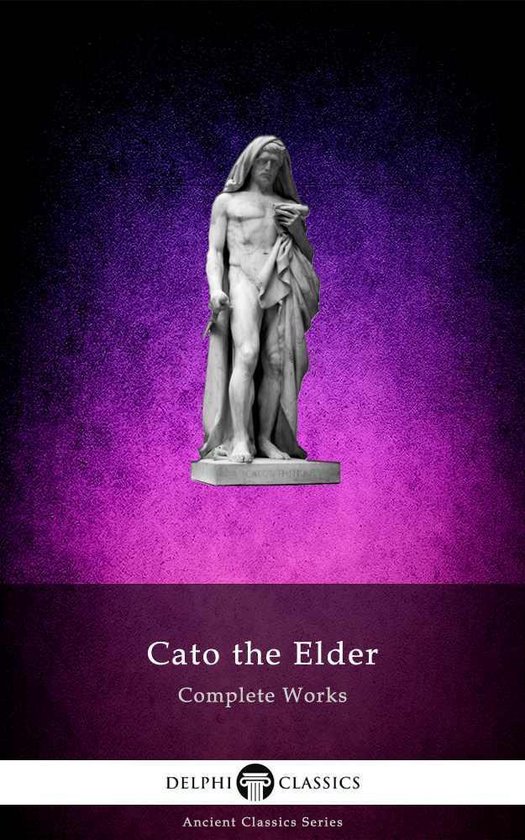
When we reviewed John Locke’s Some Thoughts Concerning Education, one of my major critiques was its lack of detail and specificity. With these ancient works, especially the ones that are not telling a story or myth, or exploring some atemporal idea, the value to me is very much in specificity. Such works can provide us insight into the texture and taste of life in times and places to which we no longer have access, which is valuable both from the perspective of seeking a deeper understanding of history, and to provide such depth and realism to stories. Certainly, Cato’s classic work has details in spades.
Pun intended, since this is a book about agriculture. To be specific, Cato is writing a how-to guide for running a Roman farm circa 150BC. Much has been said about the clarity and strength of his Latin prose, such that this slim volume of his writing is elevated to the status of a great classic alongside arguably more impactful works like Caeser’s Commentaries or Aurelius’s Meditations. Analysts and historians see evidence of classical religious practices, early stoic philosophy, and more in Cato’s writings about the proper curing of ham and how to care for cattle.
I don’t know about such pretentions. Not reading it in the original Latin, even if it is short enough that I read two translations, I can’t say I found much remarkable about Cato’s prose, though the writing was clear and cogent. Nor did I discern deep insights about early stoic thought from his descriptions about how to run a farm. No, the quality, and modern value, of the piece really is in the details. Some of those details could use footnotes, though, since terms have changed in meaning and/or are no longer in use. For instance, when a recipe calls for corn, I rather doubt that Cato was referring to what we today think of as “corn,” since I know from reading other ancient works that the ancient world often used a term which is commonly translated as “corn” to refer to all cereal grains.
Note: also, there’s a lot about cabbage. Seriously, Cato seems to think cabbage and all its byproducts are some kind of panacea to cure all ills and inspire virtue in the people. Eating it cooked, eating it raw, eating it steeped in vinegar, eating it with salt, eating it young, eating it old, macerating it and drinking the juice, putting a paste of it on wounds, growing a dozen different kinds of cabbage, bathing in the urine of people who eat a lot of cabbage…I had to go look and see if The Healing Hand had anything to say about the medical legitimacy of cabbage as an ancient cure-all, or if this was a peculiarly Cato obsession.
If there’s a bigger picture thought which On Agriculture prompted, it’s the problem of categories. In a section addressing illnesses and injuries to livestock, Cato recommended feeding cattle an egg. “But,” a modern reader might protest, “cows are supposed to be herbivores, which means they only eat plants.” We like making systems and ordering the world into categories, but nature has a tendency to defy those categories. It’s just not as neat as we can think it is from our typical daily isolation from nature. Those of us who still live on a farm, or who spend a lot of time outside, won’t be surprised by a deer eating a dead bird or a cow eating an egg – the surprise comes from thinking we know a thing because it was written down and put into a neat category on paper.
It is also interesting to note that Cato, like many of his Roman contemporaries, successors, predecessors, and others in different places and times well into the modern day, lauded the agrarian lifestyle as the pinnacle of human thriving. How much this view arises again and again because it has some substance which appeals to something innate about how humans interact with the world, and how much it endures because it is passed along from one civilization to another in our stories and ideas, is difficult to say with any certainty, but it certainly does appear and reappear all over the world and all over history (including the present day).
Mostly, though, this is a book of details. Some of them are even details you could use. There are a handful of recipes included, and while I don’t foresee making giant batches of hams by burying them in Roman salt anytime soon, and the cheesecake recipe was a little odd (plus, I would have to figure out what kind of corn and what kind of cheese is being referenced), the olive recipe actually looked rather intriguing. It could be fun to make a recipe from over two thousand years ago (and yes, I realize that basic bread recipes are pretty much all older than that, albeit with some variations). I certainly won’t be running a Roman farm anytime soon, but that doesn’t make Cato’s On Agriculture any less interesting.
 IGC Publishing
3 thoughts on “On Agriculture Review”