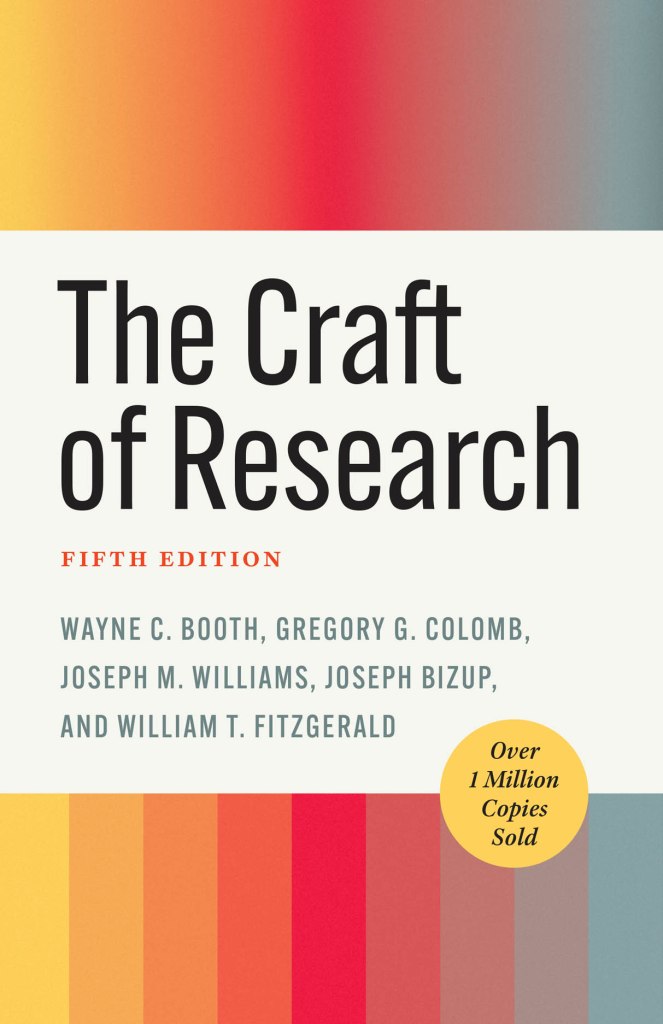
Coming from the hard sciences, “research” to me usually means the development, setup, execution, and analysis of experiments, which can subsequently be packaged into a report, whether a scientific paper, a conference presentation, or an overly academic and technical Tuesday post. The reporting of research is thus secondary to the research itself, though an important mechanism for sharing that research and contributing to the larger conversation on a particular topic. The Craft of Research flips that notion on its head, arguing that research in any field, from experimental physics to medieval art criticism, can be framed, understood, and executed from the perspective of the report (in any final form). A book ostensibly about the techniques of writing research papers thus contrives to be a book about the techniques of doing research.
I came across this book in the recommended reading section of a technical master’s degree curriculum, and I was prepared to skip it as being unnecessary for my current level until I noticed Booth listed as one of the authors. Having recently finished The Rhetoric of Fiction, with its splendid insights about seemingly surface-level aspects of writing, I supposed The Craft of Research to be in a similar vein, so I picked up a copy while shopping for used versions of a few other books from my reading list. The slim volume I read is the most recent edition, revised in 2024, which helps keep it from being outpaced by changes in technology which affect how research is conducted (one of my original concerns with a book about research originally published decades ago was that it would predate the advent of computer-based research tools, from search engines to word processors, much less natural language query search through large language models, which the recent revision mitigates). By the time I reached the first chapter, I wished I knew about the book years ago.
This is not an academic meta-study of research, nor is it a scholarly work examining different techniques of doing research; rather, it is a practical guide aimed mainly at beginning students and/or people new to doing their own, original research. It is commonly recommended for undergraduate and graduate students, but I would argue it should be taught in high school. That’s when I wish I read it, and when I think it would have been of the most use to me. As it is, I skimmed significant portions, not because they aren’t well-written, or contain valuable information and techniques, but because I’ve been conducting research of the nature the book describes for many years now.
The book suffers from two main weaknesses. The first is a didactic approach which sometimes edges into patronizing, presumptive, or preachy, acknowledgements that different researchers have different approaches and opinions on various matters notwithstanding. This doesn’t necessarily detract from the book’s utility, but it does make some of it less pleasant to read. More perniciously, the authors do not sufficiently consider the differences between different fields. While they do acknowledge that different types and fields of research have different standards and expectations, and may benefit from different approaches, the authors’ clear predisposition is towards research in fields like literature and history, with some input from the “soft” sciences. My experience with the hard sciences suggests some of the techniques the authors imply are universal have limited applicability as the research in question moves into areas like experimental physics, engineering, materials science, et cetera.
Even with these weaknesses, it is a valuable book, well worth reading for anyone who is engaged in, or plans to engage in, research in any field – or, frankly, if you plan to engage in any kind of nonfiction writing. The sooner you read it, the better. That is the source of my struggle with rating the book – for me personally, it’s probably a three- or three-and-a-half-star book, mainly because so much of it was not new to me, but for someone without research experience, it is easily a four and a half or even five star read. If I ever have the opportunity to teach a course that involves an introduction to research for a majority of the students, it will be built around this book.
 IGC Publishing
2 thoughts on “The Craft of Research Review”