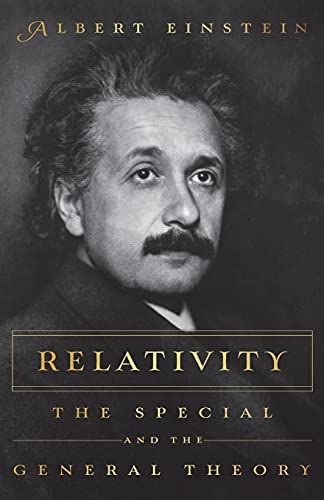
Since about the seventh grade, I’ve been studying relativity, trying to understand its nuances (and, in my more hubristic moments, look for ways to travel faster than lightspeed). A few years ago, I even found the original scientific papers which proposed the theories of general and special relativity and did my best to make my way through them (they were surprisingly readable, actually). Understanding relativity and all of its ramifications is both simple, and a lifetime pursuit. All of this is to say that I was surprised to find that Einstein wrote a book attempting to explicate relativity for the layman, which I somehow overlooked until it happened to be a Kindle special for just sixty cents.
So yes, this was an impulse buy, but I don’t regret it at all, and not just because it was only sixty cents. It might be a stretch to say that a book that includes Lorentz transforms, four dimensional abstractions, and non-Euclidean spacetimes is approachable for the layman, but Einstein really does come close. Especially in the sections on the special theory of relativity, you can work through the text and understand what Einstein is attempting to communicate without parsing the equations. Even if you’re already familiar with both theories of relativity, there is a good chance you’ll learn something new from reading Einstein’s book.
The term ‘genius’ is thrown about very casually these days. I’m sorry, but the plan you came up with at work to save ten manhours a day isn’t genius. Einstein, though, even in a book written for a non-specialist audience, is a clear genius. It is reflected in his unpretentious prose that can make logically obvious concepts that remained unexplored for centuries before Einstein came along to point them out for us. Despite the saying that ‘those who can’t do, teach,’ it takes someone who truly and deeply understands a concept to teach it in a way that anyone can approach. It shouldn’t be a surprise that Einstein has that understanding of his own theories, and yet, after reading so many, dare I say inferior, accounts and explanations of them, it was remarkable to find it laid out in such plain terms.
Many misunderstandings exist surrounding the theories of relativity, and after you read Relativity, you might wonder why. Einstein renders the special theory’s claims and precepts so self-evident that you not only need not understand the mathematical equations he supplies; you will be able, so long as you are paying attention and taking your time, to visualize what is meant by relative reference frames, and why time passes differently at different relative velocities. The clarity of the book’s explanations is such that I wish I knew of its existence back when I first began to study the subject.
When Einstein says that he’s writing for the layman, he mostly means that he wants the subject to be approachable by someone without a rigorous grounding in advanced mathematics or theoretical physics. He certainly accomplishes that in discussing the special theory, but the general theory is another matter. It is significantly more complicated, and requires an understanding of complex geometries, such that I do not know if it can really be said to be understandable by the average person, at least not without significant effort. That effort would be worthwhile, though, and you would get to read about spacetime mollusks.
Even if you think you have no interest in theoretical physics and that the theory of relativity has no relation to you or impact on your life, I still think you should consider reading this book. It’s relatively short, although it should take you some time to read it if you’re taking the time to understanding what it’s attempting to communicate. More importantly, especially the sections on the special theory, there is application in the ways it forces you to think that go far beyond applications of theoretical physics. Besides, there has perhaps been no more significant theory promulgated in the past century than the theory of relativity (although components of quantum mechanics might rival it). With that in mind, I hope you give this relatively approachable physics text a read soon.
 IGC Publishing
13 thoughts on “Relativity Review”