
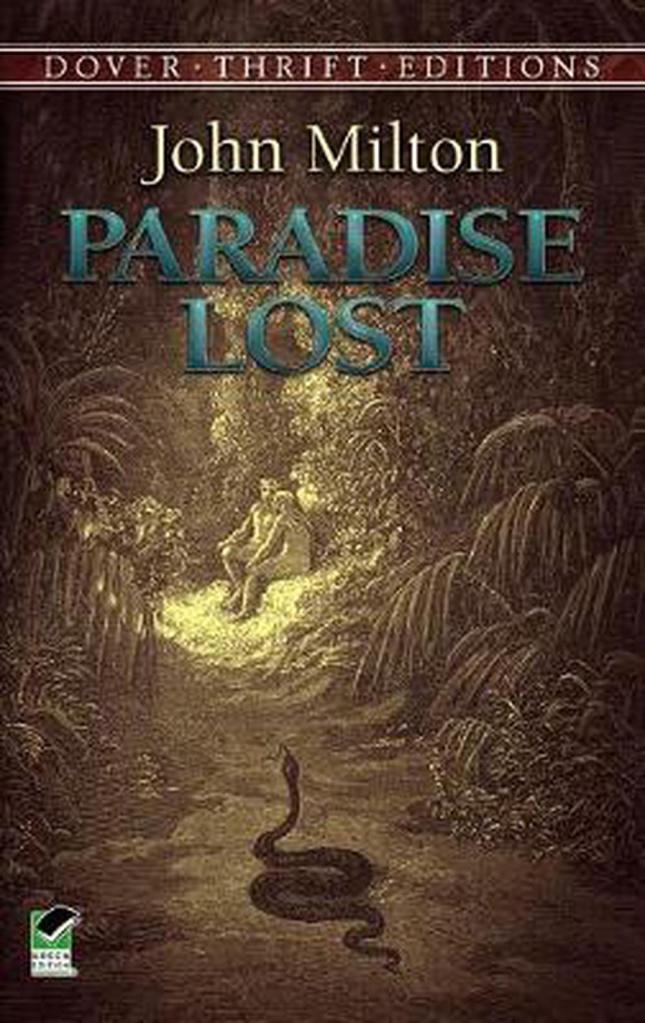
Knowing that Paradise Lost is a seventeenth century religious poem about the fall of man, I had certain expectations going into it. I expected it to be full of lamentations about man’s miserable slavery to sin, that it would follow Adam and Eve after they are cast out of Eden, and that it would be full of brow-beating religiosity delivered through opaque poetic lines and references. Best case, I anticipated something akin to Dante’s Divine Comedy; worst case, something almost unreadable, like Pilgrim’s Progress.
To my great surprise and pleasure, Paradise Lost defied my expectations and put itself alongside the Divine Comedy. Rather than focusing upon Man, much of the poem actually focuses on Satan and the Fall, even reminding me a bit of Good Omens in its depiction of that event. There are points where Milton almost seems to forget whose side he’s on, depicting Satan’s cause as, if not defensible, at least understandable, which goes a long way towards keeping the poem from deteriorating into a religious polemic.
Nor is it bogged down by overly convoluted prose or opaque poetic forms and references. Oh, you need to know your Bible, and a good bit of ancient literature, but after all of the archaic texts I’ve consumed these past few years I felt that I managed to understand most of the references. As for the poetry itself, I found it unexpectedly readable once I established the rhythm, and even had to catch myself from speaking like an old English poem to my work colleagues (as much as I’m sure that they would have enjoyed that experience). It almost tempted me to try my hand at a sequel: Paradise Found. I caught myself before that point.
An interesting note: the word “pandemonium” was actually coined by John Milton in this book, as the name for the city of demons, from “pan” meaning all, and “demonium” meaning place of demons. How it evolved to describe a state of noisy chaos is not too difficult to imagine.
Paradise Lost honestly read at points more like genre fiction than like a piece of classic religious literature, and I do not in any way mean that to be construed as an insult. We have a semi-atemporal heaven populated by inhuman beings in which Satan is God’s chief lieutenant until God gives the position to his Son, which so offends Satan that he decides to rebel. Satan doesn’t do this alone, though; he enters a conclave of disaffected deities including the various gods of death and darkness from a variety of religious and mythological traditions quite aside from Christianity or any Abrahamic faith, and fully a third of heaven’s host joins his cause. There’s an epic battle between immortals, with magic weapons and flying phalanxes of saints (though how there were saints to fight before humanity was even formed is something of an unanswered question), and Satan and the archangel Michael engage in a dramatic duel wielding enchanted swords…it really does evoke epic fantasy more than religion (then again, there’s a passage in the Bible where God summons an necromantic army – an actual army of the dead – to protect the Israelites, a passage which I’ve always thought is deserving of more attention than it gets).
The Son takes the field, the rebels fall…and God creates the Earth, and humans, as a way of re-peopling heaven after the war. Only now does mankind enter the picture, in the form of Adam, a whiney, entitled brat even before he eats the world’s most powerful apple, and later Eve, whose occasional sparks of real personality are dismissed as early signs of her lesser station in creation and eventual doom and gullibility.
Now, you long-time readers know that I am a strong proponent of reading historical works, and history itself, for their own contexts. We talked about this in our review for Mysteries of the Middle Ages, and I stand by that, so I would like to emphasize that I don’t consider this following a reason not to read the book; however, I do have to say that I found Milton’s characterization of Eve, and women in general, rather uncomfortable. Even beyond being blamed for the fall of man and the loss of paradise, despite that the serpent, possessed by Satan, offered some very convincing arguments and Eve was entirely unfamiliar with the possibility of deception, Milton consistently characterizes women as simultaneously devilish manipulators of victimized men, and passive vehicles for evil. He seems more inclined to question God’s decision to curse all snakes because one was possessed by Satan than he does to question the justice of blaming all the evils of sin on Eve and every other woman to ever exist.
That’s a shame, because so much else about Paradise Lost is truly enjoyable (and one wonders why the religious thinkers of that time and context were so eager to scapegoat women, rather than affixing the greatest portion of the blame to Satan). Even the somewhat contradictory view of free will Milton professes is more interesting than off-putting, or at least thought-provoking. This one is well deserving of its “classic” designation, and I enjoyed it far more than I expected, beyond its historical and cultural interest. Paradise may be lost, but it makes for far more interesting and exciting literature that way, which is why I hope that you read Paradise Lost soon.
 IGC Publishing
5 thoughts on “Paradise Lost Review”