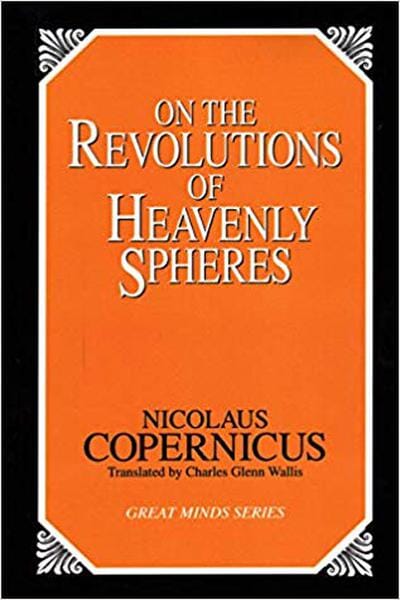
After my somewhat lackluster experience with Carnot’s On the Motive Power of Fire, I almost removed books like this one from my reading list. In the case of Copernicus’ On the Revolutions of the Heavenly Spheres, I’m glad that I did not, because this brief text – practically a pamphlet – was fascinating on several levels: historically, culturally, mathematically, scientifically, and conceptually. It also prompted yet another minor epiphany regarding how we teach and understand history, which we’ll be discussing at length in another post.
Beginning with letters of support for the work from prominent church leaders and including Copernicus’ own defense of his work, the reader is reminded that the idea of the Earth being mobile and not the center of the universe was not initially a source of enormous public controversy; it was a source of academic controversy, like an esoteric debate about whether loop quantum gravity or string theory better provide a quantum scale explanation of gravity. We also learn that, like almost everything (apparently), the Greeks did it first – Copernicus cites several Greek thinkers who proposed that the Earth moved and was not the center of the universe, albeit overshadowed by Aristotle and his crystalline spheres, and later Ptolemy. Still, none of them proposed quite the triplicate motion that Copernicus describes, and none of them presented it in a way that was as convincing as Copernicus’.
In fact, the greatest strength of Copernicus’ heliocentric model is its clarity and elegance. He is not saying whether or not his model is reflective of reality, or trying to explain why the cosmos behave the way they do; he is simply proposing an alternative way of modeling the movement of the heavens that provides simpler and more accurate predictions than the Ptolemaic model with its epicycles and other contortions. This is key, because in that sense the debate is all about reference frames. Indeed, depending on how you define your reference frame, you could put the Earth at the center of the universe with everything else revolving around it, and you would still successfully describe reality – it would just be far, far more complicated than describing those motions with respect to a reference frame with the sun at the origin. This is, then, a geometric argument, not a physics one.
No wonder, then, that Copernicus spends about half his text referencing Euclid’s Elements (and I’m glad that I read it before so that I could catch those references). The first half of the text lays the groundwork and justification for his proposal, and the second half establishes the geometric proofs by which he determines, with remarkable accuracy, the motions of the planets. With a basic grounding in geometry, I do not think you will struggle to understand his logic, even if you might not be able to replicate it.
That the sun lies at the center of the solar system with the planets moving about it and the whole arrangement determined by gravity seems obvious to us today, but that is because we are surrounding by depictions of the solar system in that configuration. Don’t allow those preconceived notions to lead you to underestimate the significance of what Copernicus did with On the Revolutions of the Heavenly Spheres; in its way, it should be considered as paradigm-shifting as Einstein’s relativity, because it similarly forces readers to approach something commonplace from a completely different perspective, presenting as obvious something that no one before managed to connect. I try to imagine looking up at the sky, and at tables of measurements taken painstakingly and with varying accuracy and precision over centuries, without any pre-existing image in my mind of the solar system’s arrangement, and I wonder if I could have had the imagination and perspective necessary to conclude that my own perspective should not be the origin of my calculations.
Yes, this piece is of particular interest to me, given my chosen profession, and doubtless that colors my opinion and experience with it. That aside, it is a clearly written piece that offers excellent (and nuanced) incite into a form of scholarship that predates the rise of the scientific method (there is far greater emphasis on rationalist approached than empiricist, for all that empiricism plays a role, and aesthetics even come into play). Not to mention its significance in the history of our understanding of the universe. Without Copernicus, it can be argued that Newton, Kepler, and Galileo may never have made their own enormous contributions to astrodynamics. By reading it, you can be a part of that history. Even if you’re not the center of the solar system.
Note: since Copernicus, physicists have now come full circle, and assert that, since the universe began as a single point and expanded infinitely outward in all directions, every point is the center of the universe. Hence the old joke: “some people think they’re the center of the universe; physicists know it.”
 IGC Publishing
5 thoughts on “On the Revolutions of the Heavenly Spheres Review”