
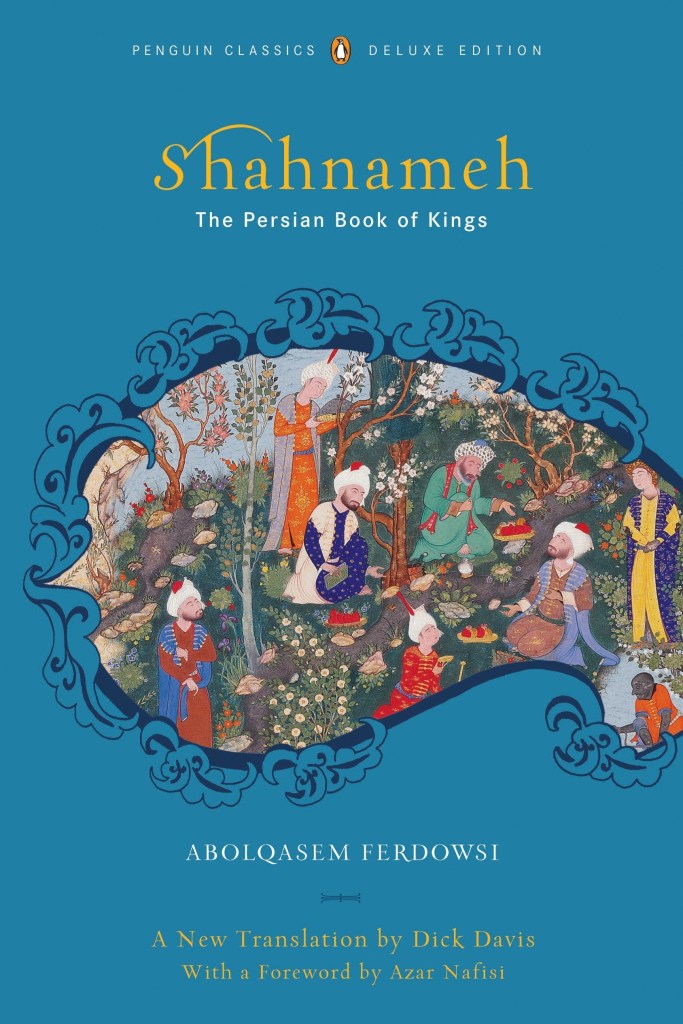
When I set out on my tour of ancient world literature, I had in my head that it would be a finite endeavor, a journey that would take me perhaps a year to complete, and then I would return to reading other things. At the time, I could only identify a handful of core, “classic” works that I knew I wanted to include, so this seemed reasonable. Before I even left Europe, where my first ancient pieces came from, I’d accumulated several more pieces on my list, and that trend has continued, so that now I suspect that I will never run out of ancient literature to read. The most recent was Shahnameh.
The ”Persian Book of Kings” is sometimes described as the Persian Iliad which, after reading it, I think is a terrible description. Shahnameh is far less narrative, and it is as much a history book as it is an epic. The original is poetry, but the version I read in translation was prose, with a few sections put into English verse. Maybe the banality of the translation contributed to my conclusions about the book, but I found that Shahnameh was not very engaging. It lacked many of the unique cultural elements that I seek in these kinds of works, and it felt, in many ways, like nothing new.
Not that I’m intimately familiar with the history of Persian kings, except insofar as they interact with other cultures, like the Greeks. No, the specific contents weren’t unoriginal, but I kept thinking as I read it that it echoed many of the other ancient works I’ve read. Maybe I would have found it more engaging if I’d read it before other pieces of similar ilk. It wasn’t boring, it just…echoed with other books.
Shahnameh covers some thousand years of Persian kings, and in so doing captures a unique view of kingship that is difficult for a modern reader to grasp. In this view, kings are at their best when they are luxuriating in the trappings of greatness, making obvious their wealth and power. It is a way of emphasizing their place in the world, perhaps, and putting them on another plane compared to ordinary people. Whereas today we view it as most right and moral to emphasize the equality of individuals and the opportunity for anyone to achieve a given position, for most of history (and, apparently, especially in Persia) such a view would have been considered dangerous and disruptive. People took comfort from the idea that certain people are meant to be in certain positions. It provided a level of certitude in a dangerous and uncertain world, to the point that at various points heroes and other figures in Shahnameh refuse to depose the “rightful” king despite his being combinations of unjust, vain, incompetent, and plain idiotic.
As you might expect from me, I found the earlier portions of Shahnameh, which are more legendary in character, more interesting than the latter portions, which are more historical. Stories of Rostam fighting demons, armies, and generally depending on his super-horse to accomplish his great deeds are similar to a lot of other, similar tales in other cultures, but are still enjoyable to read, and it was intriguing to watch as this warrior who saves his kings and all of Persia single-handedly on a regular basis refuses to take power for himself no matter how incompetent, unjust, or insane his king becomes. This is a common theme, that the greatest figures are not the king, which suggests a “power corrupts” theme, despite the persistent reverence for the greatness of kings.
As Shahnameh becomes more historical, it draws in figures like rulers of China, India, Greece, and Byzantium. Alexander the Great’s appearance is fascinating (called Sekander in this telling), and the holistic effect is to emphasize how significant Persia is in world history, serving as a kind of crossroads for the world, from Egypt to China and beyond. Persia’s influence gradually diminishes, though, and Shahnameh chronicles a series of increasingly poor rulers who oversee and exacerbate that diminution. While there were larger historical factors at play, the quality of the kings by the end of the book is far less than the legendary figures at the beginning. Perhaps that is always, inevitably, the case.
Today, the Persian region is associated with Islam, and especially some of its more extreme, destructive forms. I had hoped that Shahnameh would shed light upon how Islam came to the region, why it came in the way that it did, and what makes certain forms of it so influential there, but the book rather glosses over the event. One moment the kings are espousing Zoroastrianism, and the next they’re determined to ensure everyone converts to Islam at the point of a sword. We get a tiny view of the tension this induces between the legacy figures and the newly converted Islamic rulers and nobles, but no significant exploration, and the book seems to shy away from confronting the issue too directly.
Hardcore History’s “King of Kings” series attempts to explore a little of what the Grecco-Persian Wars would have been like from the perspective of the Persians. Shahnameh doesn’t capture Xerxes, but it does something similar, providing us with the Persian perspective on world history that we usually tell from other perspectives, like that of Greece, China, India, Byzantium, of Egypt. It was a worthwhile read, even with my reflections that it began to feel redundant with other historical works. Perhaps that speaks to the enduring nature of certain stories that we tell ourselves and why we tell stories in the first place.
 IGC Publishing
7 thoughts on “Shahnameh Review”