
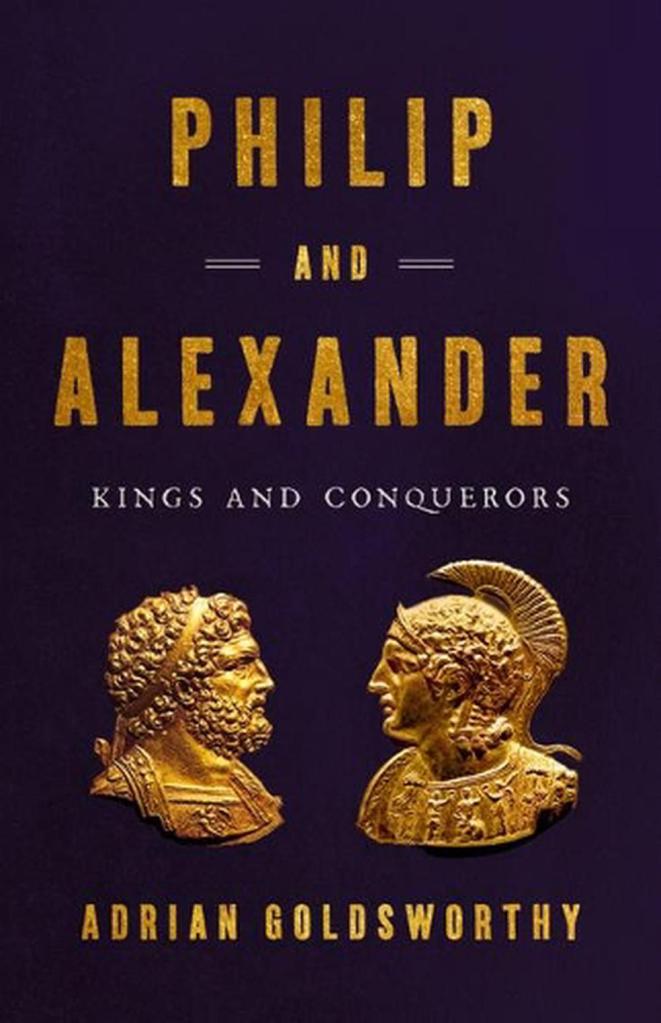
Surprise – I’m reading an actual history book, instead of a book from history. Don’t worry, I’ll be reviewing Thucydides’ history of the Peloponnesian War soon, in a return to form. I could have read about Alexander the Great from one of the many historical sources who wrote about him, either contemporaneous with his campaigns, or within a few centuries, but such ancient works tend not to capture what I hoped to find in Philip and Alexander: an exploration of both kings’ reigns, and how the one informed the other.
Goldsworthy’s text is somewhere between a genuine, scholarly history book, and a history book intended for a lay audience. It does have footnotes and references, and it does allude to some of the scholarly debates around certain events, but is not as rigorous as a more scholarly treatment might be. This is a feature, not a flaw, and I found the book an engaging and informative read. From an historical perspective, my only real gripe is that Goldsworthy at times might be too inclined to generalize and to present a “right” sequence of events after discussing all of the doubt and uncertainty around what really happened. At least there is that acknowledgement of uncertainty; some works, which might be presented as more “scholarly” and “rigorous” fail to do as much, attempting to convince the reader of the validity of the position by presenting it as indubitable fact. This is especially common in history, where so many of the details are speculation and extrapolation.
While I’m sure Goldsworthy is not the first to combine a discussion of Philip and Alexander, the practice is not as common as one might imagine, which is a shame considering how well it works here, and how interrelated the two rulers are (and I don’t mean in a genetic sense). Discussing Philip first provides important context for Macedon and for its kings’ traditions and customs, which will later inform an understanding of Alexander that makes rather more sense, in my amateur opinion, than interpretations based on retroactive psychoanalysis across twenty-five hundred years. Plus, Philip is a fascinating figure in his own right, in some ways accomplishing more relative to his starting position than Alexander did, and certainly doing it in a more durable and prudent way.
When Philip dies, he has transformed Macedon from a provincial backwater to a Hellenic powerhouse, with an experienced, highly drilled army poised already for an invasion of Persia. Alexander has only to spend some time securing the throne, killing off relatives (a venerable tradition for Macedonian monarchs), and convincing people that he is as worthy of respect and fear as his father before he can take that army and set off on the conquest that made him famous, driving into Persia, deposing Darius III, and continuing on into India before his army has finally had enough and insists that they begin heading for home.
Where Philip took, if not a thoughtful approach to conquest, at least a more deliberate one that involved securing his gains and ensuring stability, Alexander conquers a far vaster territory without much idea of how to administer it (if, indeed, it could have been effectively administered given the communication methods available at the time). He therefore leaves much of the Persian and local structures in place, causing consternation in his Greek allies. Goldsworthy does a fine job of exploring these dynamics, and the role of a Macedonian king – while Alexander’s authority is unquestioned, it is clear that his power is not absolute and that he is expected to make due consideration for his people.
Philip and Alexander can sometimes read like a protracted string of marching-marching-marching-battle!-marching-marching-battle!-marching-marching-marching-marching. It is difficult to tell how much this is Goldsworthy’s chosen emphasis, how much it is because that is what our historical sources recorded, and how much it is because both monarchs spent most of their lives doing exactly that. Countering this weakness, one of Goldsworthy’s strengths is the exploration of ancient battle dynamics. Even if some of his conclusions are surely speculation, they do paint a rather different picture of ancient battles than what you might imagine from movies or historical fiction, like the relatively lower casualties in most battles, even major ones, at least on the part of the victors, or the level of violence that often followed for the losers, or how slow most of the battles were. Also, for all the fighting and marching is almost constant, it is notable that Alexander only fought maybe four hugely significant battles during his entire conquest.
In the wars of the past few centuries, rarely was the head of state also a direct leader of battles, and certainly such figures were not charging into the thick of the melee and demonstrating their personal martial prowess, courage, and heroism. It is sometimes easy to forget that this was not always the case. For Philip and Alexander, leading a battle didn’t mean sitting on a horse and directing troops – it meant charging at the head of the infantry. An instance when Alexander ends up inside an enemy’s walls and fighting for his life, with only a couple of bodyguards, while the rest of the army is still trying to break in, really emphasized that point.
As always, I read this sort of history book with an eye towards the stories it might inspire, or the story elements that I might like to include to make more own writing more realistic. Between reading this, Xenophon’s story of the ten thousand, and various other pieces from this region and time period, I am intrigued by the idea of doing a soft science fiction riff on some of these ideas. We’ll see if that goes anywhere.
In the meantime, this was a pleasant and informative read, offering a compromise between full scholarly rigor and the lackluster treatment of most approaches intended for the lay reader. If you’re interested in this time period, or just in knowing more about one of history’s most famous figures (many people have been titled “Great,” but Alexander is one of the few to whom it seems to stick), Goldsworthy’s Philip and Alexander is a worthy place to start.


5 thoughts on “Philip and Alexander Review”