
When I first read The Name of the Wind, I think it took me about three days to finish the entire book. Granted, at least one of those days I seem to recall was mostly spent sitting in an airport waiting on a badly delayed flight sometime around the beginning of January, but still, the point is that I devoured the book. Rothfuss’s debut novel is replete with rich worldbuilding, complex characters, and evocative language which sometimes acquires an almost poetic quality. It’s one of my favorite fantasy novels, and the sequel, The Wise Man’s Fear, suffers not at all from second-book syndrome, living up to and in some ways surpassing the original. Yet, no reviews for these books exist on the site, because I don’t intend to reread them until the final book in the trilogy is released. When that will be is anyone’s guess. It’s been fifteen years as of this writing since the second book was published, and there are conflicting reports about Rothfuss’s progress on the third book…which is as far as I intend to take that discussion here.
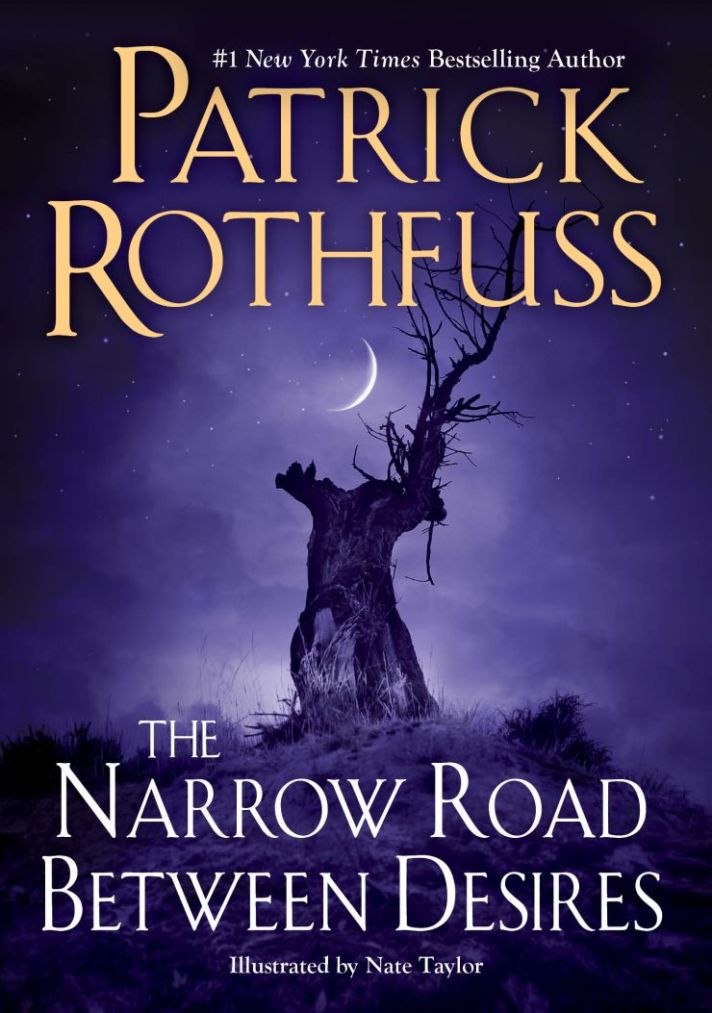
Since the publication of The Wise Man’s Fear, Rothfuss released two novellas set in the same world as the rest of the Kingkiller Chronicle, but not directly plugged into the storyline. The Slow Regard of Silent Things was an enjoyable, slightly eerie piece when I read it. Now, only a couple years after its publication, I got around to reading The Narrow Road Between Desires as a kind of palate cleanser after finishing The Wayfinder. It has the same attention to the language as the other works, but there is something missing to the story itself. It feels…hesitant. Hesitant, meandering, somewhat empty. According to the author’s note, that’s intentional.
Rothfuss’s author’s note relates an anecdote about his kids asking for a story of the big good wolf instead of the big bad wolf, which apparently led him to this whole moral agonizing over why stories are centered around conflict, and can a good story be written in which there is no conflict, and a realization that Bast, one of his characters, is an example of a “big good wolf” character. I’ve thought about whether stories must revolve around conflict, too – I suspect every author does at some point – and I enjoy stories which are quieter, lacking in the high stakes and violent conflicts which so often characterize genre fiction. There is a difference between a quiet story and one lacking in conflict, though. Even The Narrow Road Between Desires is not free of conflict, despite what the author’s note implies. It’s just the nature and scope of the conflict that changes from story to story.
What’s missing from The Narrow Road Between Desires is not conflict, or higher stakes, but a point. It never gives the reader an answer to the question “why am I reading this story?” There’s a bit of a plot, mixed in between Bast idling away his day, though the reader is left at the end without answers to many of the questions raised throughout the story. Not all questions have to be answered, but one that should have been is Bast’s motivation. We get hints and suggestions, but it’s never really revealed why Bast feels the way he feels or acts the way he acts, either to himself or to the reader. There is a motivation there, but it’s not explored for the reader or the characters.
As in his other works, Rothfuss’s prose is deliberate, clear, and evocative. You can almost sense the care with which he chooses each word and description. This time, though, I noticed certain repeated sentence structures and a lack of more complex constructions which I recall (perhaps self-deceptively in that way memory can play tricks on you) pushing the writing in The Name of the Wind into the realm of “beautiful, compelling” prose. There’s a strange preoccupation with physicality, too, which give the descriptions an odd overtone which seems mismatched with the plot’s focus and out of place in the story.
I didn’t mind it, and I appreciated the resolution and some of the cleverness on display towards the end, but the story wasn’t satisfying. A story can have a quiet plot, a low stakes conflict, a small scope, all while being substantial. Substance is not the same as stakes. The Narrow Road Between Desires lacks substance and stakes. It’s not a bad story, but it doesn’t do it for me.
 IGC Publishing