
Pundits, social scientists, politicians, and those who follow politics like fans follow sports teams are always referencing the political spectrum. Positions and people are described as “far left” or “far right,” though of course the majority of people default to an assumption of the moderacy of their own positions (regardless of the reality). In truth, the political spectrum is not so much a spectrum, a line extending from one extreme to another. It is more of a political circle. Just like a circle, at some point as you keep heading to the left or to the right from a central starting point, you’ll end up converging. For politics, both “sides” converge upon authoritarianism at their extremes. Machiavelli has something to say about that, and so does Lord Acton.
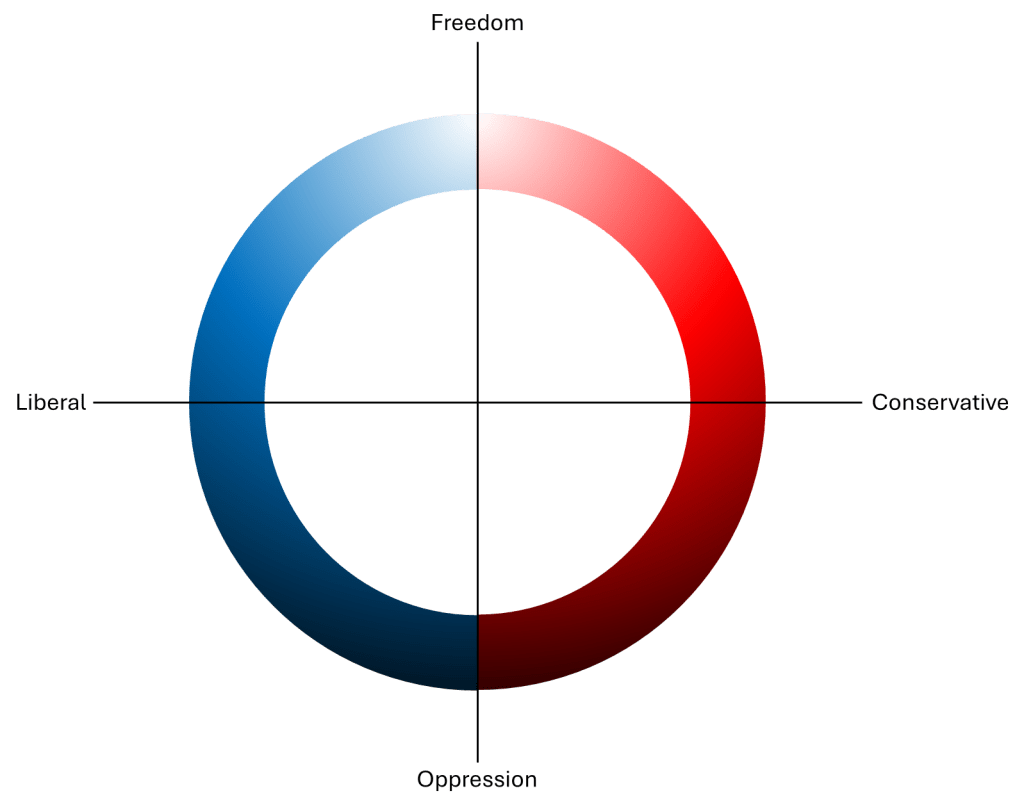
I don’t bring this up because I’m trying to transform my website into a political platform (I mostly try to avoid politics in the common sense of the word), but because it is germane to today’s book review, for We. In recent years, the media most of us consume have been dominated by narratives about the dangers of far-right ideologies, with analogies to Hitler proliferating, and warnings of the dystopic, authoritarian path we could suffer. The source of the concern changes, but the concern itself does not. The twentieth century contained ample demonstrations of the dangers and human tolls associated with both extremes of political dictatorship, from the depredations of Stalin’s Russia and Mao’s China to those of Hitler’s Germany. Nor need examples be confined to the past, as plenty can be found today.
There is a certain subversive quality, though, to the ideologies belonging to the bottom left of the chart. Perhaps it is how they dress themselves, the history behind them, something about democracy, or the particular travails of industrial and post-industrial civilizations, but left-born authoritarianism seems to achieve a place of acceptance more readily than the same tendencies on the right. They seem somehow more able to dress themselves in widely appealing garments, the trappings of freedom and democracy, than their right-born counterparts. We fear right-born dictatorships in the way we might fear a powerful predator or a threat we know exists but do not know if we can successfully defeat. We dread left-born dictatorships like a pernicious cancer creeping into our midst and subsuming us before we quite realize what is happening.
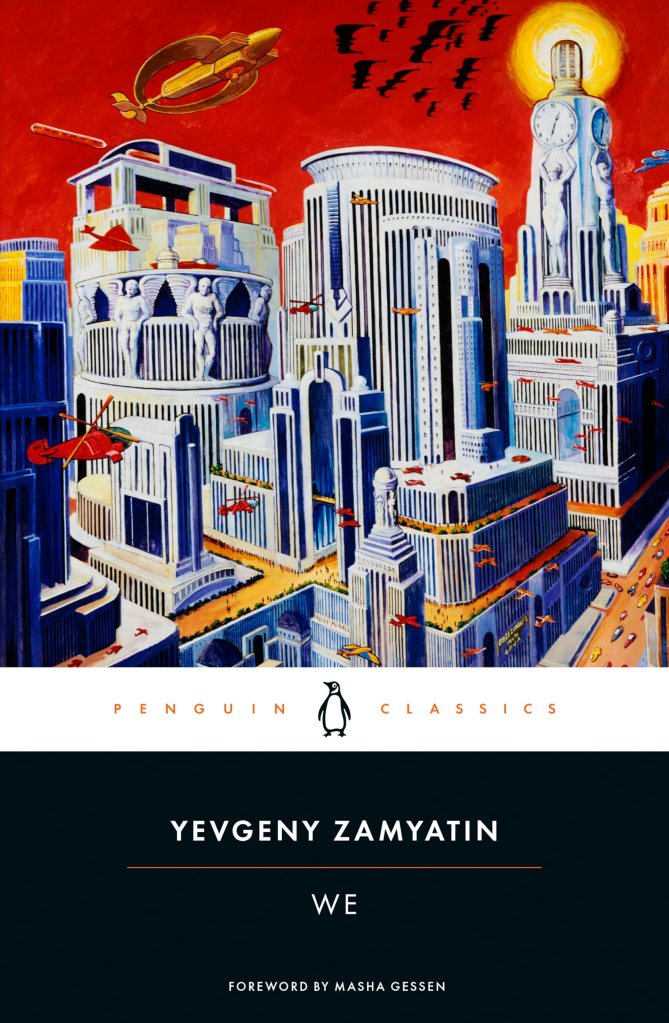
1984 is probably the most famous and widely read warning against this kind of danger, alongside Brave New World, but it was not the first. Before Orwell and Huxley wrote their dystopic visions, before Rand engaged with collectivism’s dangers, Zamyatin wrote a science fiction novel which inspired all of them. In 1924, the Russian author wrote a book so subversive to the Soviet system that it took more than sixty years before it was allowed in the country of its origin. It’s often described as predicting the worst depredations of Soviet and Chinese communism, a brilliant statement of the power and importance of individual freedom.
It could also be described as a story about the midlife crises suffered by corporate middle managers. An apparently middle-aged man with a stable job and stable relationships meets an excitingly rebellious woman who tantalizes him with intrigue and danger, shattering the accepted order of his prior life and forcing him to question his acceptance of the status quo.
Zamyatin presents his story in epistolary fashion, the chapters representing entries in a sort of diary the protagonist keeps for the purpose of lauding the enlightenment of the United State and its policies to whatever (presumably more primitive) beings should read it. It’s set almost a thousand years in the future, in a carefully controlled glass city isolated from the offensively disorderly outside world, where the protagonist is engaged in building a spaceship to conquer other planets and bring their inhabitants the same benefits attendant to the United State. People have alphanumeric designations instead of names, they follow identical, masterminded schedules each day, and they live in transparent, glass apartments in which the only privacy they are allowed is for hour-long scheduled intimacy sessions twice a week.
Even in translation, Zamyatin’s prose has a poetic quality. This helps convey the confusion and passion gradually overtaking the protagonist as he comes to an understanding of his own individuality (and/or as he goes through his midlife crisis), admittedly sometimes by making the contents confusing to the reader, too. This always feels in service to the story, so I consider it a feature, not a bug. The protagonist is a mathematician, and he often attempts to explain and describe using mathematical references and analogies, which works splendidly on so many levels: worldbuilding for the mindset of the United State, character development for the protagonist, a kind of poetry through which the reader can better appreciate the story. As always, I cannot tell you how it might read in the original Russian, but the translation I read did fine justice to the story.
I don’t read many dystopian novels. They’re usually not to my taste, and they are often overdone, overstated, polemical, and many of the modern ones contain contradictions the authors do not care to acknowledge, or questions they do not care to confront. However, when done right they can serve as important warnings while also being compelling stories. We is just such a novel, effectively capturing that sensing of creeping dread which accompanies the gradual erosion of the individual into a single United State. After being oppressed by both the Tsarist and Soviet regime, Zamyatin knew tyranny from both sides of the circle. Perhaps that is why his work, for all it is science fiction, reads true a hundred years later.


One thought on “We Review”