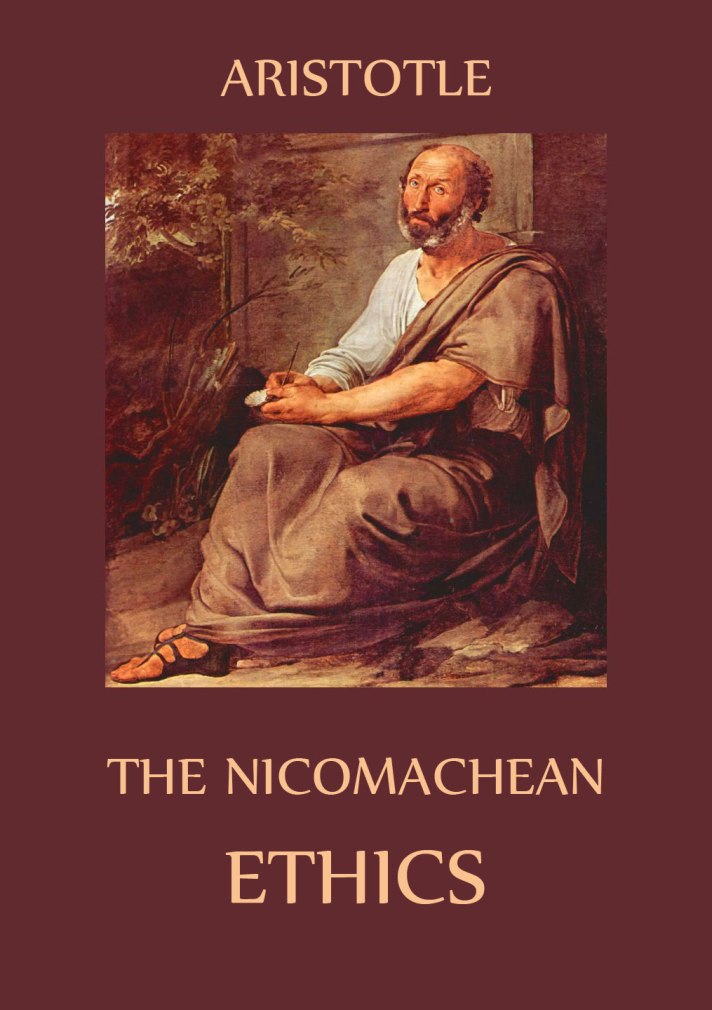
Despite this review being posted long after the popular imagination has moved on from the summer Olympics, I did, in fact, reread Nicomachean Ethics back in August, in honor of the Olympic games. After all, Aristotle was Greek, and the original Olympics games were also Greek…which is about as far as my reasoning went. That, and it’s been awhile since I last read Aristotle’s core text on ethical thought. After reading philosophers’ ideas of morality and ethics from Plato up to Camus, I remain convinced that Aristotle’s core idea – virtue is the mean between two vices – is the most insightful, and the most useful, standard of ethical behavior we as humanity have.
In modern books, philosophical or otherwise, authors/publishers tend to structure them in such a way that the main idea is presented, the book spends most of its time justifying or deriving that main idea in order to convince the reader of its validity, capped by a conclusion restating the main idea in even more definite terms. Aristotle’s writings, and Greek writings in general, are less in the business of convincing (with the exception of pieces of rhetoric, such as a few famous Greek speeches which have survived from Alexander’s time) and forgo such derivations in favor of explanations. Aristotle says almost from the first line of Nicomachean Ethics that virtue is the mean between two vices, and launches into, not a derivation of how he arrived at that conclusion, but an extensive exposition of the implications of that axiom. If you read his Organon, this pattern will be familiar to you.
In essence, Aristotle’s argument is that any trait taken to an extreme is a vice. Some of his discussions can become semantical, but he makes insightful observations throughout, including by highlighting certain states of being, in the form of vices, which are so rare as to lack specific words to describe them. Indulgence is the vice on one end of temperance, but what is the vice on the opposite side? That it cannot be so easily named does not mean it does not exist. It would be an extreme form of thrift, perhaps. Regardless, an entire book exploring what seems a relatively straightforward idea is not a waste, by any means.
However, it is the core idea’s relative simplicity that makes it so attractive, significant, and influential. Even the least philosophically or mathematically inclined amongst us can clearly visualize what is meant by the idea that virtue is the mean between two vices, identify cases in our own experiences, whether personally or in our observations of others, and determine ways and means of applying this ethical standard. Kant’s deontological “conduct is right insofar as you should desire that it become universal law” may be deeply insightful and quite cogent, but its succinctness disguises a complexity that makes it unapproachable in many cases, and furthermore it creates such a high definition of right conduct as to be impractical for application in our own lives.
Moreover, the book remains relevant, in almost all cases, despite the intervening thousands of years. A few parts show the context of their times, but the vast majority is as applicable to the modern world as that of ancient Greece. This contributes to its endurance. Of all the Greek texts to which we are fortunate enough to retain access, this is surely amongst the most significant. If I had to choose one Aristotelian work to recommend everyone read at least once in their lives, it would probably be Nicomachean Ethics.
 IGC Publishing
6 thoughts on “Nicomachean Ethics Review”