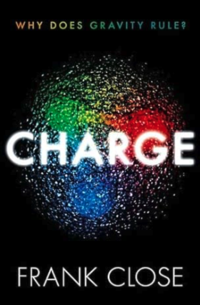
Maybe I’m looking in the wrong places, but I find it’s difficult to identify truly satisfactory science books. Medicine is something of an exception, but even looking at recommendations appearing in scientific journals reveals mostly books written by journalists about some headline-grabbing science, not books written by scientists about their area of expertise. That might be adequate for the interested lay reader, or for books about subjects to which I am just being introduced, but it leaves me hesitant to add these sorts of books about topics which I have studied in some detail to my reading list. Hence my excitement when I came across Charge, a physics book written by a physicist – it didn’t even have a chance to collect virtual dust on my to-be-read list.
The last comparable, high-quality, intellectually stimulating book on physics I can remember reading, that wasn’t a textbook or a scientific paper of some kind, is Brian Greene’s Fabric of the Cosmos, which made the leap to television documentary…over a decade ago, now? At the time, I was struggling with grasping the basics of the physics the book addresses, picking up bits and pieces from scientific papers but failing to assemble them into a cohesive comprehension. Fabric of the Cosmos helped me make that leap and broadened my mind with new ways of thinking about the universe in which we live. Many of the concepts which I rely upon regularly were first made clear to me in that reading.
However, Greene’s work is more of a survey text, exploring a multitude of ideas in physics on scales grand and miniscule. Large swathes of its content are also growing dated, now, which is why I haven’t reread it recently, and why I hesitate to recommend it to people anymore. Charge is a different kind of book, more focused than Fabric of the Cosmos, but it fills a similar role, and it combines the same kind of scientific rigor and prose-based approachability. They say you lose a significant portion of your audience with every equation you include, and Close, like Greene, does an admirable job of explaining complex physical ideas in words, without resorting to mathematics.
Don’t let the full title fool you (as it did me). Charge: Why Does Gravity Rule is not a book about the gravitational force and why the gravitational force is the weakest of the fundamental forces and yet is dominant and large scales. Or at least, not directly – it hardly discusses gravity at all, probably because gravity remains even more of a mystery than the other fundamental forces. Instead, Close introduces us to charge in all its varieties, colors, and flavors, and by implication addresses why gravity prevails. He does this by asking why and challenging what many of us probably consider fundamental truths about the world. For instance, why is the atom neutral? The surface level answer is because the proton and electron charges electrostatically cancel, but why are the proton and electron charges precisely opposite of each other? Why is the strong force just strong enough to overcome the electrostatic repulsion of collected protons over short distances? It turns out there are no simple answers to these why questions, but investigating them has opened up new understandings of physics and the world around us.
To explain a concept with a lot of assumptions is easy enough – you can do it by analogy, and handwave over the deeper matters to which we don’t have answers – but to explain a concept without making those assumptions is far more difficult. You can encounter linguistic limitations, where we simply don’t have the vocabulary to convey the results the data and the math are giving us. Close handles these difficulties well, by explaining the experiments and connecting the extreme scales of particle physics to phenomenon with which readers might be familiar. By spending significant time discussing electromagnetism, he sets up the other fundamental forces – the strong and weak nuclear forces – to be discussed by analogy with electromagnetism.
After walking the reader through the best current understanding of the three non-gravitational fundamental forces, Close turns his attention to the theoretical and the cutting edge of experimental physics. Specifically, this means discussing grand unified theories (GUTs), and the idea that the fundamental forces behave like a single, unified force at sufficiently high energies, such as those of the Planck scale. Here, Close might do an arguably better job than Greene in continuing to present a steady, objective explanation, as Greene’s books can sometimes become a little over-excited about certain theories which may or may not have the experimental and mathematical backing to support such enthusiasm. However, he almost is too objective in his explanations, since he fails to go into much detail on any of the theories mentioned.
It is a pleasant change to find a nonfiction book which is heavy on nonfiction and light on narrative, unlike many recent nonfiction books, which seem more interested in providing narrative and anecdote than facts and analysis (like, for instance, the highly disappointing Optimal Illusions). If Charge has a weakness (other than it being shorter than I would have liked), it is its failure to answer its framing question about the role of gravity, or even address it directly. Acknowledging this is not intended to be a book that directly addresses gravity, it would still have been beneficial to tie the analysis back to the exploration of why gravity dominates, based on the dynamics of the various other fundamental forces.
This book is not supposed to present an argument, though, so that is more a problem perhaps with the title than it is a problem with the text itself. While it was helpful to have some background in these topics going into the book, I do not think it is necessary, and someone with only a basic understanding of physics from, say, a high school level should be able to make sense of this book with some mental effort. Charge is one of the best science books I’ve read in a long time, and I highly encourage you to give it a read soon.
 IGC Publishing
9 thoughts on “Charge Review”