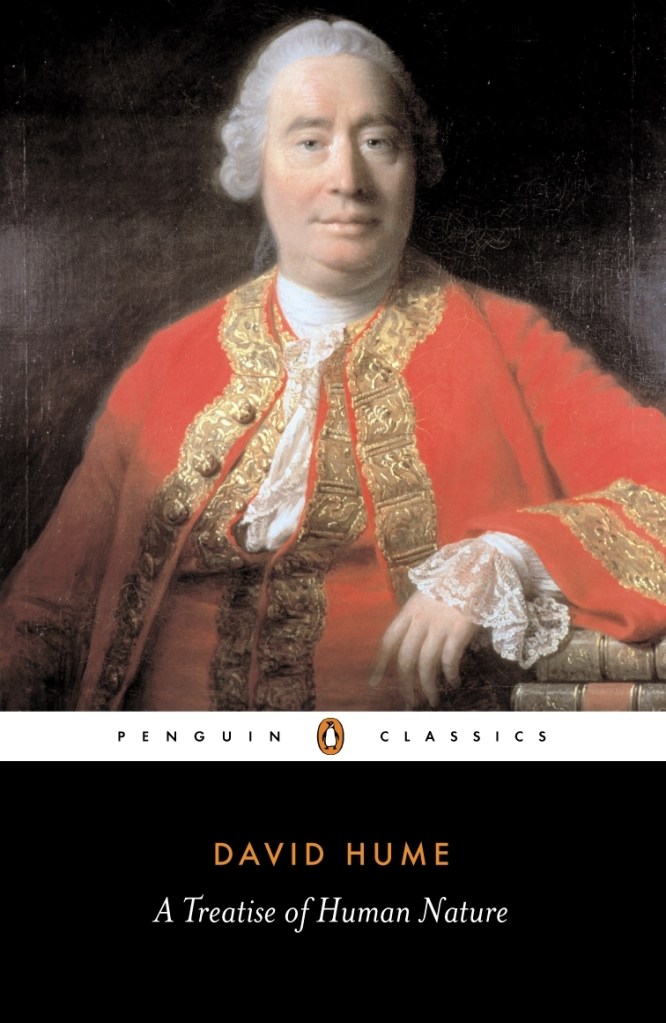
Well, I followed up on my decision to give Hume another chance after my disappointment with his essays, diving into probably his most significant work: A Treatise of Human Nature. It is at least a more worthwhile read than his essays, although that is not a high standard. Mostly, this particular piece of philosophy left an impression of being dated, rather than enduring as the best works of philosophy do.
That might seem a strange thing for someone who upholds the continued relevance of far older and more esoteric works to say of a famous philosophical text from the European Enlightenment, but it’s true. A Treatise of Human Nature, despite its lofty title, simply does not possess that eternal wisdom and insight that peers at the heart of the human experience, for the simple reason that it tries to apply rationalism in its pure form to scientific ideas, which are by nature a synthesis of the etymological schools. A little like Spinoza, although I suspect neither would appreciate the comparison, Hume attempts to examine human nature based on the fundamental physics of his time, but without Spinoza’s rigorous style of proof.
We think of Isaac Newton today almost exclusively as a physicist and mathematician, distinctions that are sensible to our modern specializations, but this leads us to underestimate the broad impact of his ideas and his ways of thinking about reality on succeeding generations of thinkers. Hume took Newton’s idea of a universally applicable physics and combines it with a rationalism that would be at home in the religious discussions and debates of the Middle Ages, to build an idea of human nature starting from the definitions of space and time. His thinking about these matters is a bit akin to contemplating Zeno’s paradoxes, except that Hume seems to take a great deal as self-evident without subjecting the ideas to any deeper thought.
Hume is at his best and most interesting when he is discussing morality. These are the portions which kept me reading, for Hume attempts to explain ideas of morality and justice with respect to innate human responses and experiences, like pleasure and pain, a bit of a rationalistic predecessor to the scientific examination of such questions that now are the provenance of fields like psychology, neurology, sociology, and anthropology. Even here, though, he tends to fall short of really encapsulating a deeper idea or insight on his topics.
In the hands of the Greeks, rationalism accomplished amazing insights, though it proved ultimately limiting for their understanding of the material, physical world. Hume tries to inherit their tradition, and fuse it with contemporary insights about gravity and physics, but the result is an awkward hybrid, lacking in enduring insight. Yes, it has some strengths, but I do not believe this book will advance your understanding of human nature.

