
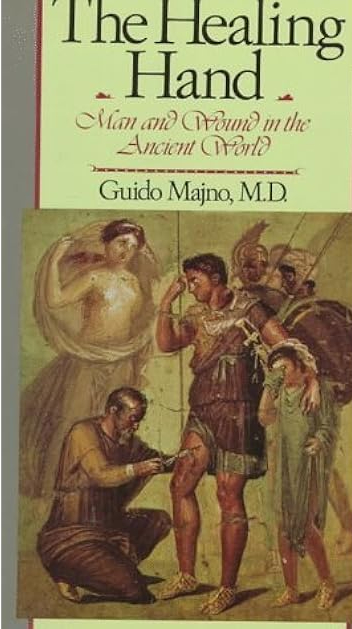
You’re writing a fantasy story, there’s a battle, and one of your characters is injured. What happens next? Does she get a bandage, stiches? How are the stiches and bandages prepared? What’s in the poultice? Who is doing the healing, and what does the healer instruct? Is there a prescribed diet? Follow-up care? What happens if and when the wound gets infected? If you haven’t read Majno’s masterpiece, and there’s no magic healing, I would hazard a guess that the details are a little vague. The Healing Hand is the answer. This was one of the most broadly interesting and specifically useful books I’ve read in a long time.
Medicine is not my field. When I select papers from multidisciplinary journals like Science or Science Advances, I rarely choose ones from the medical sciences. The terminology is too specific and far afield from my own jargon for me to make sense of most of them without significant additional investment, and the opportunity cost in terms of other papers I could be reading which are closer to my own field and which are most likely to be relevant to my own work means I leave most medical papers be. Fortunately, The Healing Hand does not presume prior knowledge in medicine beyond some basic terminology such as is commonly picked up by the informed layperson.
Yet, it is certainly a medical book, and Majno is amongst the most dedicated nonfiction and history authors I’ve read. In chapter after chapter, he discusses experiments he conducted explicitly for the book in order to empirically establish the efficacy (or lack thereof) of certain treatments from antiquity. Nor is it enough for Majno to do his own medical investigations; he does his own translations, and not just from one language. Working with Assyriologists, Egyptologists, and Hellenists, he works through making his own translations of certain medical terms from their native languages into English. Indeed, I think The Healing Hand has better descriptions of the linguistics behind cuneiform and hieroglyphics than the translation notes for books explicitly translated from those languages. Majno’s polymath tendencies extend from linguistics, to hydraulics, to history, which is doubtless one of the reasons I found the book so enjoyable. For all its small digressions, it never strays from its main purpose, presenting the history of man’s relationship with medicine, in particular the treatment of wounds, and that clarity contributes to the book’s success.
It progresses through the major civilizations of the ancient world, discussing their relationships and what makes each unique, engaging also in some cultural anthropology along the way. Sumer, Egypt, Greece, India, China, and Rome are all addressed. Indeed, the only critique I can think to leverage upon the book is that it suffers from an abrupt ending. After discussing Roman medicine, and Galen in particular, the book just…ends. Majno does assert that medicine subsequently entered a dark age in which little progress was made and much was forgotten for almost a thousand years – a reader might be skeptical of this claim after reading The Light Ages, which emphasizes that they weren’t really the Dark Ages – but the thorough research underpinning the rest of the book, including with references to how these treatments were, in some cases, passed down all the way to the nineteenth and early twentieth centuries (with varying degrees of efficacy), leaves me inclined to trust that Majno did the research to support his claim.
Doubtless, it would be too much to expect a single book to cover the entire history of medicine, anyway, but it would have been interesting to see a similar analysis done on at least one American ancient culture. It would have been especially interesting if the author had done similar experiments regarding the efficacy of traditional American remedies, which have increased in prominence in recent years, though I’ve not been able to find much empirical data on them. Considering the biodiversity bounty of the Amazon, this seems apt to be a fruitful area of potential research.
The Healing Hand is an interesting book in its own right, but it also serves exactly the purpose I wanted from it, which was to improve my understanding of ancient wound care for application to writing about historical periods and equivalent secondary world cultures and civilizations. Absent magical healing, I had a vague awareness that wound care really isn’t captured well in fantasy and historical fiction, which is even more true than I would have imagined before reading the book. This is another case of the assumptions we don’t realize we’re assuming coloring our view of what is reasonable and realistic. A tourniquet to prevent hemorrhage, for instance, makes perfect sense and is so incredibly basic that we don’t even have to think about it, and might be inclined to assume that even the most primitive cultures would be able to tie a cord around a limb in order to stop bleeding…but this presupposes an understanding of blood flow which is not shared by many ancient cultures. No less an intellectually flourishing civilization than the Greeks believed that air flows through arteries and did not conceptualize the idea of blood flowing at all until the hydrodynamic innovations of Alexandria. They also believed that blood flowing out of the wound was a good thing (which it is in limited quantities…), balancing the humors. The idea of balancing the four humors would pervade Western medicine for well over a thousand years, and China had its own equivalent conceptual framework. If there is a moral to be drawn across the medicine of every ancient civilization, it is that every culture’s medical practices had serious flaws working alongside procedures and treatments which could be quite effective.
I could go on in praise of this book, but, instead, I will encourage you to go read it. My only cautionary note (other than the abrupt ending) is that a few passages and images could be considered a little off-putting for those with a sensitive stomach. The only one that bothered me was the description of how the ancient Greeks dealt with gangrene. Perhaps the warning is unnecessary, since this is a medical text. The Healing Hand is a fantastic piece of nonfiction which I think anyone could find interest in, but it should be required reading for anyone writing about wounds in a historical (or secondary world historical) context.
 IGC Publishing
6 thoughts on “The Healing Hand Review”