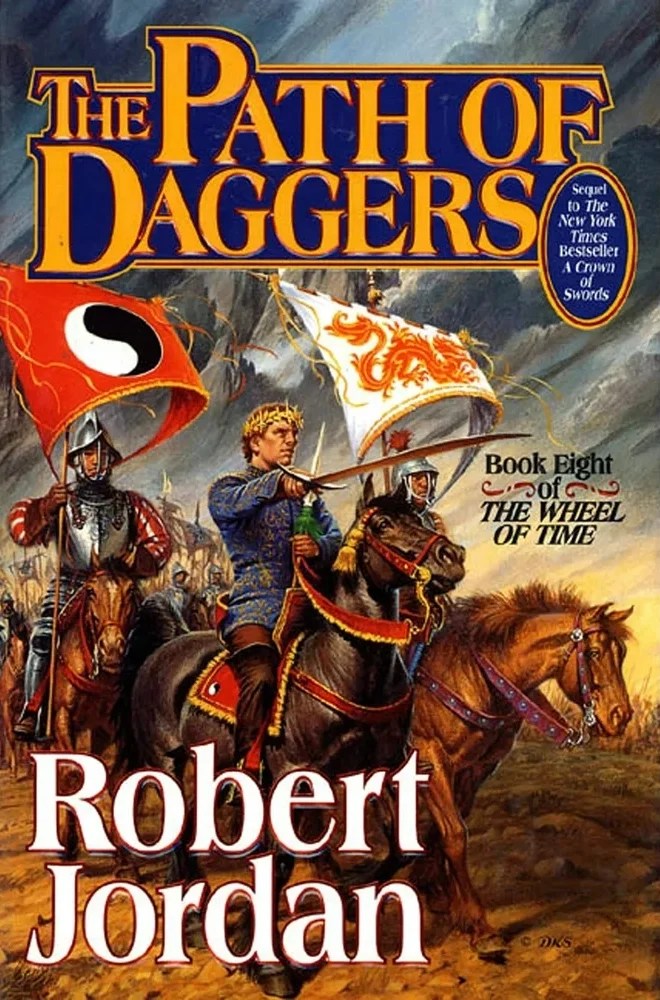
One of the most useful storytelling tools I’ve found, which I learned from the Writing Excuses podcast, is the “Yes but/No and” plotting technique. To move the plot forward, to increase the stakes and the tension, when the characters do something or some event happens, you as the author ask if that action succeeds in one or more of its objectives. If the answer is yes, then you can follow up with a “but” – that is, some complication that turns the success into a partial success or even leaves the success pyrrhic. If the answer is no, then you’d follow up with “and” – that is, whatever action it was did not succeed, and now something else is going wrong, too. This is particularly applicable for the middle parts of the plot, as towards the end you generally don’t want to be introducing additional complications.
On large and small scales, these middle books of Wheel of Time – Lord of Chaos, A Crown of Swords, Path of Daggers, and Winter’s Heart – can be viewed through the yes but/no and lens. Even the largest events, the great victories achieved, come with massive “buts” attached. Finally use the Bowl of Winds to correct the weather (yes), then have the Seanchan invade and hunt down the source of the enormous amount of Channeling that just occurred (but). Oh, and everyone may be relieved that the unnatural heat is done, but now everyone must deal with a winter that came rather unexpectedly.
So yes, Path of Daggers is certainly a middle book, not like the early books in the series with their climactic battles and resolutions which allowed them to read more like connected novels. The difference is in the plotting. In a series of connected novels, each novel is plotted like it stands on its own, with the series plot sitting mostly in the background. Harry Potter is a fine example of this method. The other option is to plot the series. In this mode, dividing the story into books is more a publishing and reading convenience than it is something that influences the writing in a significant way. Think of The Lord of the Rings, and how Tolkien thought of the “series” as a single book split into volumes for the convenience of bookbinding.
This means that the ending again feels somewhat abrupt, and the yes but/no and structure is in full force. One of Jordan’s strengths, which I am noticing more in this reread, is that he is able to drop in events in earlier books which seem like they may not go anywhere, which then become significant multiple books later. It’s an adept understanding of causation and consequence, and one of the things that adds to the fullness and realism of the world and the story.
Other elements are more obvious, like Rand’s madness and the problems with the Asha’Man. Not that Rand can see it, of course. Contriving to make something seem obvious to the reader while keeping the reader sympathetic to the character who cannot see it is a delicate balance, helped here by how well Rand’s trajectory can be traced over the preceding books. From the very beginning, the reader must wonder what channeling such large amounts of tainted Saidin will do to Rand, and he is certainly suffering the consequences by this eighth installment.
In fact, it’s a times difficult to know whether as a reader you want to feel sympathetic for Rand and the suffering he’s enduring and the weight he’s attempting to carry alone, or if you want to just grab him and shake him, like Min seems to want to, in an attempt to bring him back to his senses. Not that Rand is the only character to feature in the book, as we also get a lot of development from Elayne and Nynaeve, Egwene, and Perrin. In particular, Perrin shows a great deal of development, and the book leaves us on a note of profound tension for his arc that is not realized until Winter’s Heart.
I apologize if these reviews are starting to feel a little repetitive. That’s the hazard of writing reviews for every book in an extensive series like this. At this stage in the writing, Jordan is in a strong place, and we’ve already highlighted many of the features which make this series worthy of its place in the pantheon of great works of fantasy literature. Instead of spending more time writing about the brilliance of the Ta’veren technique, I think I’ll go pick up Winter’s Heart. I hope you’re still reading along.
 IGC Publishing
One thought on “Path of Daggers Review”