In the late sixteenth, and especially into the seventeenth century, Europe was in the process of discarding the Medieval image, stepping away from a rationalist way of interacting with reality, and inquiring more deeply into the assumptions which were previously taken as absolute, unquestionable facts. Like the nexus of brilliant thinkers in ancient Athens, or the insight of the cluster of Italian renaissance artisans, mid-sixteenth century England witnessed a remarkable convergence of incisive scientific minds wrestling with deep questions and laying the foundations for the successive revolutions of scientific understanding which occurred in subsequent centuries. Newton is by far the most famous of them, but you would likely recognize many of the other names, too, including the subject of this biography: Robert Hooke.
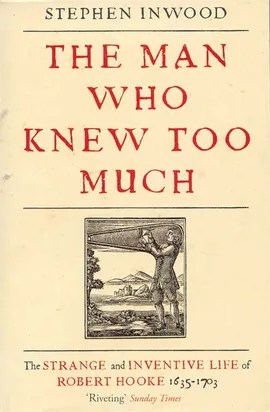
Most high school students learn Hooke’s law, a statement of the behavior of springs subject to forces and displacements. I knew little more about him, myself, but I came across a new biography of the man and his work…which I did not read. The description was lacking in scientific rigor, and many of the reviews said it was a rather shallow treatment. One review, however, referenced a slightly older biography considered the current “definitive” Hooke biography, so I read that, instead. Written by Stephen Inwood, a historian of the period, it’s titled The Man Who Knew Too Much, but published as The Forgotten Genius in the US.
Long-time readers of my reviews know that my gold standard for biographers is Chernow. Inwood doesn’t quite reach that level, but he comes close. His treatment of Hooke is sympathetic, thorough, generous, and comprehensive, helping to bring Hooke back to life for his readers, but without turning it into sensational semi-historical fiction. It’s just the approach I appreciate in biographies, and Inwood admirably accounts for the challenges of limited documentation for many aspects of Hooke’s life. This is especially true of his various medical conditions, some of which may have been caused by his self-medication.
Modern science, as most of my readers will understand the term, is a highly specialized, controlled discipline, and scientists are expected to be, or at least stereotyped as being, removed from their experiments. This is, while not perfectly reflective of the reality, a fair perception of how science is “supposed” to be conducted today. It is not the science of Hooke’s day. Hooke, Newton, and their contemporaries were polymaths, “natural philosophers” who did not draw hard lines between the study of fossils, comets, medicine, and light, who were personally invested in their experiments, and who approached the whole concept of what we today call “science” with a passionate curiosity, varying degrees of rigor, and a possibly reckless (from our perspective) disregard for their personal health. There is a possibly apocryphal story about Newton stabbing himself in the eye with a needle when he was seeking to better understand optics – I can’t imagine many modern scientists doing the same, and any who did something of that nature would certainly be considered “compromised” in their objectivity as a researcher.
Hooke might have embodied the polymath natural philosopher of this time period more than any of his associates. His interests were as broad as he could imagine, and he was restless in his efforts, perhaps to a fault – The Forgotten Genius is littered with projects he began which he never finished, and his diary and papers are replete with phrases like “I leave the rest of this effort to someone who has more time.” This is a frequent fault of polymaths – Da Vinci’s works and notebooks are similarly replete with half-finished projects and ideas which were never developed beyond a fragment of a notion. With my own polymathic tendencies, this has long been my fear – that I will spread my interests too thin and thereby start too many projects to ever do them justice and see them to completion. Perhaps the answer is to have a team of researchers will to see such disparate projects to fruition, but Hooke was not, by and large, a collaborative scientist.
He has a reputation for being cantankerous and secretive, which Inwood implies is a symptom of the nature of the intellectual scene in which he operated. Patent laws and intellectual property rights existed, but they were anything but clear and objective, and Hooke did not fit the mold of the independently wealthy gentleman pursuing science as a hobby. Some of his acrimonious and exaggerated priority assertions may have been tied to his attempt to turn his scientific pursuits into a viable income.
For all Hooke’s broad interests – and he provided key insights in fields as disparate as the nature of light and the function of the lungs – there is a unifying aspect to most of his work, which Inwood makes implicit throughout the book. Hooke’s overarching interest was measurement, enhancing and objectifying the senses to better make inquiry of the environment and its phenomena. He began his career making scientific instruments for others, and this continued to be core to his science even when he was doing experiments of his own. In that sense, he was an engineer, working with mechanical joints and systems in innovative and imaginative ways. His efforts in designing such devices highlight the value of understanding fundamental principles of mechanics which are seemingly neglected in modern engineering education.
History has not always been kind to Hooke, perhaps reflecting the tension still at times extant between engineers and scientists. His disagreements with Newton are reflective of a deeper argument over the nature of the scientific and experimental enterprise. On the one hand is Newton, the theoretician with the mathematical insight to develop and fully explain/prove a concept prior to experimental validation. On the other is Hooke, the experimentalist who designs machines and contrivances to take measurements of the natural world, and then develops explanations based on those measurements. There remains debate today about this very question, in all the lenses through which it can be viewed.
Where The Man Who Knew Too Much sometimes falls short is in its more technical segments. Inwood is a historian, so I’ll cut him some slack in the writing, and he does make the effort for Hooke’s key designs. More importantly, the book would benefit from more diagrams. A picture isn’t always worth a thousand words, but there are many places in The Forgotten Genius where details could be considerably clarified and better presented with a simple isometric diagram of a joint or other mechanical contraption. At least, I would appreciate such inclusions, as a both an engineer and a reader.
Before reading The Man Who Knew Too Much, I wouldn’t have necessarily thought to put a Hooke biography on my reading list. I wouldn’t have sought out such an entry, and there are many scientists and historical figures whose biographies I would have sought out first. However, I thoroughly enjoyed Inwood’s biography of Hooke. It is informative, interesting, engaging, and, perhaps most importantly, it prompted me along several new avenues of reflection and consideration. Now, I’m going to try to finish a project, so I don’t end up with a diary that reads like Hooke’s, complaining about not having enough time to finish all of the grand enterprises I try to begin. While I do that, I hope you consider springing into a biography about a great Forgotten Genius.
 IGC Publishing
2 thoughts on “The Man Who Knew Too Much Review”