
Warning: this review contains spoilers for other Sanderson novels and stories. I strived to avoid spoilers for Wind and Truth, but any Sanderson stories published before it are fair game.
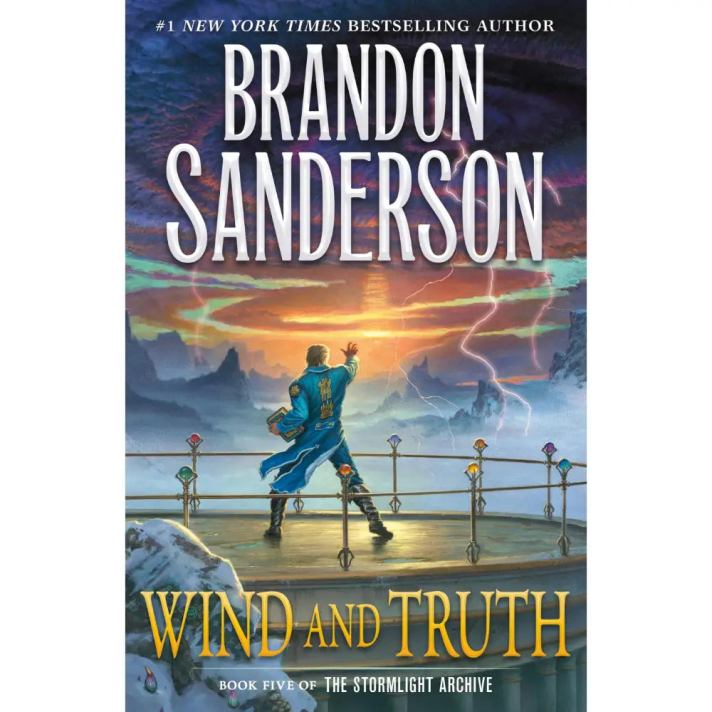
Finally, a year after its release, I sat down to read Wind and Truth, the fifth and final book in the first arc of Sanderson’s Stormlight Archive. Unlike I did for prior releases in the series, I reread only Rhythm of War, not the entire series, a decision I made based on a belief in my familiarity with the rest of the series, and the practical consideration of not wanting to spend quite that much time rereading when there are so many books I have not yet read. As I read Wind and Truth, though, and especially as I neared its conclusion, I wondered if that was a mistake. Then again, there is a sense in which it is necessary to reread just about every book Sanderson has ever written in order to fully appreciate some aspects of Wind and Truth, which is simultaneously the book’s greatest strength and its greatest weakness.
Its nearly fifteen hundred pages are divided not into parts, but days – the ten days leading up to the contest between Dalinar’s and Odium’s champions established in the previous books. Like the previous installments, these “days” are separated by interludes, but instead of expanding the world and offering a kind of literary intermezzo from the main plots, these interludes come in pairs, always involving a perspective from Odium, and a perspective from someone with whom Odium is interacting. This seemingly minor change in structure detracted from the epic scope which normally characterizes Stormlight books, and actually made it feel longer. Despite its physical length, the book is more focused plot-wise than its predecessors, and more scattered world-wise.
I remember when Sanderson first introduced the idea of the Cosmere, and when he began actively integrating it into books. At first, this consisted solely of Hoid, the world-hopping storyteller who appears in different guises, a tertiary character at best, who often went by different names and whose nature was rarely made explicit in a given story – in some early Sanderson novels, you’d never know it was supposed to be him unless you know to look for him. So, there was Hoid making cameos, and a vague sense of a connected mythology/cosmology that resulted in these worlds on which Sanderson’s stories are set having similar magic systems. In those early days, I remember being skeptical of the Cosmere as a concept, having read numerous other authors who attempted to unify their disparate works with lackluster results, but I thought if anyone can pull this off well, it will be Sanderson.
That understated implementation of the Cosmere, like coded Easter Eggs for particularly passionate Sanderson readers, lasted maybe as long as 2016, when Arcanum Unbounded was published. That collection made explicit, on several levels, the connectedness of Sanderson’s many worlds and stories, both through the structure and framing of the collection itself, and through some of the stories it contains, especially Mistborn: Secret History. Not only does Mistborn: Secret History arguably break one of Sanderson’s own cardinal rules of storytelling, but it also introduces world-hopping for people who aren’t special cases like Hoid. It lays the groundwork for characters and magic systems from one series to jump into others. The first real implementation of this occurs in Oathbringer, when Nightblood appears for the first time since Warbreaker. Even then, I was able to swallow it, because you didn’t have to be intimately familiar with Cosmere mythology and Warbreaker to understand Oathbringer – it was more like bonus knowledge.
The fourth and final book in the second Mistborn era featured an entire cabal of world-hoppers appearing at the last moment with a panoply of strange powers, some of which haven’t appeared outside of the graphic novels or short stories. It could still, perhaps, have worked, but the lack of foreshadowing throughout the rest of that series left it feeling contrived and abrupt – the whole book, Bands of Mourning, felt divorced from the other Wax and Wayne stories – but it serves as foreshadowing of Cosmere stories to come. The Cosmere-related secret projects similarly feature more and more overt Cosmere elements, by which I mean worldbuilding and plot elements which do not exist independently within a single story or series. In this context, we come at last to Wind and Truth, some of which requires a degree in Cosmereology to understand. I consider myself reasonably knowledgeable about the Cosmere, the shattering of Adonalsium, and the intricacies of Sanderson’s interrelated magic systems, but there are significant points in Wind and Truth where key events hinge on remembering details from other series or grasping Cosmere physics which are probably consistent but which have not been fully explained. Without that knowledge or memory, those key moments fell flat for me, taking on a certain hand-waving aspect where I simply had to press the “I Believe” button in order to continue with the book.
All of that is one issue I had with the book, albeit a long-running and significant one which has implications for my enjoyment of future Sanderson stories. If you’re a passionate Cosmere aficionado who follows all the Reddits, Discords, and other fora in which these things are discussed ad nauseum, or if you’re happy enough to press the “I Believe” button for such matters, it will be a nonissue for you. If it was the only issue I had with the book, I probably would still have managed to thoroughly enjoy it. My issues with the presentation of the characters are more pernicious and went further in undermining my enjoyment of the book than any other factor. Entire subplots of the book read like anachronistic polemics on mental health, and the result is a robbing of depth from most of the characters who powered the series’ earlier installments.
Mental health has been a key component of the series since The Way of Kings, to the point of being given worldbuilding justification (something about having mental health issues makes Radiant bonds easier to form, if I recall correctly), and it produces some of the series’ and characters’ most powerful, impactful moments, especially for Kaladin and Dalinar (and, to a lesser extent, Shallan). However, heretofore it hasn’t been referred to as “mental health.” Wind and Truth deploys a plethora of anachronistic terms, in both narrative and dialogue, that completely break immersivity with the story, reduce characters’ complex emotional depths to two-dimensional caricatures, and sometimes shoehorn characters into roles which are nonsensical for them and their contexts. Instead of weaving these concepts into narratives – arguably a major purpose of storytelling for the human species is to present abstract concepts and ideas in relatable, graspable narrative form – Wind and Truth repeats them explicitly over, and over, and over again. Sanderson’s prose worsens the effect, and seems even choppier and heavy-handed than usual. Similar can be said for the book’s vague attempts to address philosophical ideas, a strong point of earlier installments which is smeared into meaningless platitudes and unresolved, idle musings in Wind and Truth.
Most of the plot lines failed to be compelling, the characters marching along them like trains chugging along their tracks, unable to deviate from where the author placed them and told them to go. A couple stand out as up to Sanderson’s usual standard: Adolin comes across as the most robust character remaining in the storytelling, and Szeth’s flashbacks read as a refreshing return to early Stormlight style. Otherwise…well, I rarely agree with reviewers who say epic fantasy books are bloated – I notably disagreed with them about Oathbringer’s Shadesmar sequences, and about the middle-late books of Wheel of Time – but significant portions of Wind and Truth don’t add to the story, advance the plot, develop the world, or enhance the characters. While I didn’t dislike the conclusion of the battle of champions, and I can appreciate some of the potential implications at an intellectual level, I had little to no emotional engagement with the events or characters by the time I reached that point in the book, so it lacked the impact of the conclusions to earlier books. Even Rhythm of War’s climax was more, well, climactic.
I’d say it’s a matter of mismanaged expectations, except that my reread of Rhythm of War already tempered mine for Wind and Truth. Even so, the best descriptor for Wind and Truth is “disappointing.” When I lauded Way of Kings and Words of Radiance as the start of one of the best, most creative, imaginative, and powerful epic fantasy series ever written, I did not expect to read the end of the arc and feel almost nothing. It almost reads like someone else wrote it who knew all the pieces that should be there, but didn’t know how to capture the spark that brings those pieces to life and synergizes them into a cohesive, compelling story. I’m not giving up on Sanderson, but Wind and Truth cemented for me that I’m not as excited about his new books as I once was.
Post Script: I thought the two arcs of Stormlight Archive were going to be like the different Mistborn eras, but it’s looking like the second arc will directly involve many of the same characters from the first arc, so I will not be writing a series review at this time (just in case you were expecting that next Tuesday).
 IGC Publishing