
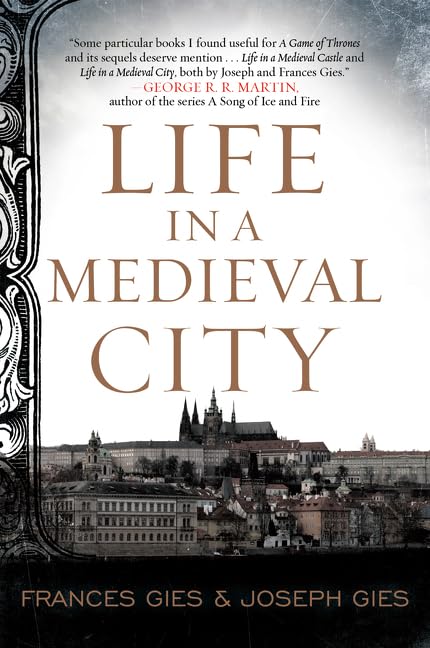
Learning about history is fascinating to me in most of its forms, from biographies to research papers, but typical history books focus on major events, times, people, and their implications, which can introduce a certain remove from the history being studied. Rather like I seek in fiction, I pursue a more immersive experience to deepen my understanding of what it was like in a particular place and time, the better to understand the people and events therein contained. This is part of why I read so many “historical” texts written during particular time periods and emerging from particular cultures, and it is also why I’m always fascinated by “day in the life” style history texts like Joseph and Frances Gies’ Life in a Medieval City.
Strongly reminiscent of The Time Traveler’s Guide to Medieval England and How to Behave Badly in Elizabethan England, Life in a Medieval City explores, well, what it was like to live in a medieval city, specifically Troyes and its prominent, prosperous Champagne Fairs. The book focuses tightly on the mid-thirteenth century, a time when the fairs were flourishing, Troyes was bustling, and the old feudal system was breaking down in favor of the foundations of a more modernly recognizable social order. While the Gieses will compare the state of life in 1250 with what is to come in a few decades, or with what was a few decades before, the focus is maintained, which greatly increases the book’s immersivity, and prevents the text from becoming a sprawling series of digressions. That said, a few more digressions for additional context would have been interesting and ultimately added to the book’s primary effect.
The Gieses’ text has been referenced by several prominent fantasy authors, including George RR Martin, as an excellent resource for doing more immersive worldbuilding of medieval-style fantasy worlds. I know, I know: we’re all supposed to be getting away from the stock, default medieval Europe-inspired fantasy settings, because they’ve become passe. It’s true such settings can be overused, but they are mostly overused because so many authors fail to utilize books like Life in a Medieval City to bring dimensionality to their imaginary worlds. Detail is the cure for what would otherwise be decried as overused. Jordan’s Wheel of Time does this deliberately in many cases, taking classic fantasy “tropes” and expanding upon them at such length and with such detail that they lose their tropey-ness altogether. Settings are no different from characters and plots in this respect. If we’re doing our worldbuilding right, we can’t even properly speak of a “medieval Europe inspired setting” – we must be far more specific, as Europe varied widely during the medieval period.
In that light, a book which focuses exclusively on a single city in barely a single century might seem too constrained to be useful, but extrapolations can be made to other cities in similar circumstances, some of which the book does mention; furthermore, the Gieses wrote several other books in the same vein, including Life in a Medieval Village, Daily Life in Medieval Times, and Life in a Medieval Castle. All are probably worth reading, although I did not immediately go out to add these other texts to my reading list upon finishing Life in a Medieval City. While focused, Life in a Medieval City is not always as dense as I would like. Yes, it contains plenty of references to explore more deeply, but given my already significant reading on this and related subjects, a book really needs to go into significant depth to be worth my time to read. For me, personally, Life in a Medieval City was a mix of learning interesting new details, and reviewing details and information with which I was already familiar (or, in a few cases, which have been revised or caveated by more recent scholarship).
This, however, should not be thought of as detracting from the book’s overall quality; for most readers, Life in a Medieval City will be an insightful, useful read, whether or not you are using it as inspiration for your fantastical or historical worldbuilding. Any student of history, which we should all be, will benefit from a deeper understanding of what ordinary, daily life was like for people in the places and times we otherwise explore, because that context will inform our understanding and appreciation of how and why events occurred and people behaved in the ways they did. Such detail is a tool for approaching history with empathy, generosity of perspective, and avoiding anachronism. It also gives new perspective on the present, which is why you should be a student of history, and why you should add Life in a Medieval City to your reading list.
 IGC Publishing