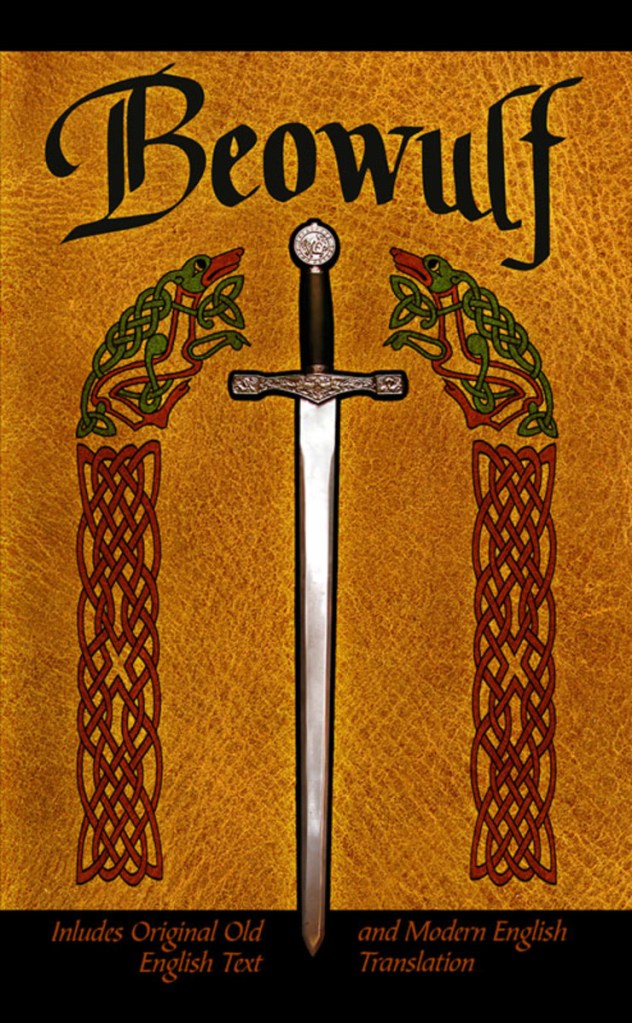
I probably read Beowulf before, or at least read translations of it in bits and pieces, but I cannot recall sitting down to read it all the way through like I’ve done with other historical works. Given my progress through Stroud’s History of English podcast, it seemed a fine time to remedy that oversight. Beowulf, of course, is one of the most famous and complete Old English poems, along with one of the most translated; for this review, I read a Delphi Classics version which contained two English translations using slightly different approaches from different decades, along with the Old English text, and a side-by-side, line-by-line translation. There are numerous other translations from which you can take your pick, including one on which JRR Tolkien worked which was recently published; however, I like the Delphi Classics version because it allows the comparison between different translational approaches and includes the Old English text.
Not surprisingly, Beowulf reads much like other stories from the northern European traditions, including stories out of the Eddas, Cath Maige Tuired, the Nibelungenlied, and the Volsunga Saga. Unlike those stories, though, there is less of a mythological overtone. By that, I mean the story is told in a grounded fashion and does not overtly invoke supernatural elements. Yes, the monsters Beowulf fights are not “real” animals, but they are presented in the same way such animals would be, despite some trappings of religiosity applied by the poet to Graendal’s lineage. Perhaps that is part of why the story has been adapted and retranslated so many times for modern audiences – it can be read, outside of some of the trappings and language, as a kind of historical-fantasy tale with which plenty of people today are familiar. We still tell monster tales, albeit usually not in alliterative verse.
That grounding comes about thanks to the poem’s historicity. It is set in a specific time period, not far removed from its supposed date of composition, and it invokes particular peoples, places, and historical figures, some of whom can be confirmed in other historical documents. This is in contrast to most other historical works, which tend to locate their events in the “distant past” or similarly ambiguous/mysterious locales, spatial, cultural, and temporal. Modern scholars cannot confirm everything Beowulf asserts historically, but it is at least plausible. In many instances, it’s enabled historians to make new progress in understanding some of the different peoples and places invoked by the poem, like the identity of the Geats.
Stroud, who hosts the History of English podcast which I’ve been so often invoking in recent posts, explores Beowulf extensively in the main podcast, which richened my experience in reading the poem, and even allowed me to make some sense of the Old English text. I highly recommend the approach of reading the poem in conjunction with the episodes of the podcast which address it and its time period. Additionally, Stroud created an audiobook dedicated to Beowulf, Beowulf Deconstructed, which explores the poem’s etymology, tells its story, provides historical context, explores Old English poetic structures, and generally applies Stroud’s thorough approach to this classic piece. An excerpt from the audiobook is included in “Bonus Episode 6.” While I’ve not listened to the full audiobook, it is intriguing enough that I may return to it in the future, and I do think it would enhance (not replace) any reading of the poem.
Beowulf is one of the few historical works which continues to capture the imagination in something close to its original form. Unlike some of the other historical tales which continue to receive modern adaptations (Homer’s epics, specific episodes from the Greco-Persian wars like Thermopylae), it is not something glorious, mythological, or grand. It’s a darker tale, the kind of story I think we still imagine telling while we sit around a fire, from a different point in history. In a sense, it is more human. Beowulf is not some demigod, he is not a hero, and while he is shown being extraordinary, he is never supposed to be more than a great warrior. Perhaps that is why it still endures as it does.
 IGC Publishing