
Back in October, I posted a review for The Knight in the Panther’s Skin, a historical piece written by a Georgian poet in about the twelfth century. It’s a story of love and some extremely emotionally overwrought knights, and it’s considered a classic masterpiece and a core Georgian cultural touchstone, one of the greatest pieces of Georgian literature ever produced. While I appreciated it, and found it historically interesting, it was not amongst my favorite of the many historical pieces I’ve read. I was somewhat surprised, therefore, when a fellow author reached out to me about rereading it.
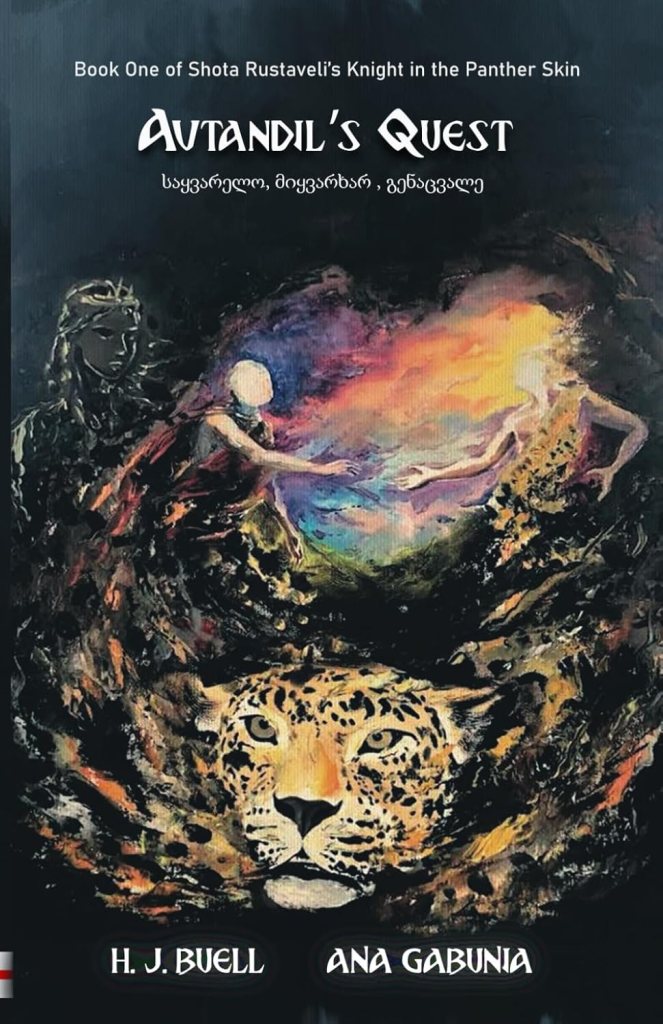
Not the original, though (or the translation, since I don’t read the original language). Rather, HJ Buell explained how he wrote an English prose translation of The Knight in the Panther’s Skin with Ana Gabuna, and he asked if I would be interested in giving it a read and a review. After some consideration, I agreed. It’s not a poem I thought I would reread, and I generally prefer straight translations as opposed to what might be closer to a retelling, given how much the format is changed from the original Rustavelian quatrains, but Buell’s offer and work were intriguing, so he shared the text with me, and I slipped it into my reading schedule for the beginning of 2026.
How you perceive Buell’s work will depend on what you look for in retellings. The language employed is largely straightforward and not especially remarkable, which sometimes makes the dialogue, which leans more towards the florid fashions of speech employed by the original poetry, stand out oddly from the narrative. Should a retelling of poetry in prose form attempt to capture in prose something of the elegance and beauty of poetry, or should it embrace a straightforward approach which is more explicit and perhaps unpretentious? It is a matter of personal preference. Buell’s approach certainly puts the story at the center for the reader, leaving much less up to interpretation than in the poetic version. Is the point of reading such a work the story, or is it something else, something perhaps less effable, less captured by a prose retelling?
When I read historical works, I am usually not looking for something specific out of them, although the little details they include are often fascinating and tend to find their way into stories and worlds I later depict. It is not to study them in depth, vet them against their various versions, translations, and the historical record, or to comb through them line by line to ponder the evolution of their language. What I am most interested in is seeking to come to some understanding of a historical culture, to immerse myself in what is otherwise impossible to approach, to attempt to understand a people who are gone (even if their ancestors remain) through the stories they told themselves. After all, these stories were written not for us, an audience the authors could scarcely imagine, but for the culture which birthed them. It’s an amorphous, slippery objective.
In that sense, with that objective in mind, is a retelling so different from a translation? Is any more lost in the process of retelling in a new and more approachable format than is lost in the process of, as in the case of The Knight in the Panther’s Skin, translating a highly specific form of twelfth century Georgian poetry into a semi-modern English in a vaguely poetic form? How much does the experience of reading Beowulf change in translations which attempt to preserve the Old English style of alliterative verse, versus those which do a precise line-by-line translation, or those which adopt a different poetic or prose form, or those that retell the story entirely? These are not questions which can be clearly and definitively answered. The experience changes, but the experience changes inevitably. We can imagine a kind of spectrum of interpretation, from reading the original in the original language, to reading line by line translations, to reading less direct translations, to reading translations which don’t preserve the original form, and then into various types of retelling.
Ultimately, we can never completely approach an ancient work on its own terms, for we do not arise from the culture in which it was steeped. Nuance and meaning are lost to an extent simply in the process of a story being translated across time, never mind the process of translating into other languages and formats. There are ways of retelling a story which I will stake out as wrong, departing too far from the basis and imposing a modern cultural context upon it, in effect telling a different story entirely with the trappings of an older one used more as set dressing than anything else. Retelling itself, though, is not a detriment to these historical works, and indeed is something I would seek to encourage for its ability to help preserve such stories and cultures, and their unique insights, for more people to read and appreciate.
Buell’s retelling of The Knight in the Panther’s Skin is the latter, an effort to preserve the heart of the original story while making it more accessible for a general English reader. Personally, I would have appreciated if a little more of the original rhythms and linguistic flairs could have been preserved, but responses to my own efforts to do retellings or stories inspired by the style of historical works suggest that’s a rather niche view. Throughout the retelling, Buell’s passion, appreciation, and respect for his source material is abundantly clear, and it is reflected in a retelling which captures the heart of the original while be approachable for a general readership. If you were intrigued by my review for The Knight in the Panther’s Skin, but struggled with reading English translations of Rustavelian quatrains, Buell’s retelling is an excellent opportunity to approach the story in a different way.


One thought on “Avtandil’s Quest Review”