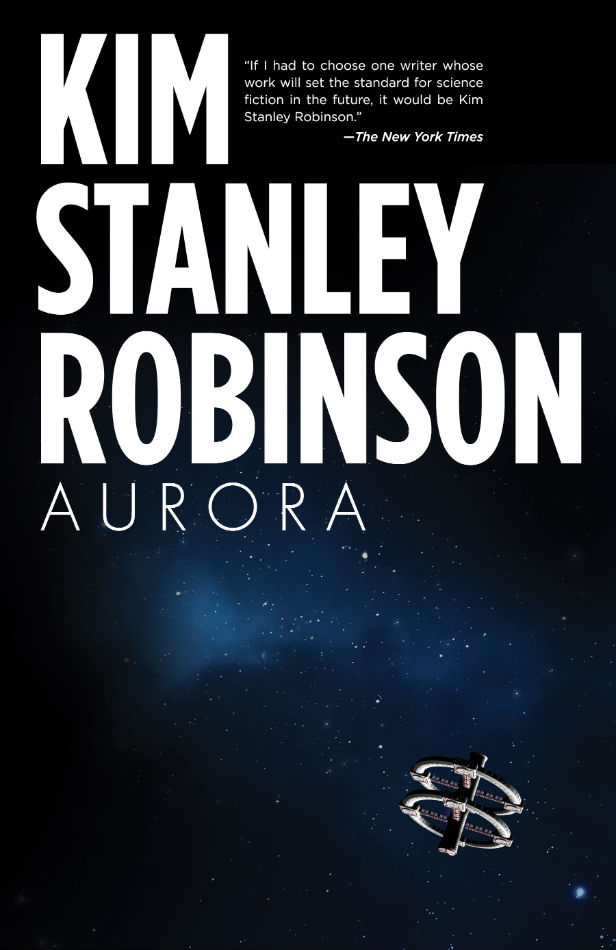
Aurora receives glowing (critical) reviews as a piece of literary hard science fiction telling the story of a generation ship finally approaching its destination. This praise, and the general description of the book’s core concept, convinced me to read a science fiction book published only eleven years ago. It proceeded to disappoint all my expectations in a thoroughly pessimistic reinterpretation of core science fiction genre tropes adorned by mediocre prose and little in the way of creativity. This from an author The New Yorker describes as “one of the greatest living science-fiction writers.” I think that says more about the caliber of living science fiction writers than it does about Robinson’s prowess.
The arc of my feelings regarding Aurora starts low, rises to a peak of interest between about a quarter and halfway through the book, and then gradually transforms into frustration and annoyance. I nearly bounced off the first-person present tense narration of the initial perspective and point of view. The prose in this section is somewhat simplistic and juvenile, which is perhaps intentional with respect to Freya’s youth at the time. However, that emphasis on short sentences and simplistic phrase structures doesn’t change even when the narration switches to other viewpoints, including the ship’s. Robinson changes tense frequently, including within paragraphs, which is at times confusing, rarely seems to serve a storytelling purpose, and diminishes the overall quality of the prose. In several places Robinson resorts to version of “maid and butler” dialogue to dump information of vary relevance on the reader, and I can’t tell if the transparency of the author’s hand manipulating these situations would be obvious to everyone, or is obvious to me because of my own study of writing. In other places, he doesn’t bother with such contrivances, and spends long paragraphs reciting basic information to the reader about what beaches and other commonplace experiences are like, rather than using rhetoric to evoke these sensations and ideas in the reader’s imagination. There is a general heavy handedness throughout the book, a sense that Robinson doesn’t trust his readers to grasp what he’s trying to accomplish with the book unless he beats them over the head with it.
Frankly, the book barely qualifies as hard science fiction, at least in the sense that I deploy the term. Robinson includes some numbers which are vaguely plausible, and he doesn’t deploy wildly speculative or fanciful technologies, but the story he’s telling really has very little to do with the matters with which hard science fiction is concerned. It’s more preoccupied with sociology and social commentary than it is with thoroughly exploring in detail some specific scientific concept in story form, as in books like Rocheworld or Ringworld. In terms of the MICE quotient, hard science fiction stories are usually idea stories, and this one is more of a milieu and character story than an idea story. Much of the “hard science” Aurora includes consists of vaguely waving about terminology from a dozen different scientific disciplines, which in several cases it is apparent Robinson does not actually understand. At one point, he has the ship’s computer be unaware of why delta-v is called delta-v, which is completely preposterous. Nor does he shy away from waving the “quantum magic technology” wand.
It’s disappointing because there is so much potential in the book and its concepts. Freya, the main protagonist through most of the book, is never labeled with a particular condition, but it seems obvious from how she’s characterized in the writing and through the lenses of other characters that she processes the world a little differently, is probably a little less intelligent, than other people. This makes for a fascinating contrast with her mother, who is the generation ship’s popularly acclaimed chief engineer and apparently the only person in the entire book capable of solving technical problems. Her interactions with her mother, her inability to be her heir-apparent, but the way in which she ends up filling a role in the ship’s community which is socially similar but technically different are all strong threads to explore which aren’t seen very often in fiction. Even the ship’s gradual development as a character, at least at first, is handled well. The struggles of the colony ship as it nears the end of its planned journey give just the right amount of tension, and up through arrival at the titular destination I thought this would be a good, though not great, entry in the long list of spacefaring colony stories.
Then comes the turning point, in more ways than one, which really marks the beginning and greatest single moment of my disillusionment with the story. To understand why, we’re going to have to dive into some spoilers, so consider this your warning. Spoilers ahead, and I will mark where you can resume reading if you choose to skip this next section.

Devi dies soon after reaching Aurora, an Earth-analog moon of a gas giant in the Tau Ceti system, without ever setting foot on the surface. The initial colony efforts are deliberate and fairly successful, everyone is optimistic, and then a medical disaster occurs. One of the people sent to the surface suffers a suit puncture and contracts some kind of contaminant that kills her, and which subsequently infects and kills almost everyone else who had contact with the surface. A portion of these people try to return to the colony ship, where decidedly uncivil strife erupts, and the people returning from the surface are all killed. More civil strife ensues, followed by the ship’s computer putting a forced end to the violence. There is considerable debate amongst three options: go to another star system, go to the Mars-analog moon in the same star system, or return to Earth. I almost quit the story just because there is no exploration of a fourth option: try to understand and address what killed the landing party on Aurora’s surface. Only one character displays even the slightest interest in understanding what happened and why, but he’s relegated in more ways than one, no one else is interested, and he never makes any progress.
It’s such a complete lack of curiosity and perseverance that it almost undermines what makes science fiction the genre it is, and if I had any faith in the story after that point, the way Robinson tries to present returning to Earth as the obviously right answer, both practically and morally – with the “stayers” largely depicted as boorish, violent, unimaginative, and in denial of reality – removes that glimmer. Along with the stayers, anyone who questions or doubts the wisdom of allowing a ship’s computer, which was never programmed to make decisions or enforce rules, to take over a law enforcement and decision making role for the entire colony is depicted as stupid, with none of them making any of several salient arguments I thought of immediately.
I could say more in this vein and continue through the rest of the story from this point, but I will instead return to the regular, non-spoiler review.
My distaste for Aurora is ultimately down to a worldview diametrically opposed to the one Robinson presents in the book, especially when it comes to what I look for in a science fiction story. Aurora’s plot throughout the whole book, but especially after the turning point about halfway through, is fundamentally pessimistic in nature. Characters are not curious, they’re not innovative, they’re not solving problems. When problems are solved, the solution usually comes from elsewhere and appears as deus ex machina so that Robinson can tell the story he wants to tell. The entire final chapter is more of a modern-day political statement than a conclusion to the story the book is ostensibly telling. And yes, science fiction has long been a vehicle or lens for exploring political ideas along with scientific ones in a format that might be more palatable than if they were presented in a more direct form, but that still requires a certain level of deftness on the author’s part such that the message is integrated with the story, in which Robinson is uninterested.
I don’t expect all science fiction to be Star Trek, full of semi-utopian optimism and a last minute save at the end of every episode to reset things for the following week (which should clue you in that I’m talking about real Star Trek, not the modern, angsty Star Trek). A lot of excellent science fiction is written to be a warning, especially where the genre intersects with its horror roots (thank you, HG Wells). However, even warning stories about the horrors that can arise from science gone wrong, like The Island of Doctor Moreau, are categorized as science fiction in part because they embrace science as a discipline and a method. They embrace the idea that through innovations in technology and scientific understanding people can affect and change the world around them, for good or for ill. Robinson’s thesis in Aurora is the opposite: advancements in science and technology are a threat, and chasing new ideas is not just dangerous, but morally wrong, fundamentally irresponsible, and socially reprehensible. Were the weak prose, disagreeable viewpoints and perspectives, and questionable technical jargon and applications (I still can’t get over the computer not knowing the origin of “delta-v”) all improved, but that core of the story’s thrust remain, it and I would remain more incompatible than Aurora and its would-be colonists.


One thought on “Aurora Review”