My rate of writing in the past few months is the lowest it’s been since probably 2019 or 2018, which might seem at odds with the number of books on writing I’ve been reading, but this is something of a habit of mine. The less I’m able to do something I want to be doing, the more I read about it, study it, scratch the itch by diving into the details of what I’d like to do in the future. When I was stuck without a kitchen, I spent years studying recipes and cooking techniques, to which I give significant credit for my present culinary abilities. Much the same is true of my woodworking, and some of my other hobbies and projects. I hope writing will prove the same when I am able to return to it properly.
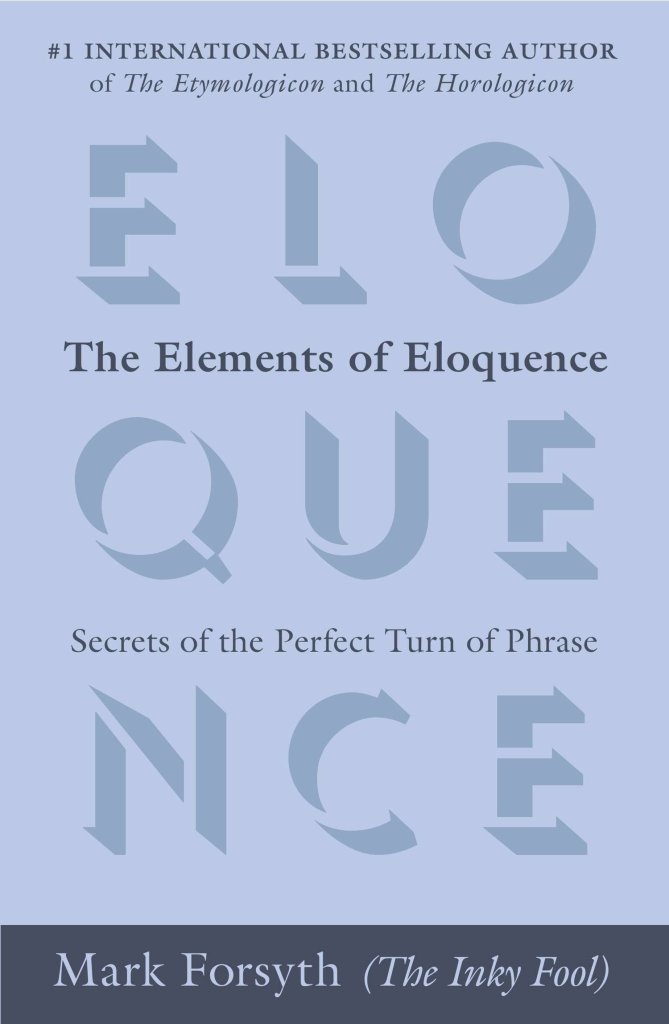
For now, I read books like Elements of Eloquence, Forsyth’s somewhat irreverent exploration of the rhetorical figures. If you haven’t heard of rhetorical figures, you’re not alone; they apparently fell out of favor during the Romantic period, when they were viewed as too mechanistic and contrary to the “art” of writing. As with so many ideas, they can be traced back to the ancient Greeks, who identified them by observation, and many of them will be familiar to you, even if you’re not familiar with the term itself. Alliteration, for instance, is the first figure Forsyth addresses, and there are others you will recognize from the description even if you don’t know the names, like hypotaxis (which I pronounced “hippo-taxis” for my wife’s amusement). I’ve included brief definitions of some of the figures at the end of the post for your (and my) reference, though the list should not be considered exhaustive.
This is not an indispensable text on the art of rhetoric which any writer should absolutely read and reference. It lacks the depth and insight of The Rhetoric of Fiction, and it doesn’t include the nuts-and-bolts practicality and utility of The Ode Less Travelled. At times, Forsyth seems more preoccupied with sharing pop culture references, making snide comments (especially about religious texts) in the hopes of provoking a laugh, and being clever with his chapter transitions by incorporating the current or succeeding rhetorical figure. Perhaps heeding his own advice, Forsyth is also inclined to overstate his positions, arguing Shakespeare’s ability to employ rhetorical figures is more significant to his works’ endurance than their contents or anything else about Shakespeare’s deployment of English, and that a well-turned phrase is valuable and memorable for itself, regardless of the substance of the communication.
For breaking down rhetorical figures, showing them in use, and highlighting how they appear and affect the reader, though, Elements of Eloquence is a valuable primer and reminder. It is an introduction to rhetorical figures as a concept, and even if you’re already familiar with some or most of them, it is a reminder of the devices which are in our toolkit as writers. At risk of repeating myself after all my posts talking about the impact of poetic thinking on prose writing, poets are much more inclined than prose writers to consciously reach for and employ devices like these, but they need not be employed only in poetry. Nor will they necessarily make your rhetoric read “poetically” – usually, the mark of a well-deployed rhetorical tool or device is that most readers won’t consciously notice what you’ve done, only feel the effects.
You might already use numerous rhetorical figures unconsciously, without knowing the formal names thereof, or making deliberate consideration of the various effects produced. There’s nothing wrong with that, and I have no doubt plenty of writers spend their entire careers without deliberating over the deployment of rhetorical figures and still manage to write compelling prose. If that approach is working for you, by all means continue. For those of us dissatisfied with the present quality of our prose, a conscious knowledge of rhetorical figures is another set of tools we can use to improve our writing. Where Forsyth’s book most differentiates itself from a simple list of rhetorical figures and their definitions you could easily find on a hundred different webpages is in his discussions of why a certain figure works the way it does, and some of the effects they produce in the reader/listener (as an aside, whereas many poetic devices like rhyme and assonance are primarily audible, the rhetorical figures are, for the most part, equally effective in print and spoken word). Therein lies the real skill involved in crafting fine prose. It is not in knowing how to stitch words together into synecdoche or a rhetorical question (in any of a dozen flavors), but in deciding when, where, and how to deploy a given figure to produce a desired effect.
Learning the rhetorical figures and how they function in famous works of literature would be a far more productive use of English classes than endlessly seeking to interpret the author’s “intent” and other, fluffier elements of “criticism” and “interpretation,” and I rather regret not learning about them in a concentrated fashion sooner in my linguistic adventures. Elements of Eloquence is far from the only extant text which would serve to introduce you to them, but it’s the one I happened to read, and it fulfills its purpose well enough. In case it isn’t already clear, this review is less a recommendation for Forsyth’s book specifically than it is a recommendation that you find a text on rhetorical figures and renew your appreciation for more semi-forgotten wisdom of the Greeks.
The following rhetorical figures are based on a list from the Merriam Webster Dictionary’s website.
- Alliteration: repeated initial sounds between neighboring or nearly neighboring words
- Anacoluthon: a break or digression within a sentence, essentially an interruption of one thought with another
- Anadiplosis: using the last word of a phrase as the first word of the next phrase, or variations thereof
- Analepsis: interjection of a chronologically discontinuous notion
- Anaphora: repeated initial word or phrase between neighboring or nearly neighboring phrases
- Antanaclasis: repeated word or phrase within a phrase or sentence where the meanings of the repeated word or phrase are different between uses
- Antiphrasis: use of a word or phrase in a context to juxtapose the usual meaning
- Antonomasia: substitution of proper name/title with each other
- Apophasis: asserting an intention not to raise a particular matter while, in the process, raising that matter in the reader’s awareness
- Aporia: expression of doubt
- Cacophony: as a rhetorical figure, the use of mixes of sounds in words and phrases which are heard as harsh/discordant
- Chiasmus: use of related phrases to express opposite meanings, similar to antanaclasis
- Dialogism: binary possibilities extrapolated from a broad premise
- Dysphemism: use of a sensorily activating, usually disturbing, phrase instead of an innocuous one
- Epistrophe: repetition of a concluding word or phrase at the end of a phrase/sentence
- Epizeuxis: repetition of a word or phrase for emphasis
- Hypallage: exchange of two elements in a phrase, usually the subject becomes the object and the object becomes the subject
- Hyperbaton: alteration to the standard or expected word order
- Hypophora: a rhetorical question followed by the answer
- Litotes: sentiment expressed by the negative of the contrary
- Meiosis: understatement
- Metonymy: substitution of a representative element
- Pleonasm: expanded restatement of a more succinct expression
- Syllepsis: a word repeated in literal and metaphorical senses
- Synecdoche: substitution of the part for the whole
- Zeugma: similar to syllepsis, but without needing to deploy the word twice in separate phrases (the phrases are both attached to a single implementation of the word)


3 thoughts on “Elements of Eloquence Review”