
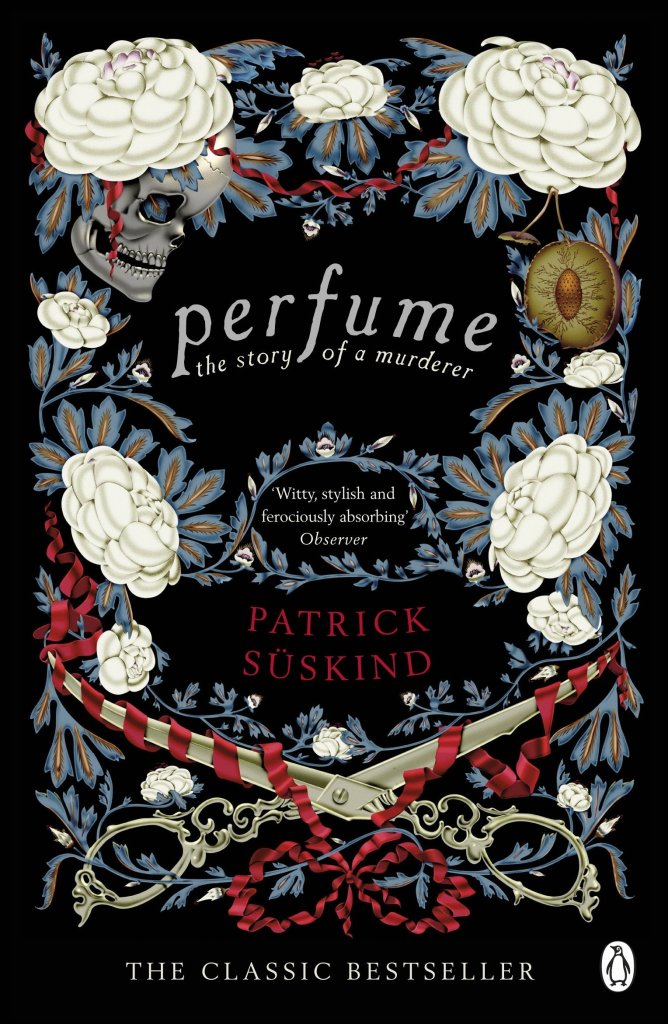
If I describe Perfume: The Story of a Murderer as X-Men c.1750, I suspect Süskind would not be especially pleased by the casual connection of his international bestselling novel with the superhero genre, nor would it be an entirely fair connection. Grenouille’s olfactory abilities fit the trope of the defining superhero trait, as does his tragic backstory, his painful and challenging training arc, and his inability to fit into normal society, but he is no hero, protecting eighteenth century Paris from crimes with his beyond-bloodhound sniffer as some manner of odor-based vigilante. However, neither is he a villain, as both the narrator and many other reviews for the book label him. He fits that role as poorly as he fits that of a hero.
English is notoriously poor as languages go for describing scents, but it is not alone in this; with a few notable exceptions of languages in which scents happen to play a major role, most languages handle aromatic descriptions by way of comparison with known baseline substances. I can describe something as smelling of cinnamon, and since most of us know what cinnamon smells like it will evoke a sense of what I mean for the reader, but describing something as “cinnamon-smelling” is of no help if you’ve never smelled cinnamon. To describe the scent of cinnamon without using other named substances is to be left with vague adjectives like aromatic, spicy-sweet (which is itself an allusion more to taste than scent, but I’ll allow it because those two senses are so intimately connected), and warm. Writing advice often emphasizes the incorporation of multiple senses into a scene, and the neuroscience of scent informs us how evocative odor-based descriptions can be, but the tools we have at our disposal to implement them are limited. Süskind’s efforts therefore sometimes come across more like ingredient lists than grounding, immersive depictions.
Of course, most of language is about references to shared experiences if you go back far enough in the etymology. Stroud mentions in an episode of History of English that languages almost all acquire their initial color words in roughly the same order, with slight variations corresponding to their environments. Those color words are usually references to things which are that color, even if these days those connections are obscured or forgotten. So perhaps we are too hasty to blame language for our shortcomings in olfactory descriptions and should instead blame the lack of conscious attention which is given to the odiferous world in daily life. Grenouille would certainly agree that people do not give enough heed to the aromas in and around them.
Then again, Grenouille is unhealthily obsessed with scent. It’s his primary means of interacting with the world, and his supreme mastery of it allows him all manner of abilities, including many which go well beyond and outside of mere “super smelling.” He can differentiate the components of individual odors within a sea of stench, he can discern which source of an odor is closest to him from hundreds of miles away, he can navigate flawlessly in absolute darkness by scent alone, he can isolate a particular scent and follow it regardless of its age or the distance to its origin. This is the story’s “buy,” but the full scope of Grenouille’s abilities evolves significantly over the course of the novel, which somewhat undermines my acceptance. In what is otherwise a well-researched and immersive historical fiction outing, the progression of Grenouille’s powers of scent from the merely exceptional to the supernatural and borderline magical feels jarring and distracting from the story’s core. I do not think his abilities must be taken to such unrealistic extremes to preserve the heart of Perfume, and they ultimately undermine the contrived and dissatisfying ending.
That heart is a story of a man obsessed. Grenouille’s upbringing seems designed to evoke our sympathy, making the sometimes-tedious processing of his growing up a necessary grounding for the story to come. Without it, we could not understand why Grenouille takes the path he does. I maintain he is not a villain, but he probably falls into the category of “chaotic evil.” He’s selfish, entirely out of synch with the society in which he moves, and he has no moral grounding (a fact for which, given his upbringing, he cannot be entirely blamed. No one taught him morality, and his division from the society he inhabits prevents him from acquiring a sense of morality from immersion as might be customarily assumed).
Süskind focuses the story on Grenouille, exploring his internality as much as his external existence, which lends the story a certain literary aspect despite his use of a ostensibly objective, third person omniscient narrator. This combination grows tiresome at times, as Grenouille’s angst is described for us rather than being experienced. The prose vacillates between deeply descriptive and detailed, evoking the streets of eighteenth-century Paris, the process of perfumery, the aromas Grenouille can discern, and oddly distant, detached, and straightforward. Sometimes the switch between the two rhetorical modes works (and the author makes excellent use of rhetorical figures in the former mode, which I now notice and identify everywhere), but in other places Süskind leans into one approach where the story seems to solicit the other, which breaks the flow of the story for me.
Though sometimes described as fantasy or historical fantasy, I think I would call Perfume literary historical fiction. The only really fantastical element is Grenouille’s sense of smell, but the overall approach, tone, and style of the story is more in line with literary and historical fiction. Süskind depicts a gritty, stinking vision of the eighteenth century, coming through despite some of his descriptions reading more like ingredient lists than evocative depictions of aromas and odors. In concept and execution, it makes for an intriguing read, but it does suffer from a lack of attention to plot. It really is Grenouille’s story, and it follows him regardless of how he strays from any apparent through-line or connecting thread. This, along with its dwelling time on Grenouille’s interiority, are what push it into the literary side of fiction. Personally, just a bit more plot emphasis would have given the story the push that it currently lacks, a motive force to maintain the book’s sense of progress. That’s more a matter of grading it against what I was seeking, though, than against what it stands to be for itself. As long as you know what to expect (and what not to expect) going in, I think you’ll find Perfume an intriguing read.

