
If you go deep enough into any topic, you’ll find it has its own unique jargon, its own characteristics and shared opinions amongst practitioners, its core debates and esoteric considerations which are meaningless to outsiders. This is obvious whenever you get your friend talking about that one hobby you don’t have in common. For subjects from carpentry to knitting you can find textbooks and instructional media to help you learn your way around the technical terms and grasp the basics, exercises you can follow to build your skills as you get into the hobby. There is something unapproachable about poetry, though. Perhaps it’s how poetry is taught in schools, which makes poetry seem entirely unapproachable and frankly undesirable, elitist in all the worst ways, or perhaps it’s something about poetry’s role in our modern culture. My own turn to poetry comes not from a desire to be a poet (even writing that seems pretentious), but from an effort to improve my prose and overall rhetoric.
However, I hardly knew how to begin, as evidenced by the paucity of poems I’ve shared as part of my practice here on the site, which I stated I intended to do back when I first indicated an interest in the subject. Occasionally, I would attempt to doodle a sonnet or a few quatrains, but there was little deliberateness to it – it was like trying to create intricate choreography without knowing how to do a box step or why one would choose to spin left or right. Or, to use a comparison more suited to me, it was like trying to build a spacecraft without knowing the spacecraft’s mission, requirements, or the differences between lithium ion and nickel hydrogen batteries. That is, I knew none of the why behind any of the thousands of decisions which go into crafting a poem, and as much as I deride English teachers for thinking authors put so much thought into the choice of every single word and its placement in a 500,000 word novel, in poetry there really is thought behind the choice and placement of each word, each syllable, each punctuation mark, even the structure of the poem on the page. It can be rather overwhelming to the novice.
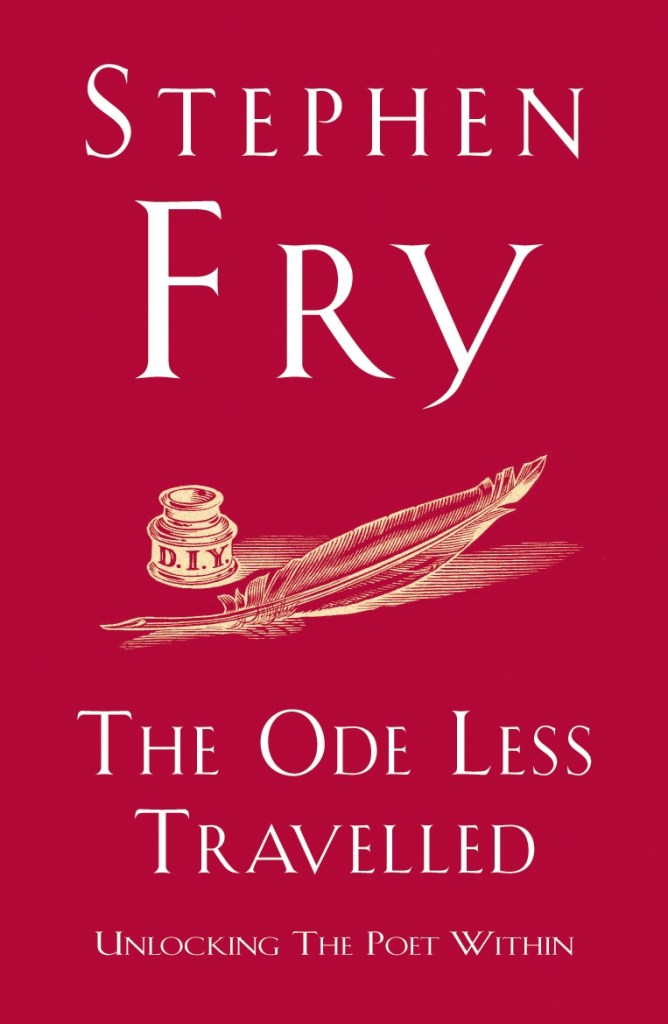
Fry’s The Ode Less Travelled, aside from having a wonderfully clever title, is that introductory manual for poetry. If you don’t know your iambs from your trochees or your caesuras from your enjambments, this is the book to get your started. It’s not about crafting the perfect verse, finding the meaning in the art, or anything esoteric and full of artistic mumbo jumbo; rather, it’s about the concrete details of how the stresses on different syllables in a word and how they fall in a line will affect how a line of poetry reads, about what true rhyme, feminine rhyme, slant rhyme, assonance, and consonance do to a story, how the different tools of stress, rhythm, meter, rhyme, and so forth affect how the eye and the ear interacts with a line of poetry and a poem as a whole. You won’t find prescriptions of what you should or shouldn’t do, but you’ll find an understanding of how the choices you make affect the poetry you produce.
And, if you do it properly, you will produce poetry from reading this book. Not good poetry, necessarily, not something you labor over for days and intend to publish to immortalize your name as the next great poet of the 21st century, but poetry nonetheless. Fry includes exercises throughout the book to guide the reader through practicing the techniques he describes, along with numerous examples both from published poems of varying degrees of fame and dexterity, and his own efforts at the exercises, often humorously straightforward and lacking in what we might conventionally think of as the “artistry” required to write poetry. His lines of verse might be about what he wants to eat for lunch, the headlines he’s reading while he’s eating, or even the fate of what he ultimately consumes. Nothing poignant, nothing deep or philosophical, but still poetry, still examples of the skills he wants you to practice.
If there is one gripe I would lodge about The Ode Less Travelled, it is Fry’s somewhat prescriptive attitude – not towards the practice of poetry, but towards how you as a reader should interact with and use his book. I understand the temptation to write it in such a fashion, and perhaps it could be considered “optimal” for the results he’s hoping you’ll achieve through the process of reading the book, but it doesn’t work for how I read or in the times I am able to do so. Instead, I wrote down all the exercises to complete at my own leisure. I’m still working through them, and I’ll be sharing some of the results here on the site, along with a few thoughts on the skills I was developing in each one, in coming weeks. Perhaps I would have gotten something more from the exercises by completing them during the chapters with which they are associated, and the prescribed times, but I don’t feel I’ve missed out; on the contrary, I feel I gained more doing them this way, since it forced me to remind myself of the techniques being practiced and return to the ideas and material in subsequent days and weeks, the better to reinforce the knowledge and practice in my mind.
This one probably isn’t for everyone, although I think you might find you’re more of a “poetry person” than you think you are if you give it a try. However, if you do have any interest in poetry, however indirectly – reading it, writing it, or using it as practice to improve other linguistic abilities – I suspect there are few better sources from which to begin than Fry’s The Ode Less Travelled. It’s a genuine, practical primer to a subject which is usually treated as something you just have to “feel.” I hope I see at least a few of you out on the ode.


3 thoughts on “The Ode Less Travelled Review”