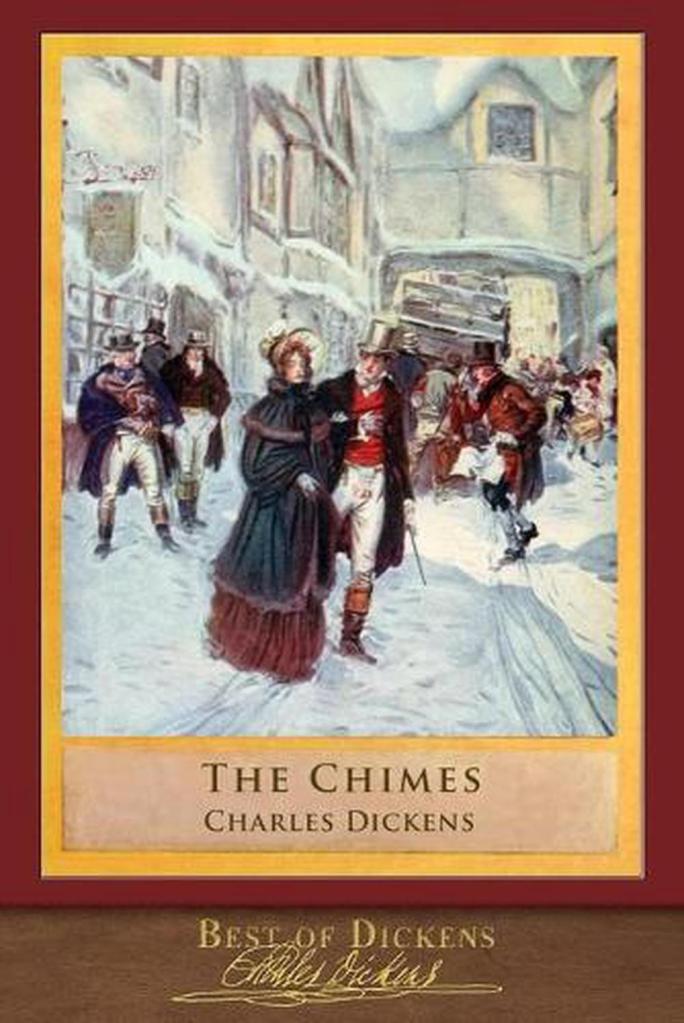
Charles Dickens’ A Christmas Carol is amongst my favorite books; I read it every December, listen to the Patrick Stewart audiobook (from back before those were cool), and usually enjoy at least one other adaptation, whether that’s one of the many movies or a local theater presentation. I am not alone in my fondness for this particular story, and would not have been even when it was published. Unlike many of the books we consider classics today, A Christmas Carol was an almost immediate popular success, which is probably why Dickens decided to launch a series of Christmas-themed stories. These include The Chimes, The Cricket on the Hearth, The Battle of Life, and The Haunted Man. This year, in addition to my annual reread of A Christmas Carol, I decided to read The Chimes.
It’s fortunate that I read The Chimes before rereading A Christmas Carol, as it allowed me to cleanse my palate with a satisfying, enjoyable story instead of…whatever The Chimes is. Many of Dickens’ books seek to bring attention to the plight of the poor and other social problems, some of them temporally relevant, others of them enduring misfortunes of the human condition. In some authors this would be off-putting to me – I don’t want to read a polemic disguised as a novel – but most of the Dickens books I’ve read have such lively, multidimensional characters, and his writing has a wry twist to it and plenty of wit, that it’s possible to both enjoy the story for the story, and receive the message he’s trying to preach without feeling, well, preached at, which I don’t think is ever desirable in reading.
A Christmas Carol is the perfect example. Dickens gives us a “villain” in Scrooge, using him as a means of showcasing many of the social ills which Dickens wanted addressed, but Scrooge is not a caricature, nor a strawman. Instead, we learn that Scrooge is a complex, multifaceted individual with a troubled past who needs, not so much a lesson, as a reminder from the three spirits that visit him. This is foreshadowed as early as the very first paragraphs, when we are told how Scrooge never painted out Marley’s name on the sign above the door, suggesting that he has yet a sliver of sentimentality despite his being “as solitary as an oyster,” and “as hard and sharp as flint, from which no steel had ever struck generous fire.” By the time the reader journeys with Scrooge and the first spirit to the past, it’s clear that Scrooge’s bad disposition is not born of a native lack of empathy or active desire to be cruel, but rather is the outward face of a man who built himself and his career as a castle behind which he could hide from life’s sordid reproach.
The same can be said for about every character in A Christmas Carol, which I suspect is why it has endured so well. Even minor side characters with just a few paragraphs of story time are evoked in multidimensional fullness. Not so in The Chimes. Even its main characters are shallow and flat, and side characters, especially those of the powerful who Dickens was seeking to critique, are frankly unbelievable caricatures, so overdone as to be almost unreadable. Even Veck, the primary viewpoint character and the story’s protagonist, doesn’t have the liveliness of so much as the miners or the businessmen who appear for only a moment in A Christmas Carol.
As for the supernatural aspect (and I am always fascinated by the old tradition of ghost stories for the holidays), it seems rather tacked onto the story. Somehow, Veck is conveyed via the titular chimes to witness various possible futures and thereby gains better perspective on his present, except I’m not exactly clear on what that perspective gained him. This is all contained in a mere ¼ of the book, with the first half of the book being devoted to exposition, and the final quarter of the book providing a conclusion to a story that never really began.
While I knew going in that The Chimes would not be on nearly the level of A Christmas Carol, especially considering the pedestal upon which I place that latter work, I thought it would be at least pleasant. I almost always enjoy Dickens, sometimes just for his writing style (I think the exception is Tale of Two Cities, which I found strange and difficult to follow compared to most of his books), and again, his characters, from the protagonist to minor side characters, are usually so well-wrought that they can drive even a dull story. With one-dimensional characters and equally flat writing, The Chimes is the exception to the rule, and not in a good way. Maybe next year we’ll see if The Cricket on the Hearth is of a caliber more typical of the great Dickens; I certainly won’t be reading The Chimes again.

