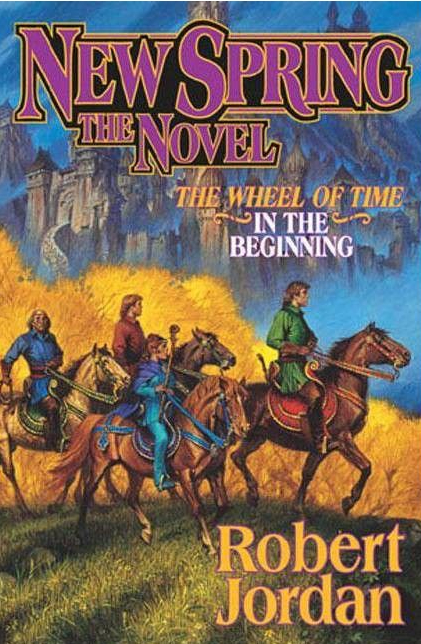
Turns out that I have a hard time sticking to a strict reading schedule, and you can see that rather more than one book held my attention before I returned to Wheel of Time. In this case, I followed up book one, Eye of the World, with book zero, New Spring.
These prequel novels tend to be a mixed bag – they are exceptionally difficult to do well. Because they tend to rehash ground covered in main-series texts, they can often seem belabored or forced, with a lot of things happening because the future plot demands that they happen in a certain way. It is also a unique challenge for an author to regress their characters convincingly, and then build them back towards how we first meet them. Plus, there is the temptation to over-explain, adding an origin story for every little detail. Coming after more than half of the Wheel of Time series was published, New Spring fits in about when Jordan’s main series writing was a bit lost in the Wastes, so I wasn’t sure how it would be.
Speaking of, I think this was my first time reading New Spring, as I have no recollection of it, or the events it covers, from my first time reading the series. I both wish that I had, because I thoroughly enjoyed it this first time, and am glad I didn’t, since that meant I got to experience it now for the first time.
If Eye of the World at times felt, understandably, like the work of a less seasoned author, New Spring is the opposite. It is Jordan at probably the height of his powers, managing with skill and finesse a task that stumps other skilled authors. He manages to depict the early days of two of the series’ most iconic characters in a way that both foreshadows the people they will become and grants them a distinct youthfulness, while avoiding the trap of forcing them to comply with the plot’s future demands.
Throughout Wheel of Time, the conflict of perspectives is a key feature in Jordan’s writing, creating a natural tension by depicting two (or more) views of the same events, and not allowing the characters to synchronize. This is often depicted through, and plays well with, the Wheel of Time world’s thoroughly explored and evoked gender roles and complex cultural dynamics. New Spring does this with both depth and discretion, integrating it into the story without over-explaining it to the reader.
Regarding explanation and exposition, New Spring features a more immersive, in-world expository style, which I preferred to the sometimes more pedantic, or at least more deliberate/obvious exposition in Eye of the World. I can’t tell if this reflects Jordan’s greater skills and confidence as an author, or if it’s a natural byproduct of his by-then intimate familiarity with all things Wheel of Time. Either way, it made the reading that much more enjoyable.
Even knowing that I had New Spring to read, I chose to read Eye of the World first, and I still think that is the appropriate order. Strictly speaking, you don’t have to read New Spring at all to get the story of Wheel of Time, though neither is it redundant with the main series. Starting with Eye of the World gives a better introduction to the series as a whole, with New Spring following on as a kind of addendum to provide additional context. Alternatively, you could read in the order of publication, which I know some people prefer (and is sometimes the subject of heated debates). Either way, New Spring is surely one of my favorite installments in Jordan’s magnum opus, and it should be included sometime in your reading of Wheel of Time.
 IGC Publishing
3 thoughts on “New Spring Review”