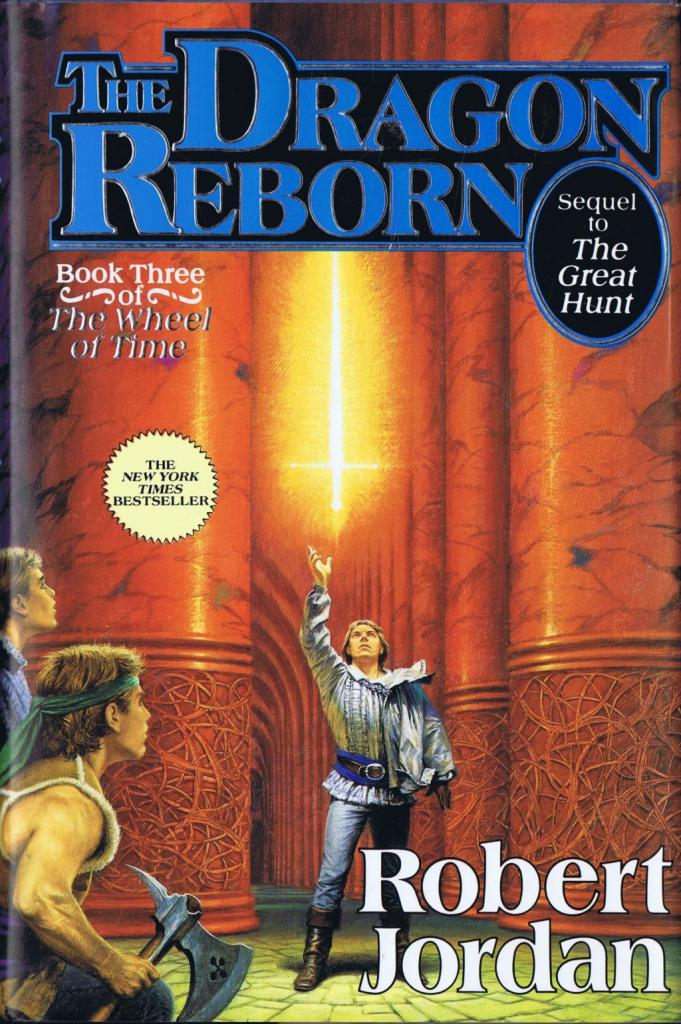
Where The Great Hunt can be read both as a semi-stand-alone quest-style fantasy novel, and as an installment in the larger epic that is Wheel of Time, The Dragon Reborn is firmly the latter. Oh, it has its own plot arcs that are resolved in its pages, but it is arguably the first Wheel of Time novel to lean fully into the epic to come. In fact, the characters give a kind of acknowledgement at the end to the idea that the main conflict with the Dark One is just getting started.
Compared to The Great Hunt, which focuses on Rand, The Dragon Reborn gives us much more development for Mat and Perrin (ironic, I know). Rand almost fades into the background, spending most of the novel in a kind of fugue state that readers and characters experience more like a plot force than a character. This exhibits itself most in the odd Ta’veren effects, which I find I appreciate more as an author than I ever did just as a reader. It’s such a clever way of explaining why the plot should seem to revolve around the main characters, and why convenient coincidences will sometimes occur.
Mat and Perrin start coming into their own in this book. We catch glimpses of who they will become as they take on active, decision-making roles for the first time in the series. This is especially the case for Mat, who has been sick for most of the last two books and from whom we’ve gotten minimal viewpoint. Perrin’s growth is more introspective as he wrestles with his fate and his identity; his moments returning to work as a blacksmith are particularly well-written.
Speaking of the writing, I tried while I read The Dragon Reborn to pay more deliberate attention to what Jordan was doing with word choice, descriptions, and other technical sides of constructing a book. It is often difficult to do this, instead of getting swept up in reading the story (which is a testament to Jordan’s skill), but I noticed a few things. First, despite the series’ reputation for length, the books are not slow. There is no chapter where there is not some kind of plot progress. All of The Dragon Reborn effectively chronicles the different groups’ journeys to Tear, where they all conveniently manage to be at the same time (that’s what I mean about the Ta’veren trick – it lets an author get away with something like that, without it seeming unrealistic). Jordan also takes advantage of his many viewpoint characters to give the reader more information than any one character, so the reader feels higher stakes at times than the characters do.
There were a few moments that bothered me, though. The way Egwene and Nynaeve pick up, intuit, or instinctively form specific weaves with the One Power (and to a lesser extent Rand, but in his case it’s more that he’s using brute force to mimic subtler effects) seemed too simple. The same pair, plus Elayne, are also prone to impulsive, rash decisions in this book, which seems somewhat out of character for them. They have the most opportunities to put together the larger picture, and they never take the time to consider it. Also, the ending, which is a little too much like the previous two endings for my taste. While it’s a convenient way to give the reader the satisfaction of a victory at the end of the book, while still having more to come, it feels repetitive by book three.
Minor critiques aside, The Dragon Reborn is a worthy continuation of Wheel of Time. It gives us immense character growth from viewpoint and side characters, massively raises the stakes and complexity of the plot, and sets the stage for the broadening war against the Dark One coming in the subsequent installments. For really the first time in three books, the characters are obliged to make their own decisions and take their own actions, and we start to see who they may become as the story progresses. Recommendations are always a little odd for books in the middle of a series – if you’ve read this far, there’s a decent chance you’re in it for the long haul – but The Dragon Reborn reinforces why Wheel of Time deserves its place as one of the great pieces of fantasy.
 IGC Publishing