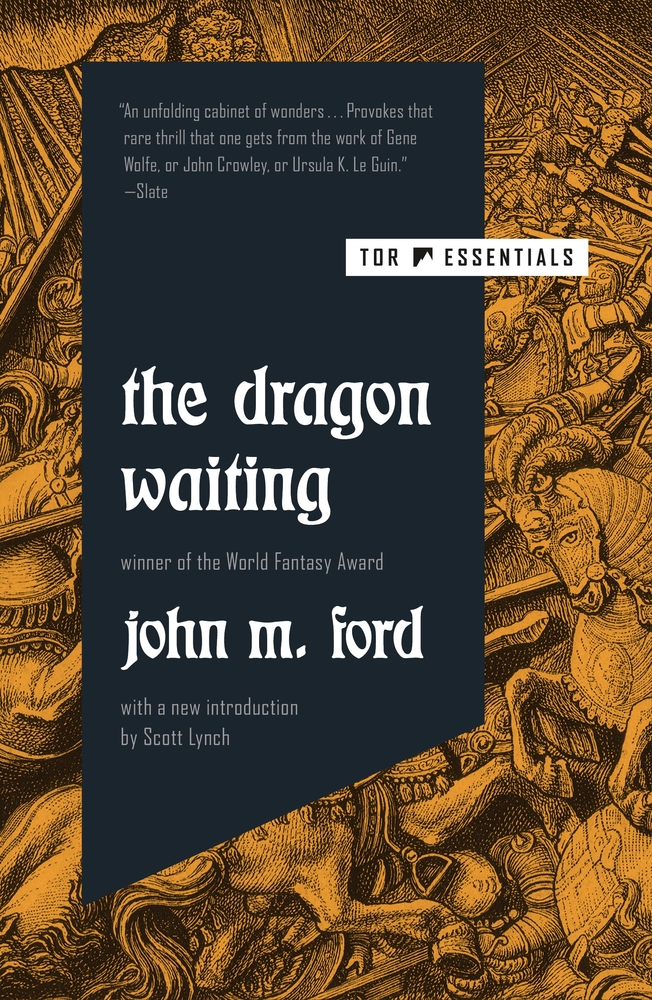
All speculative fiction – indeed, perhaps all fiction, and not a small amount of nonfiction – revolves around asking “what if?” What if life could exist on the surface of a neutron star? What if the theory of Platonic forms had physical meaning in a universe’s cosmology? What if our emotions could leave an imprint upon reality? The same question underlies the idea of alternative history: what if the USSR beat the US to the Moon, what if Germany won WWII, what if Julius Caesar lost to Pompey? A few, core, what-if questions form the foundation of Ford’s genre-blending The Dragon Waiting, too. The most important is what if Byzantium adopted a policy of religious toleration instead of Christianity? Oh, and what if there were vampires and wizards, too?
Maybe that premise sounds a little silly, and it’s true that I don’t usual enjoy alternate histories. They so rarely take into account all of the myriad factors which led to the outcomes which occurred in real history that they feel dissatisfying and hollow, never moving beyond the realm of vaguely interesting through experiments and into that of being compelling, immersive stories. Part of the problem, I think, is that such stories don’t tend to go back far enough, and they focus on the big picture. They start from the change they want to make and extrapolate forward, without examining the foundation of that change and the factors which could have led to the different outcome. The key change in The Dragon Waiting is both small (in a way), and occurs long before the events of the novel: Emperor Julian reverses course on Constantine’s conversion to Christianity to embrace religious toleration in the Byzantine Empire, centuries before the novel takes place. That change, though significant, is a small-scale one, one it is conceivable Julian could have made, and the novel gets to explore how that change alters the face of history. It’s a small-scale change with enormous consequences, because Ford’s argument is that, without the Byzantine Empire making Christianity the state religion, Christianity remains one religion amongst many, Rome doesn’t split into East and West, and the fate especially of Western Europe looks dramatically different without that religious force.
With just that element, this story could almost be shelved as historical fiction, albeit of a very different variety from that which authors like Iggulden write. It’s closest analog might be Dunnett’s Lymond Chronicles (which I should reread one of these days). The presence of vampires and wizards pushes The Dragon Waiting firmly into fantasy, yet the historical elements remain prominent, even dominant, and it would be wrong to think of this as merely another vaguely medieval fantasy novel. It is richly immersive and deeply textured with a level of historical knowledge and realism it is rare to find outside of a genuine history book, both on the large scales of nations and significant historical figures, and on the small scales of architecture, clothes, and customs. Combined with the integration of fantastical elements like vampirism as a medical condition, and a fascinating soft magic system, the worldbuilding alone would put this book on my shortlist.
The worldbuilding is not alone; it is in service to plot and characters who are as fully real and embodied as the genuine historical figures with whom they interact. Indeed, it is difficult to precisely extract the plot and characters from each other and the world, for they are all so intimately linked as to hardly exist without each other. There is never a sense that the plot or the characters are being driven by historical necessity, nor are the characters driven by the plot. There are no neat plot arcs and character arcs as we like to discuss with more traditional stories, for history is rarely so neat and orderly, but that doesn’t diminish – in fact, it increases – the dynamism of both. Indeed, the only element of the whole story that can be considered anything approach simple or straightforward is the depiction of the expanding Byzantium as an adversary to be thwarted, yet each of the characters comes to this conflict for their own reasons and with their own motives.
Ford tells his tale from a third person omniscient perspective, never diving deeply into one character, and flitting from one to another with ease. Indeed, the early chapters of the book give no indication that these characters are connected in any way, or how they would ever come together. We are probably a third of the way into the book before we can attest to a conventional understanding of unifying plot for the novel. Even then, much is left unsaid. Ford’s prose is not especially lyrical in the sense of possessing rhythms and devices as seem to lubricate the writing of authors like Tolkien or Rothfuss, but it is poetic in the sense of being spare, leaving much to the reader to interpret, infer, and understand on their own. For readers accustomed to more modern books, which seem intent on making everything abundantly explicit and laying out all of the pieces for the reader, this may take some adjustment, but I found it a rather pleasant respite. I find there’s something missing when it comes to some contemporary writing that does not leave some mystery for the reader. It robs even the most magical stories of some of their magic, but such explicitness is not a concern here. Ford perfectly balances answers with questions. This is one of the first fiction books I’ve read in a long while that I finished certain I would be reading again, and that I would pick up far more with each reading.
If it’s not clear how much I enjoyed The Dragon Waiting, let me try putting it another way. You long-time readers of my reviews know that it is a mark of extreme favor for me to read past the first book in a series these days. When I was two-thirds through The Dragon Waiting, I looked specifically to see if Ford had written other books, related or unrelated, to this one. Alas, his catalogue of works is sparse, and few of them have anything in common (aside from their author) with The Dragon Waiting. Perhaps one or two might be worth reading, but they don’t sound like they will be on the level of The Dragon Waiting.
Above all, I would describe The Dragon Waiting as determinedly real. It incorporates history, magic, medicine, and religion, but those aren’t what the story is about – the story is about people, in all their complexities, at their highest and at their lowest. It comes to life in a vivid way which few stories can manage thanks to both what Ford says, and what he leaves unsaid. This is a must-read for anyone who enjoys fantasy and/or historical fiction, and not just once.
 IGC Publishing
3 thoughts on “The Dragon Waiting Review”