
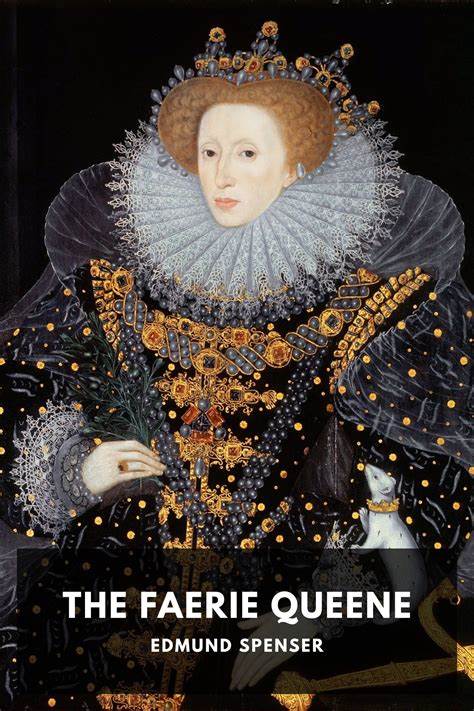
This book was on my reading list for so long that I forgot it was there, or didn’t realize to what it referred, until I went to add Spenser’s The Faerie Queen to the list (again) after seeing it referenced alongside Canterbury Tales. To be perfectly honest, knowing it is associated with Canterbury Tales did not exactly make me excited to read it; while that work had its interesting points, it was not exactly the most scintillating piece of literature I’ve ever read, and getting through old English poetry can be tedious. However, The Faerie Queen’s premise was more intriguing to me, and with it listed as one of the three great works of classical English writing (the other two being Canterbury Tales, and the works of Shakespeare), I decided the time was right to tackle it.
It’s composed of six books, divided into twelve cantos each, and I have to say the first book is a slog. It takes about that long to parse the plot and figure out which characters we’re supposed to be following, it is heavily and blatantly allegorical, and there’s the background knowledge that this is another epic poem that was never finished. I almost gave up after finishing the first book, but there were enough elements that intrigued me to continue into the second, and I’m sometimes a little stubborn, so I pushed on. I’m glad I persevered.
Unlike Canterbury Tales, which is essentially a loose short story collection in poetic form held together by a framing story, The Faerie Queen has plots. It’s not a central plot that runs through the whole collection (which is good, since we only have six of the books, and there were supposed to be many more), but there are several threads that connect all of the stories, including familiar characters who come with their own objectives. The allegory also becomes less heavy-handed, and we have something akin to character development, which tends to be rare in these sorts of works. Prince Arthur, the Redcross Knight, Artegall, Britomart, and their various pages and squires have all kinds of adventures, vanquishing giants, slaying dragons, confronting witches, and unhorsing unchivalrous knights.
Of these, Britomart is by far the most interesting, in part because she’s so unexpected in an allegorical poem from the sixteenth century. She looks in a magic mirror, falls in love, so her old nurse helps her don armor, take up an enchanted lance (while the aged nurse acts as her squire), and set out on a knightly quest in search of the knight she saw in the mirror. This would not be out of place as the contrived plot of a modern Disney movie trying too hard to show a strong female lead, but this is a sixteenth century epic poem intended as moral allegory. And, it gets better, because the reaction to Britomart is not what a modern reader would be led to expect from common conceptions of gender relations at the time. Almost no one suggests Britomart should go back to her “place,” and not just because she proves herself as one of the top knights in the land. When most people discover her identity, the reaction is more of “oh, I didn’t expect that,” rather than “oh no, a woman is wearing armor and doing manly things!” Not that everything will defy your expectations in this sphere – the depiction of the Amazons is about what you’d expect, and one of the more uncomfortable parts of the book.
In the time-honored tradition of most of these older works, Spencer makes free use of mythologies and folklore from numerous different traditions. The common suspects all make appearances – Greek, Roman, Christian, and variations on the folklore of the British Isles – but there are some less typical appearances, too. Egyptian gods make an appearance, as do some allusions that are probably Norse, or at least Norse/Icelandic/northernly inspired, a few notions that seem drawn from Eastern European traditions, and even a possible reference to some of the Asiatic traditions.
There are more, and more detailed, references, which the footnotes do a decent job of explaining, including the appearance of a variety of English royalty, contemporary religious and cultural figures, members of the nobility, and what could be called celebrity appearances. Like Dante’s Divine Comedy, Spenser is clearly using parts of The Faerie Queen to convey political messages that modern readers are apt to miss completely, but which were surely caught by his contemporary readers. Nothing like spitting a disfavored politician on the end of the Knight of Chastity’s lance to send a message.
Indeed, there are so many references, allusions, traditions, and allegories mixed together in The Faerie Queen that it makes modern contenders for “most ambitious crossover” seem quite unambitious. The thousands (not hyperbole) of endnotes in the version I read help explain most of these, although in many cases you don’t strictly need to know the references to understand the basic events of the plot. Knowing that such and such character is supposed to represent a nobleman who served the queen by fighting in a rebellious province is more interesting from a historical perspective than it is necessary to understanding what’s happening, and why, within the story.
I’m always intrigued by the origins of storytelling, and especially of genre fiction. Reading The Faerie Queen, I couldn’t help but think that it could be considered a nearly direct predecessor of what became the fantasy genre. With knights, dragons, wizards, witches, quests, and adventures, the elements of The Faerie Queen are almost all elements that still appear in today’s fantasy, and there were stretches of the poem where I quite forgot it was a moral allegory from the sixteenth century. This is not to say it’s an easy read, but the language is easier than Canterbury Tales, and the inclusion of consistent plot, characters, and objectives makes it a far more interesting and enjoyable read.
Yes, there are places where it is slow, where the poet comes to the fore and we spend twelve stanzas describing one person’s appearance while the reader impatiently awaits that same person getting their comeuppance from Prince Arthur and his magic shield, or maybe one of the many squires who routinely outshine their respective knights (the knights of temperance and of justice in particular wouldn’t have gotten far without their squires). My point is not to suggest that reading The Faerie Queen will be just like reading Eye of the World. Rather, my point is that The Faerie Queen can be read as a story, in something like the modern understanding of the word, and that it is replete with elements both enjoyable, and pertinent to the eventual evolution of genre fiction. If you have a little patience, and an interest in the history of storytelling, I think Spenser’s (unfinished) classic English poem should be on your list.
 IGC Publishing
2 thoughts on “The Faerie Queen Review”